
Logo

Log In Sign Up |  An official publication of: American College of Emergency Physicians
Navigation
  • Home
  • Multimedia
    • Podcasts
    • Videos
  • Clinical
    • Airway Managment
    • Case Reports
    • Critical Care
    • Guidelines
    • Imaging & Ultrasound
    • Pain & Palliative Care
    • Pediatrics
    • Resuscitation
    • Trauma & Injury
  • Resource Centers
    • mTBI Resource Center
  • Career
    • Practice Management
      • Benchmarking
      • Reimbursement & Coding
      • Care Team
      • Legal
      • Operations
      • Quality & Safety
    • Awards
    • Certification
    • Compensation
    • Early Career
    • Education
    • Leadership
    • Profiles
    • Retirement
    • Work-Life Balance
  • Columns
    • ACEP4U
    • Airway
    • Benchmarking
    • Brief19
    • By the Numbers
    • Coding Wizard
    • EM Cases
    • End of the Rainbow
    • Equity Equation
    • FACEPs in the Crowd
    • Forensic Facts
    • From the College
    • Images in EM
    • Kids Korner
    • Medicolegal Mind
    • Opinion
      • Break Room
      • New Spin
      • Pro-Con
    • Pearls From EM Literature
    • Policy Rx
    • Practice Changers
    • Problem Solvers
    • Residency Spotlight
    • Resident Voice
    • Skeptics’ Guide to Emergency Medicine
    • Sound Advice
    • Special OPs
    • Toxicology Q&A
    • WorldTravelERs
  • Resources
    • ACEP.org
    • ACEP Knowledge Quiz
    • Issue Archives
    • CME Now
    • Annual Scientific Assembly
      • ACEP14
      • ACEP15
      • ACEP16
      • ACEP17
      • ACEP18
      • ACEP19
    • Annals of Emergency Medicine
    • JACEP Open
    • Emergency Medicine Foundation
  • About
    • Our Mission
    • Medical Editor in Chief
    • Editorial Advisory Board
    • Awards
    • Authors
    • Article Submission
    • Contact Us
    • Advertise
    • Subscribe
    • Privacy Policy
    • Copyright Information

How One U.S. EP Connects with Her Profession and Birthplace in Ethiopia

By Cedric Dark, MD, MPH, FACEP | on June 13, 2022 | 0 Comment
Features WorldTravelERs
  • Tweet
  • Click to email a link to a friend (Opens in new window) Email
Print-Friendly Version

This month, we explore the type of health care system experienced by much of the developing world. Termed the “voluntary system,” other than for some basic primary care, many countries that function this way do not offer comprehensive health care coverage to their citizens who often witness high out-of-pocket costs. Technically speaking, prior to the Affordable Care Act, much of the United States was part of a voluntary system of private health care insurers often only available to people holding a job with good benefits or for individuals purchasing their own plans. 

You Might Also Like
  • The World Health Assembly Adopts an Emergency Care Resolution
  • Ten Ways Obamacare Could Impact Patients, Emergency Departments, and the Physician Workforce
  • New Study: EPs Key to Reducing Health Care Costs
Explore This Issue
ACEP Now: Vol 41 – No 06 – June 2022

Tsion Firew, MD, MPH, FACEP, is an emergency physician, assistant professor of emergency medicine at Columbia University in New York City, and an advisor to the Ministry of Health for the Federal Democratic Republic of Ethiopia. She has previously written for ACEP Now about her work for the World Health Assembly at the World Health Organization (WHO). Our conversation focused on Ethiopia’s health care situation and how their government tackles key issues. 

Share a little bit of your background and why you’re so passionate about health care in Ethiopia. 

Dr. Tsion Firew: I interned at WHO when I was a fellow in 2017. We worked on developing emergency care toolkits that could be used at first level entry hospitals in most places around the world. A year later, I joined the Ministries of Ethiopia’s advisory team. One thing we realized at that time was that a resolution on emergency care at WHO-level had not been passed for almost a decade. And that was a very important distinction because a lot of the medical priorities are set by donor markets. Most philanthropists and a lot of money for global health purposes go toward infectious diseases like tuberculosis (TB), HIV, and malaria, but not so much on health care system strengthening, like emergency care.
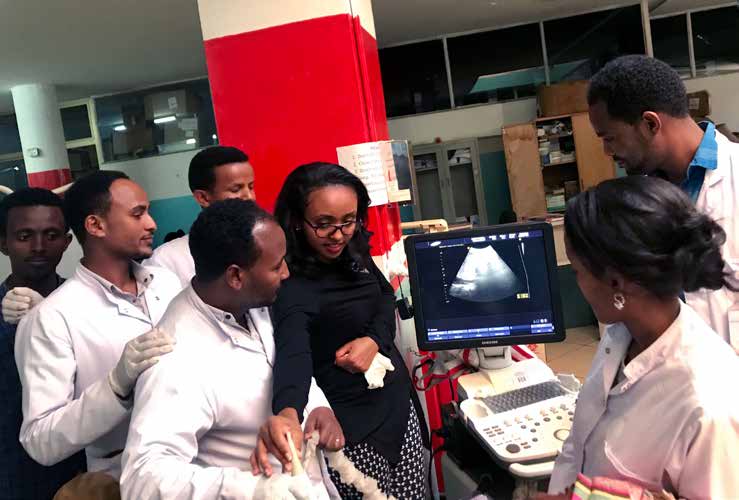
Dr. Firew (middle) demonstrates an ultrasound to medical students.

We were able to galvanize the support of the executive board committee at WHO to pass a resolution on emergency care. The resolution passed in 2019 and outlined the needs and the gaps to make emergency care a reality. This victory happened coincidentally right before the pandemic, which as we know, emergency physicians have been at the forefront all over the world. 

Ethiopia is the second largest country in Africa by population with 115 million people. And going back to 1978, there is the Alma-Ata Declaration for Primary Health Care. There‘s been a focus in trying to get primary care universalized in Ethiopia.

Pages: 1 2 3 4 | Single Page
Topics: Dr. Tsion Firew

Current Issue

ACEP Now: November 2025

Download PDF

Read More

No Responses to “How One U.S. EP Connects with Her Profession and Birthplace in Ethiopia”

Leave a Reply Cancel Reply

Your email address will not be published. Required fields are marked *


*
*


Wiley
  • Home
  • About Us
  • Contact Us
  • Privacy
  • Terms of Use
  • Advertise
  • Cookie Preferences
Copyright © 2025 by John Wiley & Sons, Inc. All rights reserved, including rights for text and data mining and training of artificial technologies or similar technologies. ISSN 2333-2603