
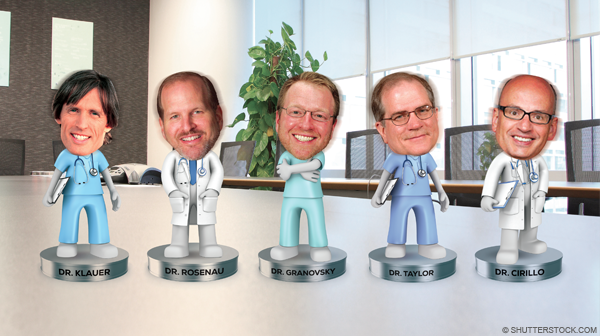
Dr. Granovsky: In 2003, tax-law changes facilitated the growth of high-deductible health plans, and we had 8 million enrollees in high-deductible health plans in 2010 and 13.5 million in 2012 and over 15 million in 2013. And the experience has shown exactly what both Kevin and Todd are saying. We actually have the experience already: those dollars are harder to collect.
Explore This Issue
ACEP Now: Vol 33 – No 01 – January 2014Dr. Klauer: That brings me to my next question: How do you think the Affordable Care Act will impact reimbursements, short-term and long-term?
Dr. Granovsky: There is a silver lining, which is the Medicaid expansion for states that opt into that expansion. The typical self-pay collection runs $15 to $20 per visit. The typical Medicaid payment for an ED visit to physicians is between $50 and $80. And over time, some modeling has shown that you could see a shift of 7 percent to 10 percent of a given ED’s patient population moving from self-pay to that state’s Medicaid pool. Medicaid doesn’t pay quickly, the rates aren’t so robust, but nonetheless, you could see a difference of $50, $60, $65 a patient, which for a typical 40,000-visit ED could create $150,000 in additional revenue.
However, that would all be offset by high-reimbursing patients moving into health insurance exchange products. Our general feeling is that it will trend toward Medicare or close to Medicare rates from what now are much higher rates.
Dr. Klauer: Tony, quick question for you. If Medicaid expansion could almost be a safe harbor in this plan that in some way helps us or protects us, is that going to be a place that we’re going to drive emergency care?
Dr. Cirillo: There are 25 states plus the District of Columbia that have opted to expand and 25 that have opted not to. In those states that opt not to, not only are there still going to be people who are more self-pay when they could have been covered by Medicaid, but those hospitals are still going to lose their disproportionate share payments. So I will tell you that the people working in those hospitals are going to continue to see self-pay patients, and their hospitals are going to be put in a more financially challenging position.
I think the other issue is that, remember, there are only two states that pay above Medicare for Medicaid patients, and that’s North Dakota and Wyoming. So if you practice there, you’re doing OK, but many states pay 25, 30, 40 cents on the Medicare dollar. So although it will be better than nothing, I agree with Mike: the reality is that it’s not much better than nothing, and you’re still going to have to work so much harder to get that first dollar out of the patients who have these pseudo-insurance cards. I don’t see this as being a magic windfall for emergency medicine in any way.



2 Responses to “What Will Obamacare Mean for Emergency Physicians?”
January 12, 2014
jpedmdRe. Dr. Klauer’s comment “So when it comes down to it, this is a shell game. You’re still paying $11,000 before anybody pays one penny of coverage for your family.”
This is just wrong, especially for the example cited – a family of 4, presumably with 2 children and 2 adults. Remember there is substantive free preventative care mandated under the ACA that is often the predominant type of care needed for young healthy families. See:
https://www.healthcare.gov/what-are-my-preventive-care-benefits/
May 27, 2015
Pennsylvania Governor Acts to Ensure Federal Health Care Subsidies - ACEP Now[…] Pennsylvania Governor Tom Wolf said on Friday the state will set up its own health care exchange if needed to save insurance subsidies for thousands of residents under the federal government’s 2010 Affordable Care Act. […]