
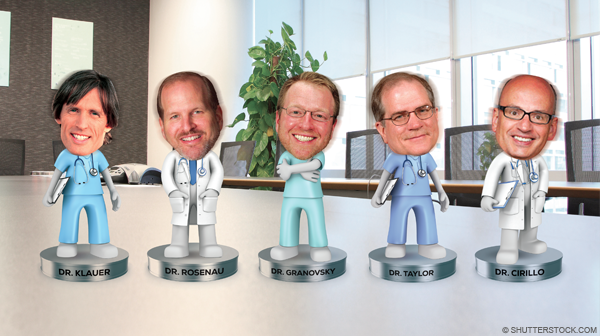
—Alexander Rosenau, DO, FACEP
Explore This Issue
ACEP Now: Vol 33 – No 01 – January 2014Dr. Klauer: Tony, anything to add to that?
Dr. Cirillo: I think the fact that there’s at least some hope that more people will have insurance coverage—even if that takes another seven or eight years down the road to get fully expanded out—certainly might help us.
The fact that we see so many patients, particularly on the admission side, I think will give us more leverage because the underlying driver for this is still going to be finances and how to pay for care for more people who are getting older and sicker. And I think it will give us more voice because we’re going to be a key player in deciding how best to do that.
Dr. Rosenau: What we found good is that one of the main goals of the Affordable Care Act—and of course, the word “affordable” remains to be seen—but the ACA is useful because by providing a means of payment, a means of insuring the whole population, we share the burden among more people, and that should eventually lower the cost per person—we’re hoping.
Dr. Klauer: Mike, anything else to add on that question? Anything in the ACA you see as really a windfall for emergency medicine?
Dr. Granovsky: One item that I’ll add, and it seems obvious at the surface, is the inclusion of emergency department care, which ACEP advocated and supported, as one of the essential health benefits so that ED care is required to be a covered service. Now the degree to which that coverage ultimately leads to remuneration for our members remains to be seen, but ED care is a defined, covered service as an essential health benefit.
Dr. Klauer: You mentioned, Todd, that there were caps on the out-of-pocket expenses for the insured. If your deductible is $10,000, are they really capping your expenses at $6,350? Then your deductible isn’t really $10,000. So what are your comments on that?
Dr. Taylor: One of the impacts of the website [http://healthcare.gov] unavailability is that people really haven’t gotten all of the information. The maximum out-of-pocket is $6,350, so you really don’t see deductibles above that, but you do see some plans that have a $6,350 deductible. Beyond that, there’s no coinsurance, no co-pays, or anything else because that’s the maximum out-of-pocket. The rest of the plans are really just some mathematical derivation of that, and if you really start to delve into them, what you’ll see is that as you get to the lower deductible amounts, the premiums increase to an extent and the coinsurance increases to an extent that essentially you’re better off, if you have the resources, to go with a high deductible—say, a $5,000 to $6,000 deductible—pay the lower premium, and save that money toward whatever health-care services you may incur.



2 Responses to “What Will Obamacare Mean for Emergency Physicians?”
January 12, 2014
jpedmdRe. Dr. Klauer’s comment “So when it comes down to it, this is a shell game. You’re still paying $11,000 before anybody pays one penny of coverage for your family.”
This is just wrong, especially for the example cited – a family of 4, presumably with 2 children and 2 adults. Remember there is substantive free preventative care mandated under the ACA that is often the predominant type of care needed for young healthy families. See:
https://www.healthcare.gov/what-are-my-preventive-care-benefits/
May 27, 2015
Pennsylvania Governor Acts to Ensure Federal Health Care Subsidies - ACEP Now[…] Pennsylvania Governor Tom Wolf said on Friday the state will set up its own health care exchange if needed to save insurance subsidies for thousands of residents under the federal government’s 2010 Affordable Care Act. […]