Logo

Log In Sign Up |  An official publication of: American College of Emergency Physicians
Navigation
  • Home
  • Multimedia
    • Podcasts
    • Videos
  • Clinical
    • Airway Managment
    • Case Reports
    • Critical Care
    • Guidelines
    • Imaging & Ultrasound
    • Pain & Palliative Care
    • Pediatrics
    • Resuscitation
    • Trauma & Injury
  • Resource Centers
    • mTBI Resource Center
  • Career
    • Practice Management
      • Benchmarking
      • Reimbursement & Coding
      • Care Team
      • Legal
      • Operations
      • Quality & Safety
    • Awards
    • Certification
    • Compensation
    • Early Career
    • Education
    • Leadership
    • Profiles
    • Retirement
    • Work-Life Balance
  • Columns
    • ACEP4U
    • Airway
    • Benchmarking
    • Brief19
    • By the Numbers
    • Coding Wizard
    • EM Cases
    • End of the Rainbow
    • Equity Equation
    • FACEPs in the Crowd
    • Forensic Facts
    • From the College
    • Images in EM
    • Kids Korner
    • Medicolegal Mind
    • Opinion
      • Break Room
      • New Spin
      • Pro-Con
    • Pearls From EM Literature
    • Policy Rx
    • Practice Changers
    • Problem Solvers
    • Residency Spotlight
    • Resident Voice
    • Skeptics’ Guide to Emergency Medicine
    • Sound Advice
    • Special OPs
    • Toxicology Q&A
    • WorldTravelERs
  • Resources
    • ACEP.org
    • ACEP Knowledge Quiz
    • Issue Archives
    • CME Now
    • Annual Scientific Assembly
      • ACEP14
      • ACEP15
      • ACEP16
      • ACEP17
      • ACEP18
      • ACEP19
    • Annals of Emergency Medicine
    • JACEP Open
    • Emergency Medicine Foundation
  • About
    • Our Mission
    • Medical Editor in Chief
    • Editorial Advisory Board
    • Awards
    • Authors
    • Article Submission
    • Contact Us
    • Advertise
    • Subscribe
    • Privacy Policy
    • Copyright Information

When to Use Point-of-Care Ultrasound for Skull Fractures

By Ken Milne, MD | on September 13, 2015 | 2 Comments
Skeptics' Guide to EM
  • Tweet
  • Click to email a link to a friend (Opens in new window) Email
Print-Friendly Version
When to Use Point-of-Care Ultrasound for Skull Fractures

There was a single false-negative patient (missed fracture) who had a fracture adjacent to the hematoma. The authors describe the patient with the missed fracture as only requiring observation and no specific treatment.

You Might Also Like
  • Point-of-Care Pelvic Ultrasound Done by Emergency Physicians Comes Under Fire
  • How to Use Point-of-Care Ultrasound to Identify Shoulder Dislocation
  • Ultrasound-Guided Serratus Anterior Plane Block Can Help Avoid Opioid Use for Patients with Rib Fractures
Explore This Issue
ACEP Now: Vol 34 – No 09 – September 2015

There were two false positives in the study. One false positive was by a novice scanner but was over-read as negative by a more senior clinician. This suggests training may be important to ensure accuracy. The second false positive was reported positive by both physicians reading the scan, which was not noted on CT. However, CT is not a 100 percent sensitive test either, and the patient may have had a true positive on ultrasound and false negative on CT.

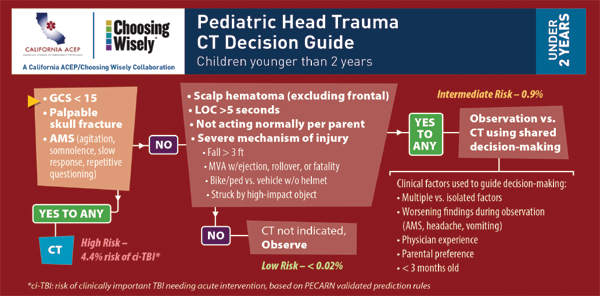
Bottom Line: Emergency physicians can be taught POCUS to identify pediatric skull fractures with high specificity. When used along with a clinical decision instrument like PECARN, POCUS can be a useful adjunct for detecting skull fractures and further risk-stratifying minor head injuries. However, serious intracranial injuries can occur without fracture, and the sensitivity of ultrasound for fracture is not yet sufficient to use it as the sole method for detecting injury and making treatment and disposition decisions.

Case Resolution: Instead of ordering a CT, you decide to use POCUS to look for a skull fracture and combine this with the PECARN rule.

Mom is able to hold her daughter on her lap while you gently scan over and around the frontal hematoma. You are not able to identify a fracture. The parents are reassured and happy to avoid doing a CT scan at this time. The child is observed for a few hours in the ED as per the PECARN rule. They are discharged home with clear instructions to return if the clinical picture changes.

Thanks to Greg Hall, MD, who is faculty member at McMaster University in Hamilton, Ontario, and part of the Best Evidence in Emergency Medicine group, for his help with this review.

Remember to be skeptical of anything you learn, even if you learned it on the Skeptics’ Guide to Emergency Medicine.


Dr. Milne is chief of emergency medicine and chief of staff at South Huron Hospital, Ontario, Canada. He is on the Best Evidence in Emergency Medicine faculty and is creator of the knowledge translation project the Skeptics’ Guide to Emergency Medicine (www.TheSGEM.com).

References

  1. Weinberg ER, Tunik MG, Tsung JW. Accuracy of clinician-performed point-of-care ultrasound for the diagnosis of fractures in children and young adults. Injury. 2010;41:862-868.
  2. Jin W, Yang DM, Kim HC, et al. Diagnostic values of sonography for assessment of sternal fractures compared with conventional radiography and bone scans. J ultrasound Med. 2006; 5:1263-1268.
  3. You JS, Chung YE, Kim D, et al. Role of sonography in the emergency room to diagnose sternal fractures. J Clin Ultrasound. 2010;38:135-137.
  4. Riera A, Chen L. Ultrasound evaluation of skull fractures in children: a feasibility study. Pediatr Emerg Care. 2012;28:420-425.
  5. Parri N, Crosby BJ, Glass C, et al. Ability of emergency ultrasonography to detect pediatric skull fractures: a prospective, observational study. J Emerg Med. 2013;44:135-141.

Pages: 1 2 3 | Single Page

Topics: Clinical GuidelineEmergency DepartmentEmergency PhysicianImaging and UltrasoundPractice ManagementSkull FractureUltrasound

Related

  • Florida Emergency Department Adds Medication-Dispensing Kiosk

    November 7, 2025 - 1 Comment
  • Q&A with ACEP President L. Anthony Cirillo

    November 5, 2025 - 0 Comment
  • How Does Emergency Medicine Navigate Consolidation Trends in Health Care?

    October 29, 2025 - 0 Comment

Current Issue

ACEP Now: November 2025

Download PDF

Read More

About the Author

Ken Milne, MD

Ken Milne, MD, is chief of emergency medicine and chief of staff at South Huron Hospital, Ontario, Canada. He is on the Best Evidence in Emergency Medicine faculty and is creator of the knowledge translation project the Skeptics Guide to Emergency Medicine.

View this author's posts »

2 Responses to “When to Use Point-of-Care Ultrasound for Skull Fractures”

  1. October 8, 2015

    Kenn Ghaffarian Reply

    Sensitivity in the article is misquoted at 8%. Should read 88%.

    • October 8, 2015

      Dawn Antoline-Wang Reply

      Thank you, we have corrected the error.

Leave a Reply Cancel Reply

Your email address will not be published. Required fields are marked *


*
*


Wiley
  • Home
  • About Us
  • Contact Us
  • Privacy
  • Terms of Use
  • Advertise
  • Cookie Preferences
Copyright © 2025 by John Wiley & Sons, Inc. All rights reserved, including rights for text and data mining and training of artificial technologies or similar technologies. ISSN 2333-2603
