
Logo

Log In Sign Up |  An official publication of: American College of Emergency Physicians
Navigation
  • Home
  • Multimedia
    • Podcasts
    • Videos
  • Clinical
    • Airway Managment
    • Case Reports
    • Critical Care
    • Guidelines
    • Imaging & Ultrasound
    • Pain & Palliative Care
    • Pediatrics
    • Resuscitation
    • Trauma & Injury
  • Resource Centers
    • mTBI Resource Center
  • Career
    • Practice Management
      • Benchmarking
      • Reimbursement & Coding
      • Care Team
      • Legal
      • Operations
      • Quality & Safety
    • Awards
    • Certification
    • Compensation
    • Early Career
    • Education
    • Leadership
    • Profiles
    • Retirement
    • Work-Life Balance
  • Columns
    • ACEP4U
    • Airway
    • Benchmarking
    • Brief19
    • By the Numbers
    • Coding Wizard
    • EM Cases
    • End of the Rainbow
    • Equity Equation
    • FACEPs in the Crowd
    • Forensic Facts
    • From the College
    • Images in EM
    • Kids Korner
    • Medicolegal Mind
    • Opinion
      • Break Room
      • New Spin
      • Pro-Con
    • Pearls From EM Literature
    • Policy Rx
    • Practice Changers
    • Problem Solvers
    • Residency Spotlight
    • Resident Voice
    • Skeptics’ Guide to Emergency Medicine
    • Sound Advice
    • Special OPs
    • Toxicology Q&A
    • WorldTravelERs
  • Resources
    • ACEP.org
    • ACEP Knowledge Quiz
    • Issue Archives
    • CME Now
    • Annual Scientific Assembly
      • ACEP14
      • ACEP15
      • ACEP16
      • ACEP17
      • ACEP18
      • ACEP19
    • Annals of Emergency Medicine
    • JACEP Open
    • Emergency Medicine Foundation
  • About
    • Our Mission
    • Medical Editor in Chief
    • Editorial Advisory Board
    • Awards
    • Authors
    • Article Submission
    • Contact Us
    • Advertise
    • Subscribe
    • Privacy Policy
    • Copyright Information

When the Patient is a Male: Breaking Down the Stigma of Male Rape

By Ralph J. Riviello, MD, MS, FACEP; and Heather V. Rozzi, MD, FACEP | on June 25, 2022 | 0 Comment
Forensic Facts
  • Tweet
  • Click to email a link to a friend (Opens in new window) Email
Print-Friendly Version

There are also several male rape myths that perpetuate the stigma and keep men from seeking treatment.9–11 First, the reality is that what happened was not controllable or preventable by the victim. And if the perpetrator is male, it does not imply or form the basis for sexual orientation of the victim. Arousal, erection, and ejaculation are not fully controllable and can occur due to stress, anxiety, and penile/anal stimulation. This can cause confusion around consent, enjoyment of the activity, and the victim’s sexual orientation. Table 1 highlights common rape myths.11 Fear of being labeled as homosexual and/or that the rape will make them become homosexual are powerful motivators for males to keep silent and not seek medical, behavioral health, or law enforcement services. Even a feminized name of a rape crisis center may deter male victims from seeking care.  However, the majority of programs do offer very competent, trauma-informed, victim-centered services for males.

You Might Also Like
  • Know the Legal Requirements When Caring for Sexual Assault Victims
  • Dos and Don’ts for Pelvic or Genitourinary Exams in Minors
  • How to Conduct a Sexual Assault Examination and Collect Evidence
Explore This Issue
ACEP Now: Vol 41 – No 07 – July 2022
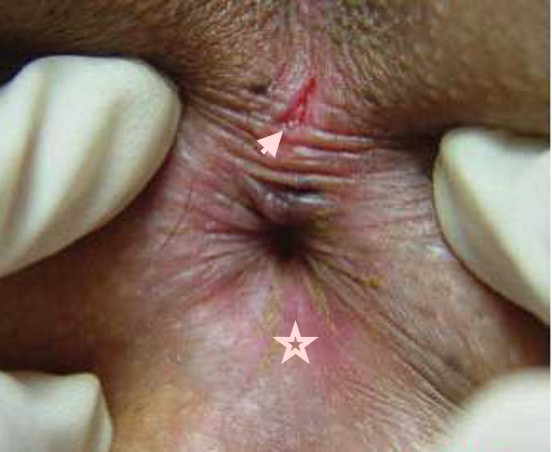
FIGURE 1 (click to enlarge): External anal exam using separation technique. Findings include an anal tear (solid arrow) and anal fold redness and some swelling (star).

Studies have shown that females suffer higher rates of penile rape than males, but males show higher rates of digital or object penetration.4,5,12,13 Thus, anal injury rates are higher in males. Women also sustain higher percentages of bodily injuries.13 Also, males tend to have higher rates of multiple assailants, and may have higher rates of rapes involving a weapon.5,13–15

Emergency Department Care

Emergency departments need to provide male SA victims the same trauma-informed, victim-centered care as female victims.14 All protocols and procedures should be the same. Rapid triage assessment, including evaluation for potential injuries, should occur. The patient should be placed in a quiet area to await evaluation. All the options should be explained to the patient. The patient should be offered a medical forensic examination by the SANE nurse, accompaniment by the rape crisis advocate, and law enforcement notification. The patient can then accept or decline any or all of the services. Male victims are entitled to the same rights as female victims and exams are to be provided without charge to the patient. These services can be billed to State Crime Victims’ Compensation programs. Patients also have the right to request no law enforcement response and to have anonymous reporting and evidence collection. 

The emergency physician should evaluate the male patient as they would any other female victim. Detailed forensic history should be reserved for the SANE nurse, and the clinician needs to rule out potentially serious injuries and instability. Laboratory and radiographic testing should be performed as indicated. Although rare, some serious injuries seen in male victims include: head injury, fractures, genital injury/mutilation, and anorectal tears and perforation (the patient may present with peritoneal signs).  

Pages: 1 2 3 4 | Single Page

Topics: male rapeRapeSexual Assault

Related

  • Emergency Physicians Step Up for Women

    October 15, 2025 - 4 Comments
  • Drug-Facilitated Sexual Assault Presentation Varies

    August 25, 2025 - 0 Comment
  • The Medical Director’s Role in Sexual Assault Nurse Examiner Programs

    March 10, 2025 - 0 Comment

Current Issue

ACEP Now: November 2025

Download PDF

Read More

No Responses to “When the Patient is a Male: Breaking Down the Stigma of Male Rape”

Leave a Reply Cancel Reply

Your email address will not be published. Required fields are marked *


*
*


Wiley
  • Home
  • About Us
  • Contact Us
  • Privacy
  • Terms of Use
  • Advertise
  • Cookie Preferences
Copyright © 2025 by John Wiley & Sons, Inc. All rights reserved, including rights for text and data mining and training of artificial technologies or similar technologies. ISSN 2333-2603
