Logo

Log In Sign Up |  An official publication of: American College of Emergency Physicians
Navigation
  • Home
  • Multimedia
    • Podcasts
    • Videos
  • Clinical
    • Airway Managment
    • Case Reports
    • Critical Care
    • Guidelines
    • Imaging & Ultrasound
    • Pain & Palliative Care
    • Pediatrics
    • Resuscitation
    • Trauma & Injury
  • Career
    • Practice Management
      • Reimbursement & Coding
      • Legal
      • Operations
    • Awards
    • Certification
    • Early Career
    • Education
    • Leadership
    • Profiles
    • Retirement
    • Work-Life Balance
  • Compensation Reports
  • Columns
    • ACEP4U
    • Airway
    • Benchmarking
    • By the Numbers
    • EM Cases
    • End of the Rainbow
    • Equity Equation
    • FACEPs in the Crowd
    • Forensic Facts
    • From the College
    • Kids Korner
    • Medicolegal Mind
    • Opinion
      • Break Room
      • New Spin
      • Pro-Con
    • Pearls From EM Literature
    • Policy Rx
    • Practice Changers
    • Problem Solvers
    • Residency Spotlight
    • Resident Voice
    • Skeptics’ Guide to Emergency Medicine
    • Sound Advice
    • Special OPs
    • Toxicology Q&A
    • WorldTravelERs
  • Resources
    • mTBI Resource Center
    • ACEP.org
    • ACEP Knowledge Quiz
    • CME Now
    • Annual Scientific Assembly
      • ACEP14
      • ACEP15
      • ACEP16
      • ACEP17
      • ACEP18
      • ACEP19
    • Annals of Emergency Medicine
    • JACEP Open
    • Emergency Medicine Foundation
  • Issue Archives
  • Archives
    • Brief19
    • Coding Wizard
    • Images in EM
    • Care Team
    • Quality & Safety
  • About
    • Our Mission
    • Medical Editor in Chief
    • Editorial Advisory Board
    • Awards
    • Authors
    • Article Submission
    • Contact Us
    • Advertise
    • Subscribe
    • Privacy Policy
    • Copyright Information

When Delayed Diagnosis Leads to a Malpractice Lawsuit

By Eric Funk, MD | on December 20, 2019 | 0 Comment
Medicolegal Mind
  • Tweet
  • Click to email a link to a friend (Opens in new window) Email
Print-Friendly Version

Patients presenting to the emergency department with multiple vague and nonspecific symptoms pose a particular diagnostic challenge. Generally, these presentations do not result in discovery of any severe issues, but periodically, they herald the onset of a sinister and hidden emergency disease. Multiple return visits give the emergency physician an opportunity to rethink the situation with the benefit of further information.

You Might Also Like
  • Survival Tips for the First Step of a Malpractice Lawsuit
  • A Patient Transfer Leads to a Lawsuit
  • Tips for Navigating Discovery and Deposition in a Malpractice Lawsuit
Explore This Issue
ACEP Now: Vol 38 – No 12 – December 2019

The below medical malpractice lawsuit highlights a patient presenting with vague complaints over multiple visits, leading to a bad outcome from a diagnosis that is a well-known medicolegal risk.

The Case

A 36-year-old man presented to an urgent care with a dry cough, body aches, and general malaise. He was seen by a physician, who did not order any testing and discharged him with generic instructions to take Tylenol and ibuprofen.

Two days later, the patient’s symptoms persisted, and he presented to a local emergency department. The documentation from this visit notes he was also complaining of back pain and neck stiffness. An aggressive workup was ordered, including a complete blood count, a comprehensive metabolic panel, mononucleosis testing, urinalysis, an ECG, and a chest X-ray.

The results showed thrombocytopenia of 61,000 and a glucose of 245. Given the patient’s neck stiffness, a lumbar puncture was recommended. The cerebrospinal fluid results did not show any abnormal findings. The patient was ultimately discharged with a diagnosis of viral meningitis, thrombocytopenia, and hyperglycemia (see Figure 1).
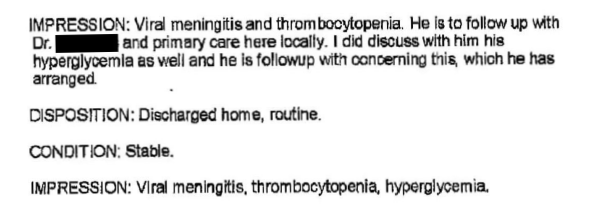
Figure 1: The physician’s notes following the patient’s first ED visit.

Figure 1: The physician’s notes following the patient’s first ED visit.

Over the next few days, the patient continued to feel worse. His malaise progressed, and his back pain also worsened. He presented back to the emergency department. His platelet count had improved to 120,000. A lactate was in the normal range. He was prescribed Percocet and Soma, then discharged again.

Following his third discharge, he began to experience weakness and numbness in his legs. He returned to the emergency department for a fourth time. The emergency physician reviewed his case and appropriately recognized the patient was showing signs of a spinal cord syndrome. Therefore, an MRI of his lumbar spine was ordered.

The results of the lumbar spine MRI did not show any acute abnormalities. Given the patient’s objective neurological deficits, he was admitted to the hospital. Eventually, a thoracic MRI was ordered as well. The results showed a spinal epidural abscess (SEA) at T9/T10 (see Figure 2).

Pages: 1 2 3 | Single Page

Topics: careerCase ReportsLawsuitLegalMalpracticeMRI

Related

  • Case Report: A Pediatric Amputated Juvenile Polyp

    January 6, 2026 - 0 Comment
  • How Evidence-Based Medicine Strengthens Your Malpractice Defense

    October 28, 2025 - 0 Comment
  • ABEM’s New Physician Certification Portal Includes Waiver Clause

    October 23, 2025 - 1 Comment

Current Issue

ACEP Now: January 2026

Download PDF

Read More

No Responses to “When Delayed Diagnosis Leads to a Malpractice Lawsuit”

Leave a Reply Cancel Reply

Your email address will not be published. Required fields are marked *


*
*


Careers Center
  • Physician Director, Observation Unit

    The Physician Director of the Observation Unit provides medical, operational, and strategic leadership for a 10-bed hospital

    Charlottesville, Virginia

    Competitive compensation and benefits package

    UVA Health – Department of Emergency Medicine

    Read More
  • Vice Chair of Education, Emergency Medicine

    The Department of Emergency Medicine at Stanford University School of Medicine seeks a nationally renowned educator and leader

    Palo Alto, California

    Associate Professor: $359,000 - $377,000 Professor: $392,000 - $407,000

    Stanford School of Medicine, Department Of Emergency Medicine

    Read More
  • Senior Medical Director of Emergency Medicine

    Unique opportunity to lead one of the highest performing programs in the country in a physician-led, independent, multispecialty clinic.

    Lexington, Kentucky

    Ownership shares, sign-on bonus, performance bonus, moving allowance, and benefits

    Lexington Clinic

    Read More
More Jobs
Wiley
  • Home
  • About Us
  • Contact Us
  • Privacy
  • Terms of Use
  • Advertise
  • Cookie Preferences
Copyright © 2026 by John Wiley & Sons, Inc. All rights reserved, including rights for text and data mining and training of artificial technologies or similar technologies. ISSN 2333-2603

