
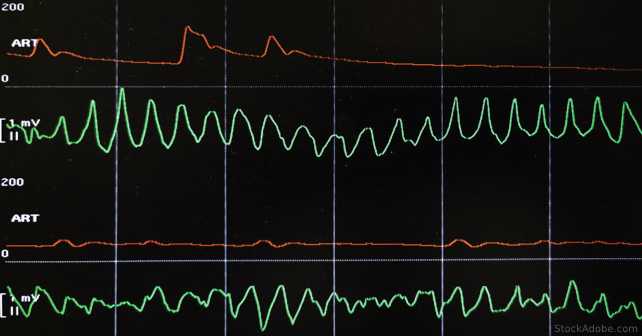
In conclusion, this recent study adds to the body of knowledge that DSED and VC defibrillation can be important techniques to treat refractory ventricular fibrillation. Utilization of these techniques can be expected to improve survival for patients with refractory ventricular fibrillation.
Explore This Issue
ACEP Now: Vol 42 – No 11 – November 2023Disclaimer
This article is not intended to be a thorough review of the topic, but rather a discussion of a recently published article and its impact on the practice of emergency medicine.
 Dr. Marco is professor of emergency medicine at Penn State Health-Milton S. Hershey Medical Center and associate editor of ACEP Now.
References
- Go AS, Mozaffarian D, Roger VL, et al. Heart disease and stroke statistics—2014 update: a report from the American Heart Association. Circulation. 2014;129(3):e28-e292.
- Larribau R, Deham H, Niquille M, et al. Improvement of out-of-hospital cardiac arrest survival rate after implementation of the 2010 resuscitation guidelines. PLoS One. 2018;13(9):e0204169.
- Margey R, Browne L, Murphy E, et al. The Dublin cardiac arrest registry: temporal improvement in survival from out-of-hospital cardiac arrest reflects improved pre-hospital emergency care. Europace. 2011;13(8):1157–65.
- Kudenchuk PJ, Brown SP, Daya M, et al. Amiodarone, lidocaine, or placebo in out-of-hospital cardiac arrest. N Engl J Med. 2016;374:1711-1722.
- Spies DM, Kiekenap J, Rupp D, et al. Time to change the times? Time of recurrence of ventricular fibrillation during OHCA. Resuscitation. 2020;157:219-224.
- Holmén J, Hollenberg J, Claesson A, et al. Survival in ventricular fibrillation with emphasis on the number of defibrillations in relation to other factors at resuscitation. Resuscitation. 2017;113:33-38.
- Yannopoulos D, Bartos J, Raveendran G, et al. Advanced reperfusion strategies for patients with out-of-hospital cardiac arrest and refractory ventricular fibrillation (ARREST): A phase 2, single centre, open-label, randomised controlled trial. Lancet. 2020;396(10265):1807-1816.
- Alaeddini J, Feng Z, Feghali G, et al. Repeated dual external direct cardioversions using two simultaneous 360-J shocks for refractory atrial fibrillation are safe and effective. Pacing Clin Electrophysiol. 2005;28:3-7.
- Gerstein NS, Shah MB, Jorgensen KM. Simultaneous use of two defibrillators for the conversion of refractory ventricular fibrillation. J Cardiothorac Vasc Anesth. 2015;29:421-424.
- Davis M, Schappert A, Van Aarsen K, et al. P029: A descriptive analysis of defibrillation vector change for prehospital refractory ventricular fibrillation. Canadian Journal of Emergency Medicine. 20(S1):S67.
- Emmerson AC, Whitbread M, Fothergill RT. Double sequential defibrillation therapy for out-of-hospital cardiac arrests: The London experience. Resuscitation. 2017;117:97-101.
- Simon EM, Tanaka K. Double sequential defibrillation. Cardiol Clin. 2018;36(3):387-393.
- Miraglia D, Miguel LA, Alonso W, et al. Double sequential defibrillation for out-of-hospital refractory ventricular fibrillation: A scoping review. Am J Emerg Med. 2020;38(6):1211-1217.
- Cheskes S, Verbeek PR, Drennan IR, et al. Defibrillation strategies for refractory ventricular fibrillation. N Engl J Med. 2022;387(21):1947-1956.
- Cheskes S, Dorian P, Feldman M, et al. Double sequential external defibrillation for refractory ventricular fibrillation: The DOSE VF pilot randomized controlled trial. Resuscitation. 2020;150:178-184.
- Cortez E, Krebs W, Davis J, et al. Use of double sequential external defibrillation for refractory ventricular fibrillation during out-of-hospital cardiac arrest. Resuscitation. 2016;108:82-86.
Pages: 1 2 3 | Single Page



No Responses to “What Is the Best Defibrillation Strategy for Refractory Ventricular Fibrillation?”