Logo

Log In Sign Up |  An official publication of: American College of Emergency Physicians
Navigation
  • Home
  • Multimedia
    • Podcasts
    • Videos
  • Clinical
    • Airway Managment
    • Case Reports
    • Critical Care
    • Guidelines
    • Imaging & Ultrasound
    • Pain & Palliative Care
    • Pediatrics
    • Resuscitation
    • Trauma & Injury
  • Resource Centers
    • mTBI Resource Center
  • Career
    • Practice Management
      • Benchmarking
      • Reimbursement & Coding
      • Care Team
      • Legal
      • Operations
      • Quality & Safety
    • Awards
    • Certification
    • Compensation
    • Early Career
    • Education
    • Leadership
    • Profiles
    • Retirement
    • Work-Life Balance
  • Columns
    • ACEP4U
    • Airway
    • Benchmarking
    • Brief19
    • By the Numbers
    • Coding Wizard
    • EM Cases
    • End of the Rainbow
    • Equity Equation
    • FACEPs in the Crowd
    • Forensic Facts
    • From the College
    • Images in EM
    • Kids Korner
    • Medicolegal Mind
    • Opinion
      • Break Room
      • New Spin
      • Pro-Con
    • Pearls From EM Literature
    • Policy Rx
    • Practice Changers
    • Problem Solvers
    • Residency Spotlight
    • Resident Voice
    • Skeptics’ Guide to Emergency Medicine
    • Sound Advice
    • Special OPs
    • Toxicology Q&A
    • WorldTravelERs
  • Resources
    • ACEP.org
    • ACEP Knowledge Quiz
    • Issue Archives
    • CME Now
    • Annual Scientific Assembly
      • ACEP14
      • ACEP15
      • ACEP16
      • ACEP17
      • ACEP18
      • ACEP19
    • Annals of Emergency Medicine
    • JACEP Open
    • Emergency Medicine Foundation
  • About
    • Our Mission
    • Medical Editor in Chief
    • Editorial Advisory Board
    • Awards
    • Authors
    • Article Submission
    • Contact Us
    • Advertise
    • Subscribe
    • Privacy Policy
    • Copyright Information

VisualDx Answer: b) Necrotizing Fasciitis

By ACEP Now | on February 15, 2024 | 0 Comment
VisualDx
  • Tweet
  • Click to email a link to a friend (Opens in new window) Email
Print-Friendly Version

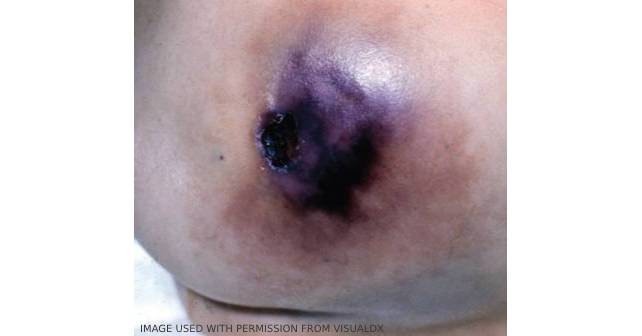
Answer: The correct answer is necrotizing fasciitis (b).

You Might Also Like
  • VisualDx Question: What Is This Painful Spot on Patient’s Buttocks?
  • Necrotizing Fasciitis Diagnoses and Therapy
  • VisualDX Answer: d) Retropharyneral Abscess
Explore This Issue
ACEP Now: Vol 43 – No 02 – February 2024

Necrotizing fasciitis is a deep and often devastating bacterial infection that tracks along fascial planes and expands well beyond any outward cutaneous signs of infection. Necrotizing fasciitis can occur without a clear portal of entry, although predisposing risk factors include major penetrating trauma (e.g., crush injury, deep penetrating wound), minor non-penetrating trauma (e.g., muscle strain, sprain, or contusion), and breaches in the skin and mucosa (e.g., lacerations, vesicles, injection drug use, episiotomies, and other surgical wounds).

Vibrio cholera is associated with necrotizing fasciitis infections in cirrhotic patients with exposure to ingestion of raw oysters and with exposure of lacerations to salt water. Aeromonas hydrophila is part of the Vibrionaceae family and can cause necrotizing fasciitis in both immunocompromised and immunocompetent patients. Unlike V. vulnificus sepsis, where exposure is usually to seawater, in A. hydrophila, infection, contact with brackish water, soil, wood, or dirty ditches is typically the common exposure. Infections can follow any trauma, fracture, or injury where there was exposure to fresh water. Patients with necrotizing fasciitis are acutely ill. They are often thought to have an infection that is not responding to standard antibiotic therapy. There is commonly a paucity of cutaneous findings in the early course of the disease. Pain is out of proportion to physical findings. There may be associated skin necrosis and bullae formation. While necrotizing fasciitis most commonly involves the lower extremities, other sites may also be involved. Signs of systemic illness such as fever, lethargy, hypotension, and tachycardia are present; these may progress to multi-organ failure.

(See the original question here.)

Member Benefit: All ACEP members receive a 20 percent discount on VisualDX.

Reference

  1. VisualDx.com.

Topics: ClinicalNecrotizing FasciitisVisualDx

Related

  • Non-Invasive Positive Pressure Ventilation in the Emergency Department

    October 1, 2025 - 0 Comment
  • Emergency Department Management of Prehospital Tourniquets

    October 1, 2025 - 0 Comment
  • ACEP’s October 2025 Poll: How Often Do You Read Your Own X-Rays?

    September 30, 2025 - 0 Comment

Current Issue

ACEP Now: November 2025

Download PDF

Read More

No Responses to “VisualDx Answer: b) Necrotizing Fasciitis”

Leave a Reply Cancel Reply

Your email address will not be published. Required fields are marked *


*
*


Wiley
  • Home
  • About Us
  • Contact Us
  • Privacy
  • Terms of Use
  • Advertise
  • Cookie Preferences
Copyright © 2025 by John Wiley & Sons, Inc. All rights reserved, including rights for text and data mining and training of artificial technologies or similar technologies. ISSN 2333-2603