Logo

Log In Sign Up |  An official publication of: American College of Emergency Physicians
Navigation
  • Home
  • Multimedia
    • Podcasts
    • Videos
  • Clinical
    • Airway Managment
    • Case Reports
    • Critical Care
    • Guidelines
    • Imaging & Ultrasound
    • Pain & Palliative Care
    • Pediatrics
    • Resuscitation
    • Trauma & Injury
  • Resource Centers
    • mTBI Resource Center
  • Career
    • Practice Management
      • Benchmarking
      • Reimbursement & Coding
      • Care Team
      • Legal
      • Operations
      • Quality & Safety
    • Awards
    • Certification
    • Compensation
    • Early Career
    • Education
    • Leadership
    • Profiles
    • Retirement
    • Work-Life Balance
  • Columns
    • ACEP4U
    • Airway
    • Benchmarking
    • Brief19
    • By the Numbers
    • Coding Wizard
    • EM Cases
    • End of the Rainbow
    • Equity Equation
    • FACEPs in the Crowd
    • Forensic Facts
    • From the College
    • Images in EM
    • Kids Korner
    • Medicolegal Mind
    • Opinion
      • Break Room
      • New Spin
      • Pro-Con
    • Pearls From EM Literature
    • Policy Rx
    • Practice Changers
    • Problem Solvers
    • Residency Spotlight
    • Resident Voice
    • Skeptics’ Guide to Emergency Medicine
    • Sound Advice
    • Special OPs
    • Toxicology Q&A
    • WorldTravelERs
  • Resources
    • ACEP.org
    • ACEP Knowledge Quiz
    • Issue Archives
    • CME Now
    • Annual Scientific Assembly
      • ACEP14
      • ACEP15
      • ACEP16
      • ACEP17
      • ACEP18
      • ACEP19
    • Annals of Emergency Medicine
    • JACEP Open
    • Emergency Medicine Foundation
  • About
    • Our Mission
    • Medical Editor in Chief
    • Editorial Advisory Board
    • Awards
    • Authors
    • Article Submission
    • Contact Us
    • Advertise
    • Subscribe
    • Privacy Policy
    • Copyright Information

Trauma First Aid at the 2025 Boston Marathon

By Sophia Görgens, MD | on September 22, 2025 | 0 Comment
Features
  • Tweet
  • Click to email a link to a friend (Opens in new window) Email
Print-Friendly Version

Although mass gatherings are well prepared for sports injuries, drug overdoses, or other expected pathologies, they often have no set response for these types of traumatic mass casualty incidents. It is here that we can look to combat medicine for guidance. Just behind the frontlines, health care workers near combat zones often use trauma stabilization points (TSPs) to provide lifesaving interventions in a timely manner before transport to a field or tertiary hospital for more definitive care.6,7 In a similar way, the medical tents at events—usually used for seeing injured athletes or unwell concert goers, depending on the event—could, with the right equipment and training, be turned into TSPs if needed.

You Might Also Like
  • Onsite Medical Care, Resuscitation Increasingly Important at Mass Gathering Events
  • Meet the 2025 ACEP President-Elect, Board of Directors, and Council Candidates
  • Four Perfect Days in Boston at ACEP21
Explore This Issue
ACEP Now: October 2025 (Digital)

Better Prepared

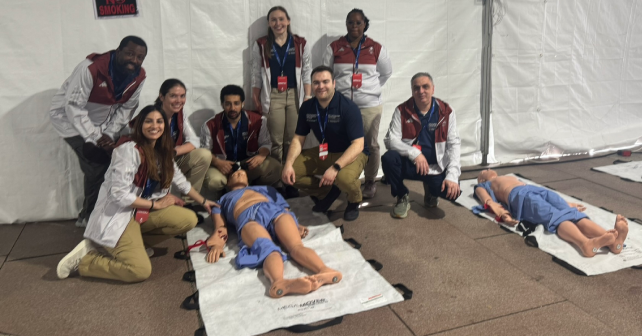
To address this gap in trauma supplies and training at mass gathering medical tents, the BIDMC Disaster Medicine Fellowship initiated a project to introduce essential trauma training for medical professionals and trauma first-aid kits to all medical tents along the Boston Marathon route. These kits include commercial tourniquets, hemostatic gauze, pressure dressings, medical gloves, and trauma shears—crucial tools for controlling life-threatening hemorrhage. The kits along with the training would prepare the medical tents to become TSPs in the case of a traumatic mass casualty event.
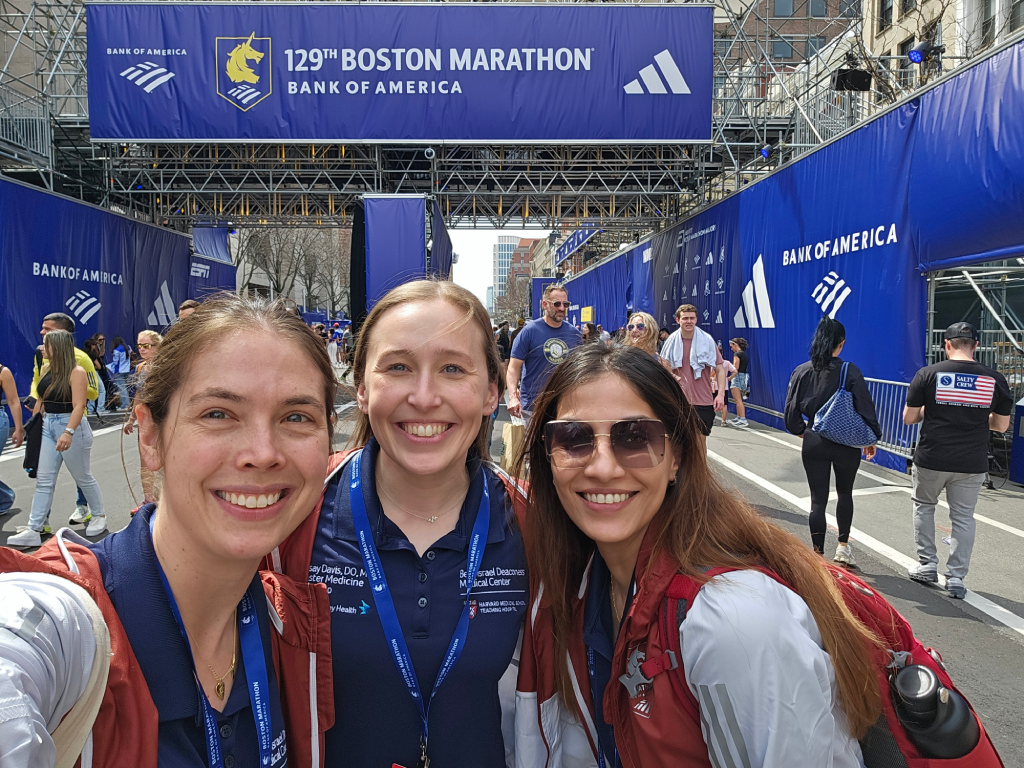
Left to right: Sophia Görgens, MD; Lindsay Davis, DO, MPH; and Almas Malik, MD, pose at the Boston Marathon finish line. Click to enlarge. (Photo: Sophia Görgens, MD)

Because little research exists on disaster medicine preparedness at mass gathering events, more data and advocacy for preparedness is crucial to mitigate the fallout from future terrorist attacks such as car rammings, active shooters, or bombing attacks.

Like many other mass gatherings, the Boston Marathon uses a group of diverse medical volunteers, from athletic trainers to physical therapists to emergency physicians.

“Medical volunteers at marathons come from various specialties and don’t all possess the same prehospital or first-aid skills,” said Christina Woodward, MD, who serves as associate director of education, BIDMC Disaster Medicine Fellowship. “Our standardized trauma education ensures all volunteers possess essential life-saving skills, regardless of their specialty background.”

Although emergency physicians have always been leaders in trauma and disaster care, mass gatherings allow them to share their expertise and ensure that everyone is prepared. The American College of Surgeons, who implemented their Stop the Bleed program in 2015 to teach laypeople the basics of trauma first-aid, provides an excellent example of how teaching these skills is feasible and effective.8,9

Pages: 1 2 3 4 | Single Page

Topics: Disaster Medicinedisaster preparednessEMSMass CasualtyMass Gatheringpre-hospital careTerrorismTourniquetTrauma

Related

  • The First National Congress on Emergency Medical Care in Ukraine

    December 4, 2025 - 0 Comment
  • Event Medicine: Where Fun and Safety Sing in Perfect Harmony

    October 9, 2025 - 1 Comment
  • Emergency Department Management of Prehospital Tourniquets

    October 1, 2025 - 0 Comment

Current Issue

ACEP Now: November 2025

Download PDF

Read More

No Responses to “Trauma First Aid at the 2025 Boston Marathon”

Leave a Reply Cancel Reply

Your email address will not be published. Required fields are marked *


*
*


Wiley
  • Home
  • About Us
  • Contact Us
  • Privacy
  • Terms of Use
  • Advertise
  • Cookie Preferences
Copyright © 2025 by John Wiley & Sons, Inc. All rights reserved, including rights for text and data mining and training of artificial technologies or similar technologies. ISSN 2333-2603
