Logo

Log In Sign Up |  An official publication of: American College of Emergency Physicians
Navigation
  • Home
  • Multimedia
    • Podcasts
    • Videos
  • Clinical
    • Airway Managment
    • Case Reports
    • Critical Care
    • Guidelines
    • Imaging & Ultrasound
    • Pain & Palliative Care
    • Pediatrics
    • Resuscitation
    • Trauma & Injury
  • Career
    • Practice Management
      • Reimbursement & Coding
      • Legal
      • Operations
    • Awards
    • Certification
    • Early Career
    • Education
    • Leadership
    • Profiles
    • Retirement
    • Work-Life Balance
  • Compensation Reports
  • Columns
    • ACEP4U
    • Airway
    • Benchmarking
    • By the Numbers
    • EM Cases
    • End of the Rainbow
    • Equity Equation
    • FACEPs in the Crowd
    • Forensic Facts
    • From the College
    • Kids Korner
    • Medicolegal Mind
    • Opinion
      • Break Room
      • New Spin
      • Pro-Con
    • Pearls From EM Literature
    • Policy Rx
    • Practice Changers
    • Problem Solvers
    • Residency Spotlight
    • Resident Voice
    • Skeptics’ Guide to Emergency Medicine
    • Sound Advice
    • Special OPs
    • Toxicology Q&A
    • WorldTravelERs
  • Resources
    • mTBI Resource Center
    • ACEP.org
    • ACEP Knowledge Quiz
    • CME Now
    • Annual Scientific Assembly
      • ACEP14
      • ACEP15
      • ACEP16
      • ACEP17
      • ACEP18
      • ACEP19
    • Annals of Emergency Medicine
    • JACEP Open
    • Emergency Medicine Foundation
  • Issue Archives
  • Archives
    • Brief19
    • Coding Wizard
    • Images in EM
    • Care Team
    • Quality & Safety
  • About
    • Our Mission
    • Medical Editor in Chief
    • Editorial Advisory Board
    • Awards
    • Authors
    • Article Submission
    • Contact Us
    • Advertise
    • Subscribe
    • Privacy Policy
    • Copyright Information

Transition from Academia to Community Hospital Practice Is Complicated for Emergency Physician

By Patricia Van Leer, MD | on August 14, 2016 | 0 Comment
New Spin
  • Tweet
  • Click to email a link to a friend (Opens in new window) Email
Print-Friendly Version
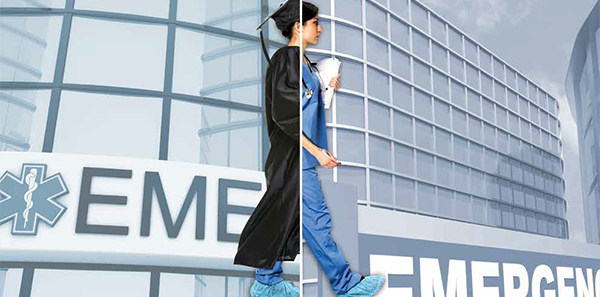
Transition from Academia to Community Hospital Practice Is Complicated for Emergency Physician
ILLUSTRATION/PAUL JUESTRICH; PHOTOs shutterstock.com

I listened to EMS’s story (hypotension, bradycardia, altered) via the new electronic medical record then looked to head of the bed for my PGY-2, who would already have a GlideScope, bougie, and endotracheal tube ready to go. Instead, there was a nurse at the head of the bed, waiting for me to say something. My eyes then scanned the entire room for familiar sights (interns, residents, onlookers); there were none.

You Might Also Like
  • Opinion: Independent Emergency Group Practice Model Boosts Physician Satisfaction
  • What Emergency Physicians Should Know About Getting a Job in Academia
  • Building a Democratic, Independent, Community ED Practice
Explore This Issue
ACEP Now: Vol 35 – No 08 – August 2016

After graduating from the residency program at St. Luke’s-Roosevelt Hospital in New York City, I continued working at the same hospital for several years. I was the assistant program director for two years when I made a huge life change last summer. I willfully stepped off of the academic train, but transitioning to a community hospital has not been the smooth ride that I expected.

Residents Versus No Residents

Getting back to my first shift without residents, in Catch Me If You Can, Leonardo DiCaprio briefly plays an attending. He fakes his way through medicine by asking for one resident’s opinion, then turning to a second resident and asking, “Do you concur?” In some ways, I spent years asking, “Do you concur?” without having to initiate a plan of my own.

While I missed my residents for the complicated patients, I missed them even more during the minute-to-minute ED moments. I felt lonely without someone to share in the excitement of making a rare diagnosis or someone to show a cool X-ray finding.

Education

Surprisingly, the thing I don't miss is teaching. Don’t freak out. I love teaching, and I think it’s something I do well. The reason I don't miss teaching is that I'm still constantly teaching. I work with scribes who are super-eager premed students dying for two minutes of teaching. Have you tried to explain an anion gap to a kid who is taking biochemistry? It requires an understanding of the science well beyond MUDPILES. It’s both fun and challenging to teach to their academic level.

I also work with many nurses who are working on their nurse practitioner degree. Once I know they are interested in education, I’ll take a minute to pull them aside and teach. I made the mistake of waltzing into my new emergency department and assuming that everyone wanted me to teach. Many nurses are receptive, but some are not interested in pausing during their busy day for “learning.” On a few occasions, my two-minute mini-lectures were taken as pejorative instead of well-intentioned. Asking the simple question, “Do you have a minute to discuss that patient?” has gone a long way in figuring out who is interested and who is not.

Pages: 1 2 3 | Single Page

Topics: AcademiacareerCommunity HospitalEmergency DepartmentEmergency MedicineEmergency PhysicianPatient CarePractice ManagementWorkforce

Related

  • Despite Drawbacks, Emergency Medicine Remains a Great Specialty

    January 9, 2026 - 0 Comment
  • Opinion: Emergency Physicians Witness the Universal Truth of Humanity

    January 9, 2026 - 3 Comments
  • New ACEP Executive Director Addresses America’s Emergency Docs

    December 23, 2025 - 0 Comment

Current Issue

ACEP Now: January 2026

Download PDF

Read More

No Responses to “Transition from Academia to Community Hospital Practice Is Complicated for Emergency Physician”

Leave a Reply Cancel Reply

Your email address will not be published. Required fields are marked *


*
*


Careers Center
  • Urgent Care Physician

    MercyOne Waterloo Urgent Care Seeking BC/BE physician to staff busy urgent care Full time position Clinic hours Mon-Fri 8am-8pm, weekends 10am-6pm...

    Waterloo, Iowa

    Competitive

    Trinity Health

    Read More
  • ER Physician- Mason City, Iowa- $100,000 bonus package

    MercyOne North Iowa- Emergency Medicine Level III Trauma Center 25,000 visits/year Full-service hospital with a 24/7 Hospitalist program, air medic...

    Mason City, Iowa

    Competitive

    Trinity Health

    Read More
  • Vice Chair of Education, Emergency Medicine

    The Department of Emergency Medicine at Stanford University School of Medicine seeks a nationally renowned educator and leader

    Palo Alto, California

    Associate Professor: $359,000 - $377,000 Professor: $392,000 - $407,000

    Stanford School of Medicine, Department Of Emergency Medicine

    Read More
More Jobs
Wiley
  • Home
  • About Us
  • Contact Us
  • Privacy
  • Terms of Use
  • Advertise
  • Cookie Preferences
Copyright © 2026 by John Wiley & Sons, Inc. All rights reserved, including rights for text and data mining and training of artificial technologies or similar technologies. ISSN 2333-2603

