Logo

Log In Sign Up |  An official publication of: American College of Emergency Physicians
Navigation
  • Home
  • Multimedia
    • Podcasts
    • Videos
  • Clinical
    • Airway Managment
    • Case Reports
    • Critical Care
    • Guidelines
    • Imaging & Ultrasound
    • Pain & Palliative Care
    • Pediatrics
    • Resuscitation
    • Trauma & Injury
  • Resource Centers
    • mTBI Resource Center
  • Career
    • Practice Management
      • Benchmarking
      • Reimbursement & Coding
      • Care Team
      • Legal
      • Operations
      • Quality & Safety
    • Awards
    • Certification
    • Compensation
    • Early Career
    • Education
    • Leadership
    • Profiles
    • Retirement
    • Work-Life Balance
  • Columns
    • ACEP4U
    • Airway
    • Benchmarking
    • Brief19
    • By the Numbers
    • Coding Wizard
    • EM Cases
    • End of the Rainbow
    • Equity Equation
    • FACEPs in the Crowd
    • Forensic Facts
    • From the College
    • Images in EM
    • Kids Korner
    • Medicolegal Mind
    • Opinion
      • Break Room
      • New Spin
      • Pro-Con
    • Pearls From EM Literature
    • Policy Rx
    • Practice Changers
    • Problem Solvers
    • Residency Spotlight
    • Resident Voice
    • Skeptics’ Guide to Emergency Medicine
    • Sound Advice
    • Special OPs
    • Toxicology Q&A
    • WorldTravelERs
  • Resources
    • ACEP.org
    • ACEP Knowledge Quiz
    • Issue Archives
    • CME Now
    • Annual Scientific Assembly
      • ACEP14
      • ACEP15
      • ACEP16
      • ACEP17
      • ACEP18
      • ACEP19
    • Annals of Emergency Medicine
    • JACEP Open
    • Emergency Medicine Foundation
  • About
    • Our Mission
    • Medical Editor in Chief
    • Editorial Advisory Board
    • Awards
    • Authors
    • Article Submission
    • Contact Us
    • Advertise
    • Subscribe
    • Privacy Policy
    • Copyright Information

How To Relieve Sciatica Pain with New TransGluteal Nerve Block Treatment

By Andrew J Goldsmith, MD, MBA; Joseph Brown, MD; Jeff Herrala, MD; and Arun Nagdev, MD | on June 15, 2022 | 0 Comment
Pain & Palliative Care Sound Advice
  • Tweet
  • Click to email a link to a friend (Opens in new window) Email
Print-Friendly Version

5. Needle Entry

You Might Also Like
  • Ultrasound-Guided Posterior Tibial Nerve Block
  • How to Perform Ultrasound-Guided Distal Sciatic Nerve Block in the Popliteal Fossa
  • How to Perform an Adductor Canal Nerve Block
Explore This Issue
ACEP Now: Vol 41 – No 06 – June 2022

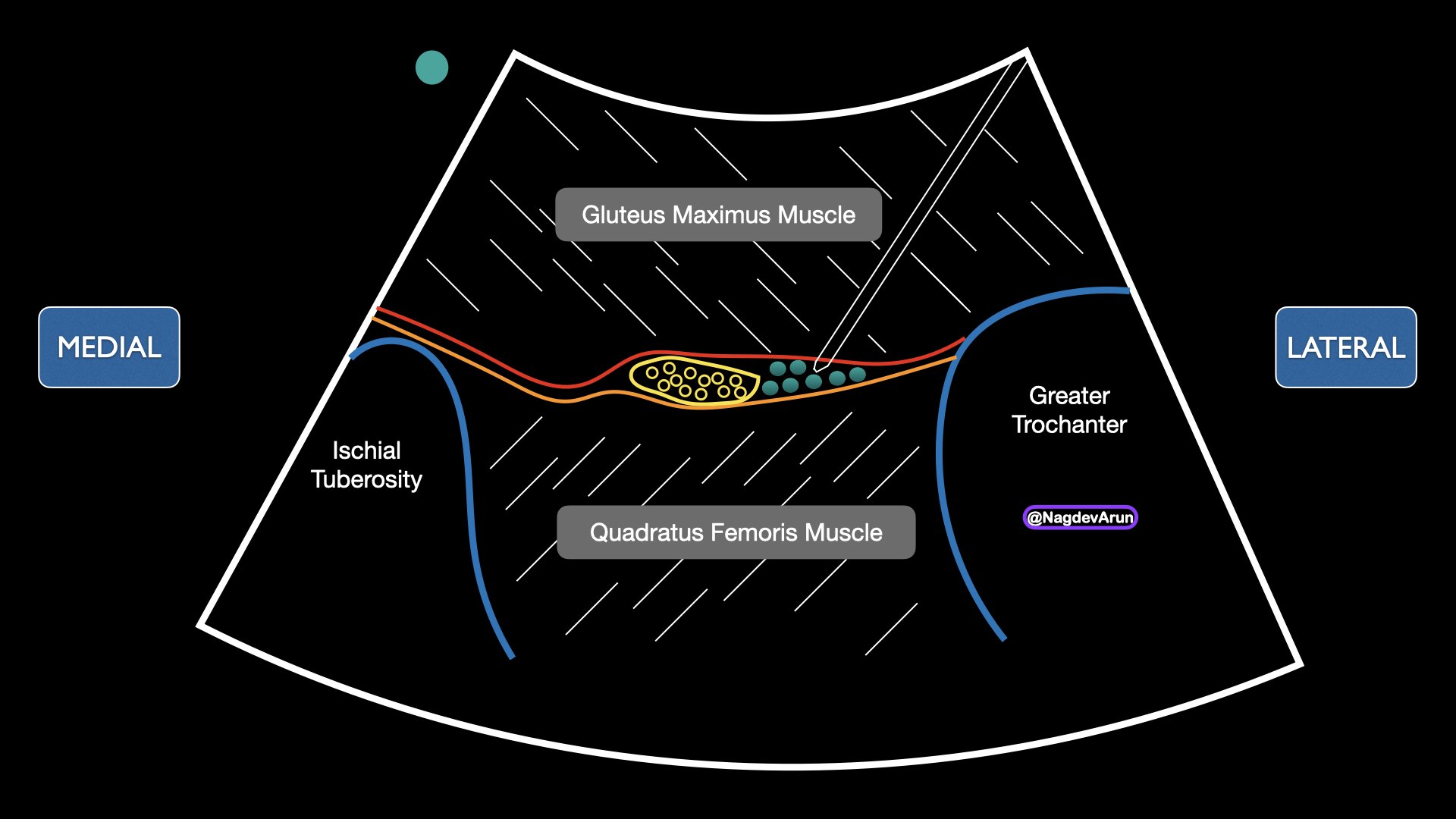
PICTURE 4 (click to enlarge): Schematic of an in-plane lateral to medial approach with a blunt block needle. Note that the anesthetic is placed in the fascial plane adjacent to the sciatic nerve. Note the nerve encompasses the yellow circles and the anesthetic is the green/blue circles.

With the transducer fixed over the targeted nerve, using an in-plane approach, insert a block needle and/or blunt tip needle and advance at approximately 70 degrees from the greater trochanter down toward the sciatic nerve (Picture 4). After the 1–2 cm of insertion, stop further needle advancement and make subtle probe adjustments until the needle is visualized. Continue advancing with in-plane ultrasound guidance to position the needle tip approximately 1–2 cm away from the nerve. Once the needle tip is visualized adjacent to the sciatic nerve, aspirate prior to injecting small aliquots of sterile saline to hydro-dissect the gluteal maximus fascial plane. Anechoic fluid should be seen separating the fascial plane away from the sciatic nerve.(Picture 4) After aspiration to ensure no vascular puncture, small aliquots of anesthetic are first injected deep to the sciatic nerve followed by the medial aspect of the nerve. Afterwards, advance the needle to the far side of the nerve, aspirate to ensure no vascular puncture, and inject small aliquots of anesthetic on the far side then the proximal aspect of the nerve. In our experience, this order of injection helps prevent any obscuring of the nerve of interest in case there is a small amount of air that was not fully expressed from the needle or tubing prior to initiating the procedure. Ensure that the injected anechoic fluid is not placed in the gluteus maximus muscle or into the sciatic nerve itself.

Summary

The TGSNB is a simple, safe block that can provide pain relief to a large number of patients in your ED. Given its effectiveness, this can be a valuable tool for acute multimodal pain control for a condition that usually can be difficult to manage with traditional oral analgesics. The combination of dexamethasone to a long-acting anesthetic may provide longer pain relief and further provide additional time for your patient to get ahead of their pain cycle.


Andrew J Goldsmith, MD, MBA, is Ultrasound director at Brigham and Women’s Hospital

Joseph Brown, MD, is a part of the Ultrasound Division at the University of Colorado.

Pages: 1 2 3 4 | Single Page

Topics: Nerve Blockssciatic painUltrasound-Guided Nerve Block

Related

  • A Simplified Protocol for Intralipid Administration in the Emergency Dept.

    May 10, 2025 - 0 Comment
  • The Ultrasound-Guided Genicular Nerve Block

    May 10, 2024 - 0 Comment
  • How to Manage Elderly Patient Pain without Opioids

    February 13, 2024 - 0 Comment

Current Issue

ACEP Now: November 2025

Download PDF

Read More

No Responses to “How To Relieve Sciatica Pain with New TransGluteal Nerve Block Treatment”

Leave a Reply Cancel Reply

Your email address will not be published. Required fields are marked *


*
*


Wiley
  • Home
  • About Us
  • Contact Us
  • Privacy
  • Terms of Use
  • Advertise
  • Cookie Preferences
Copyright © 2025 by John Wiley & Sons, Inc. All rights reserved, including rights for text and data mining and training of artificial technologies or similar technologies. ISSN 2333-2603