
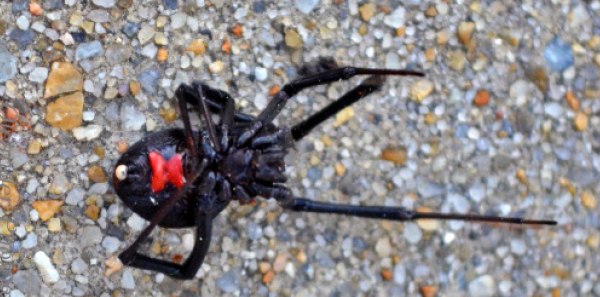
Answer: Beware! Although small, the black widow spider has powerful venom.
Explore This Issue
ACEP Now: Vol 40 – No 12 – December 2021When you talk about black widow spiders, you are primarily talking about the female of the species. She has a classic spider shape: shiny black body with a red hourglass shape on her large round abdomen and is about 10–13 mm when fully mature. The red mark seen above is thought to warn predators that they will get more than they bargained for with this arachnid. These spiders create distinctive disorganized web constructs of tough silk strands called tangle webs; they hang upside down within the web to show off their hourglass while waiting for prey.
Black widows are named because of the species’ sexual cannibalism. The male is much smaller and lighter in color and sometimes gets eaten after mating. This mostly occurs when the male cannot get away (like in a laboratory setting with scientists watching what is happening) and not outside in the wild—there, males only get eaten only about 2 percent of the time. These spiders are generally solitary, live one to three years, and eat insects and other spiders.
Venom
Black widow spiders are the most venomous spiders in North America, with venom several times more potent than rattlesnake venom.1–3 They are far from the most venomous in the world (that honor goes to Australia’s funnel-web spiders). Venom is delivered through fang bites and not from a posterior stinger.
Despite this, most people who are envenomated have no serious damage due to the low volume of venom delivered, although they can get very uncomfortable. Rarely, bites can be fatal, usually only in the very young, very old, or infirm. Annually, there are 1,000–2,000 black widow spider bites reported to the American Association of Poison Control Centers; no deaths have been reported in the last 10 years.
Identification and Treatment
Generally, black widow bites hurt and may appear as a pale area of skin. The venom injected contains alpha-latrotoxin, whose mechanism of action involves binding to the motor end plates in the neuromuscular junction causing sodium channel opening and massive exocytosis of acetylcholine and norepinephrine.
This can cause hypertension, extreme muscle cramping in the torso and abdomen within minutes (it’s one of the zebra differential diagnoses for “acute abdomen”), nausea, vomiting, and difficulty breathing. “Facies lactrodectismica” is facial sweating and grimacing that is unique to this bite. There are also reports of profound persistent localized sweating near the bite site. Symptoms may last for several days.
Treatment is usually supportive. Wash the site, then provide pain medicine, muscle relaxants for spasms, and time.
There is an antivenin. It is horse-derived and can be useful in the right circumstances, but there are downsides. It has the risk of serum sickness and allergic reactions, including anaphylaxis.
References
- Black widow. Saint Louis Zoo website. Accessed Nov. 15, 2021.
- Daly FF, Hill RE, Bogdan GM, et al. Neutralization of Latrodectus mactans and L. hesperus venom by redback spider (L. hasseltii) antivenom. J Toxicol Clin Toxicol. 2001;39(2):119-123.
- Glenn JL, Straight RC, Wolfe MC, et al. Geographical variation in Crotalus scutulatus scutulatus (Mojave rattlesnake) venom properties. Toxicon. 1983;21(1):119-130.
Pages: 1 2 | Single Page



No Responses to “Toxicology Q&A Answer: Beware the Black Widow!”