Logo

Log In Sign Up |  An official publication of: American College of Emergency Physicians
Navigation
  • Home
  • Multimedia
    • Podcasts
    • Videos
  • Clinical
    • Airway Managment
    • Case Reports
    • Critical Care
    • Guidelines
    • Imaging & Ultrasound
    • Pain & Palliative Care
    • Pediatrics
    • Resuscitation
    • Trauma & Injury
  • Resource Centers
    • mTBI Resource Center
  • Career
    • Practice Management
      • Benchmarking
      • Reimbursement & Coding
      • Care Team
      • Legal
      • Operations
      • Quality & Safety
    • Awards
    • Certification
    • Compensation
    • Early Career
    • Education
    • Leadership
    • Profiles
    • Retirement
    • Work-Life Balance
  • Columns
    • ACEP4U
    • Airway
    • Benchmarking
    • Brief19
    • By the Numbers
    • Coding Wizard
    • EM Cases
    • End of the Rainbow
    • Equity Equation
    • FACEPs in the Crowd
    • Forensic Facts
    • From the College
    • Images in EM
    • Kids Korner
    • Medicolegal Mind
    • Opinion
      • Break Room
      • New Spin
      • Pro-Con
    • Pearls From EM Literature
    • Policy Rx
    • Practice Changers
    • Problem Solvers
    • Residency Spotlight
    • Resident Voice
    • Skeptics’ Guide to Emergency Medicine
    • Sound Advice
    • Special OPs
    • Toxicology Q&A
    • WorldTravelERs
  • Resources
    • ACEP.org
    • ACEP Knowledge Quiz
    • Issue Archives
    • CME Now
    • Annual Scientific Assembly
      • ACEP14
      • ACEP15
      • ACEP16
      • ACEP17
      • ACEP18
      • ACEP19
    • Annals of Emergency Medicine
    • JACEP Open
    • Emergency Medicine Foundation
  • About
    • Our Mission
    • Medical Editor in Chief
    • Editorial Advisory Board
    • Awards
    • Authors
    • Article Submission
    • Contact Us
    • Advertise
    • Subscribe
    • Privacy Policy
    • Copyright Information

Toxicology Answer: What Garden Visitor Made This Mark?

By Jason Hack, MD | on June 15, 2021 | 0 Comment
Toxicology Q&A
  • Tweet
  • Click to email a link to a friend (Opens in new window) Email
Print-Friendly Version
Jason Hack (Oleander Photography)

See Question

I like to think of myself as a fairly even-keeled person. I have a short list of hated things: root canals, traffic, wood rot, and the like. In the natural world, the list is even shorter, but it’s topped by a large margin by fire ants, who were, in my opinion, designed to inflict misery and pain. I’ve yet to meet someone who takes a strong counterpoint to this position, so if I’ve missed the boat, please let me know.

You Might Also Like
  • Toxicology Question: What Garden Visitor Made This Mark?
  • Toxicology Answer: Can This Toxic Plant Treat Certain Illnesses?
  • Toxicology Answer: What Flower Did the Greek Army Use Against a City?
Explore This Issue
ACEP Now: Vol 40 – No 06 – June 2021

Names

Names include fire ants, Solenopsis invicta, red ants, and red imported fire ants (RIFAs). There are also black imported fire ants (BIFAs). The difference between the two (red and black fire ants) is largely academic, as they have similar biologies and behaviors. There are also hybrids of these two species.

Anatomy

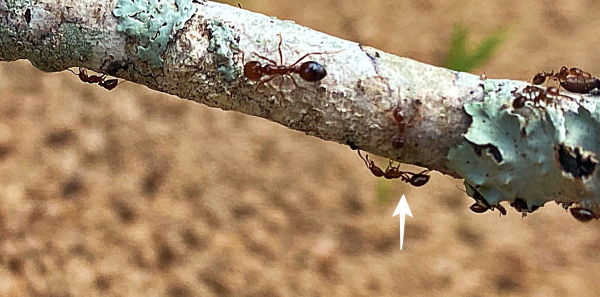
Distinct attributes of the fire ant include a narrow wasp-like waist, or pedicel, that is composed of two segments (see white arrow). Workers vary in lengths between 1/8 and 1/4 inches. They have large biting mandibles with four teeth, and their antennae have 10 segments, ending in a two-segmented club. A sting is present at the tip of the rear segment (gaster). The body color is usually red to brown.

History and Distribution

Fire ants first entered the United States somewhere around 1918 in Alabama—brought north from South America in dumped ballast from ships. They immediately began to spread though the costal Southeast and now infest most of that region of the United States.

Northern migration of fire ants was thought to be limited by the colder climate because winter temperatures freeze the soil deeply enough to affect overwintering colonies. However, recent research shows RIFA colonization in colder higher elevations.

Ant Life

Mounds: Fire ant mounds look like heaped-up fluffy dirt. The mounds do not have central entrance holes on the surface, which distinguishes them from other ant hills. The mounds have interconnecting galleries and underground tunnels that can extend to the surface five to 25 feet away from the mound.

Colony life: Fire ants are social insects that nest in the soil in large colonies that contain 200,000 to 400,000 workers, although some super colonies have millions of individuals.

Fire ants spread by saltatory swarming. Reproductive male and female ants leave the mound en masse, fly into the air, and mate while airborne. The fire ant queens fall back to the ground, shed their wings, and start new colonies where they land.

Most of the ants in the colony are infertile female workers gathering food and caring for the colony—and all can sting. They are omnivores and feed on almost anything—invertebrates and vertebrates as well as plants and honeydew. There is usually one queen per colony, but some colonies have several that all lay eggs.

Attitude: These ants are highly aggressive. They scavenge food for the colony and vigorously attack intruders to defend their mound. They do so by swarming in large numbers to attack any animal disturbing their nest. They instinctively climb vertical surfaces, including limbs. Although they are small, their sting and strength in numbers allow them to overwhelm and kill much larger prey.

Fire ants use their strong jaws to dig in and pinch human skin. This bite anchors the insect to the skin and acts as a pivot, allowing it to inject venom multiple times using its sharp stinger. A single ant stings an average of three times before removal.

Pages: 1 2 | Single Page

Topics: AntStingVenom

Related

  • Toxicology Answer: the Lionfish, a Dangerous, Non-Native Invader

    August 9, 2024 - 0 Comment
  • Toxicology Question: Which Sea-Dweller Causes Skin Necrosis Upon Contact?

    August 9, 2024 - 0 Comment
  • Toxicology Question: Is This Little Spider Friend or Foe?

    December 16, 2021 - 0 Comment

Current Issue

ACEP Now: November 2025

Download PDF

Read More

About the Author

Jason Hack, MD

Dr. Hack (Oleander Photography) is chief of the division of medical toxicology and vice chair for research at East Carolina University in Greenville, North Carolina. He enjoys taking photographs of beautiful toxic, medicinal, and benign flowers that he stumbles upon or grows in his garden. Contact him at ToxInRI@gmail.com, www.toxinRI.com, or on Instagram @oleanderphotography.

View this author's posts »

No Responses to “Toxicology Answer: What Garden Visitor Made This Mark?”

Leave a Reply Cancel Reply

Your email address will not be published. Required fields are marked *


*
*


Wiley
  • Home
  • About Us
  • Contact Us
  • Privacy
  • Terms of Use
  • Advertise
  • Cookie Preferences
Copyright © 2025 by John Wiley & Sons, Inc. All rights reserved, including rights for text and data mining and training of artificial technologies or similar technologies. ISSN 2333-2603