Logo

Log In Sign Up |  An official publication of: American College of Emergency Physicians
Navigation
  • Home
  • Multimedia
    • Podcasts
    • Videos
  • Clinical
    • Airway Managment
    • Case Reports
    • Critical Care
    • Guidelines
    • Imaging & Ultrasound
    • Pain & Palliative Care
    • Pediatrics
    • Resuscitation
    • Trauma & Injury
  • Resource Centers
    • mTBI Resource Center
  • Career
    • Practice Management
      • Benchmarking
      • Reimbursement & Coding
      • Care Team
      • Legal
      • Operations
      • Quality & Safety
    • Awards
    • Certification
    • Compensation
    • Early Career
    • Education
    • Leadership
    • Profiles
    • Retirement
    • Work-Life Balance
  • Columns
    • ACEP4U
    • Airway
    • Benchmarking
    • Brief19
    • By the Numbers
    • Coding Wizard
    • EM Cases
    • End of the Rainbow
    • Equity Equation
    • FACEPs in the Crowd
    • Forensic Facts
    • From the College
    • Images in EM
    • Kids Korner
    • Medicolegal Mind
    • Opinion
      • Break Room
      • New Spin
      • Pro-Con
    • Pearls From EM Literature
    • Policy Rx
    • Practice Changers
    • Problem Solvers
    • Residency Spotlight
    • Resident Voice
    • Skeptics’ Guide to Emergency Medicine
    • Sound Advice
    • Special OPs
    • Toxicology Q&A
    • WorldTravelERs
  • Resources
    • ACEP.org
    • ACEP Knowledge Quiz
    • Issue Archives
    • CME Now
    • Annual Scientific Assembly
      • ACEP14
      • ACEP15
      • ACEP16
      • ACEP17
      • ACEP18
      • ACEP19
    • Annals of Emergency Medicine
    • JACEP Open
    • Emergency Medicine Foundation
  • About
    • Our Mission
    • Medical Editor in Chief
    • Editorial Advisory Board
    • Awards
    • Authors
    • Article Submission
    • Contact Us
    • Advertise
    • Subscribe
    • Privacy Policy
    • Copyright Information

Toxicology Answer: What Are the Side Effects of Chewing This Beautiful Bloom?

By Jason Hack, MD | on December 15, 2020 | 1 Comment
Toxicology Q&A
  • Tweet
  • Click to email a link to a friend (Opens in new window) Email
Print-Friendly Version
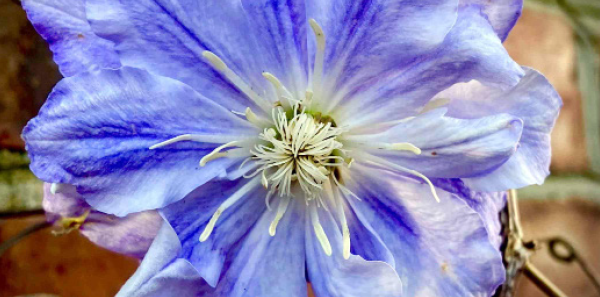
PHOTO: Jason Hack (Oleander Photography)
Clematis spp. (virgin’s bower, traveler’s joy, and leather flowers) are members of the buttercup family (Ranunculaceae) and a beautiful perennial addition to any trellis. CREDIT: Jason Hack (Oleander Photography)

See Question

Answer: Chewing releases protoanemonin, causing burning of mouth and mucous membranes, salivation, abdominal pain and cramping, nausea, and vomiting.

You Might Also Like
  • Toxicology Question: What Are the Side Effects of Chewing This Beautiful Bloom?
  • Toxicology Answer: What Flower Did the Greek Army Use Against a City?
  • Answer: Purple Bloom’s Hollywood History
Explore This Issue
ACEP Now: Vol 39 – No 12 – December 2020

Description

The plant consists of woody vines six to 18 feet long that climb by twining. It has big, bold flowers composed of striking septals of various colors surrounding a central basket of stamens and pistils. It grows throughout North America. Clematis species have attractive, complex flowers that are usually single and spaced out across the plant’s length, but some varieties have clustered blooms. The deep-green leaflets are arranged opposite, at intervals along the central vine (as seen in the accompanying photograph).

Toxins

Clematis and other plants in the buttercup family contain the compound ranunculin. Ranunculin is a glycosidic precursor that gets converted to the vesicant protoanemonin by enzymes released when the plant is chewed. This toxic compound is in highest concentration in the leaves and sap and can cause irritation and skin blistering. If eaten, it will cause burning of mouth and mucous membranes, salivation, abdominal pain and cramping, nausea, and vomiting. Hematuria and renal function effects have also been described.

Inadvertent exposure and exposure in animals is often self-limited by the oral symptoms.
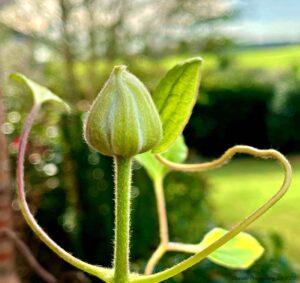
Clematis bud. © Jason Hack (Oleander Photography) Facts

  • Although all flowers are made of modified leaves, the clematis has colorful septals, not petals. They are therefore “incomplete” flowers (a “complete” flower has four parts: septals, petals, stamens, and pistils). Septals are the outermost protective leaves for budding flowers. The lack of an internal set of colored leaves (petals) sets clematis (and hydrangeas) apart from most flowers.
  • Clematis are also toxic to dogs, cats, and horses and can induce salivation, vomiting, and diarrhea.
  • Protoanemonin has antimicrobial and fungicidal properties.
  • A clematis leaf is compound and made up of the two opposite leaflets—each one is part of the “whole leaf.”


Current Issue

ACEP Now: November 2025

Download PDF

Read More

About the Author

Jason Hack, MD

Dr. Hack (Oleander Photography) is chief of the division of medical toxicology and vice chair for research at East Carolina University in Greenville, North Carolina. He enjoys taking photographs of beautiful toxic, medicinal, and benign flowers that he stumbles upon or grows in his garden. Contact him at ToxInRI@gmail.com, www.toxinRI.com, or on Instagram @oleanderphotography.

View this author's posts »

One Response to “Toxicology Answer: What Are the Side Effects of Chewing This Beautiful Bloom?”

  1. February 18, 2021

    Vicki Sabie Reply

    Very cool. Who would have thought such a common flower would be toxic. Thanks or the information. I love reading your column.

Leave a Reply Cancel Reply

Your email address will not be published. Required fields are marked *


*
*


Wiley
  • Home
  • About Us
  • Contact Us
  • Privacy
  • Terms of Use
  • Advertise
  • Cookie Preferences
Copyright © 2025 by John Wiley & Sons, Inc. All rights reserved, including rights for text and data mining and training of artificial technologies or similar technologies. ISSN 2333-2603