Logo

Log In Sign Up |  An official publication of: American College of Emergency Physicians
Navigation
  • Home
  • Multimedia
    • Podcasts
    • Videos
  • Clinical
    • Airway Managment
    • Case Reports
    • Critical Care
    • Guidelines
    • Imaging & Ultrasound
    • Pain & Palliative Care
    • Pediatrics
    • Resuscitation
    • Trauma & Injury
  • Resource Centers
    • mTBI Resource Center
  • Career
    • Practice Management
      • Benchmarking
      • Reimbursement & Coding
      • Care Team
      • Legal
      • Operations
      • Quality & Safety
    • Awards
    • Certification
    • Compensation
    • Early Career
    • Education
    • Leadership
    • Profiles
    • Retirement
    • Work-Life Balance
  • Columns
    • ACEP4U
    • Airway
    • Benchmarking
    • Brief19
    • By the Numbers
    • Coding Wizard
    • EM Cases
    • End of the Rainbow
    • Equity Equation
    • FACEPs in the Crowd
    • Forensic Facts
    • From the College
    • Images in EM
    • Kids Korner
    • Medicolegal Mind
    • Opinion
      • Break Room
      • New Spin
      • Pro-Con
    • Pearls From EM Literature
    • Policy Rx
    • Practice Changers
    • Problem Solvers
    • Residency Spotlight
    • Resident Voice
    • Skeptics’ Guide to Emergency Medicine
    • Sound Advice
    • Special OPs
    • Toxicology Q&A
    • WorldTravelERs
  • Resources
    • ACEP.org
    • ACEP Knowledge Quiz
    • Issue Archives
    • CME Now
    • Annual Scientific Assembly
      • ACEP14
      • ACEP15
      • ACEP16
      • ACEP17
      • ACEP18
      • ACEP19
    • Annals of Emergency Medicine
    • JACEP Open
    • Emergency Medicine Foundation
  • About
    • Our Mission
    • Medical Editor in Chief
    • Editorial Advisory Board
    • Awards
    • Authors
    • Article Submission
    • Contact Us
    • Advertise
    • Subscribe
    • Privacy Policy
    • Copyright Information

Toxicology Answer: the White-Marked Tussock Moth Caterpillar

By Jason Hack, MD, FACEP | on June 11, 2024 | 0 Comment
Toxicology Q&A
  • Tweet
  • Click to email a link to a friend (Opens in new window) Email
Print-Friendly Version

There are three species of white-marked tussock moths, Orgyia detrita, Orgyia leucostigma, and Orgyia definita, found across the eastern United States. Orgyia is Greek for a unit of measurement “the length between outstretched arms.” Their life cycle begins in the winter as eggs, from which caterpillars hatch from April to June. These mature over 30 days and create cocoons. Adults emerge two weeks later and mate; new eggs are laid on the surface of old cocoons by the flightless females.

You Might Also Like
  • Toxicology Q&A: Which Plant’s Sap Is Toxic to the Eyes?
  • Toxicology Answer: Milkweed (Asclepias)
  • Toxicology Answer: What toxin makes this pretty plant one to watch for—and avoid?
Explore This Issue
ACEP Now: Vol 43 – No 06 – June 2024

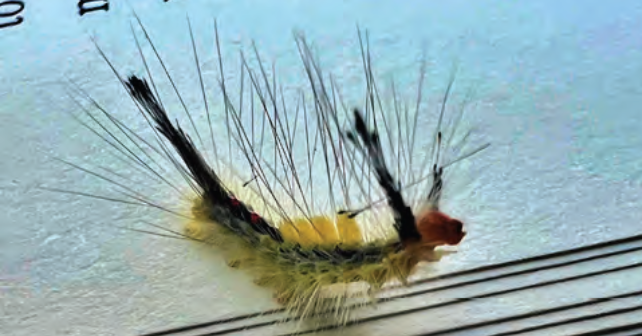
All three species have similar characteristics, and while their adult form is gray and drab, their larval or caterpillar form is striking. Orgyia leucostigma (illustrated here) has a deep red-colored head and matching red dots (glands) on its back, coupled with clumps of short, vertical yellow hairs (called dorsal tussocks) on the first four abdominal segments, all surrounded by an inviting covering of fluffy long black ‘plume hairs’.

They are most commonly encountered by people in spring and early summer. Symptoms usually begin between 30 minutes and three hours.

They look friendly and fuzzy, especially when they raise the front of their body to search for their next path forward, the “hair pencils” looking like arms reaching out (hence the name Orgyia; see image at right. They are most commonly encountered by people in spring and early summer; however, your reaction of “how cute, I must pick it up” should be tempered by the knowledge that looks can be deceiving. Those hairs and warning colors are a clear announcement that they should be treated with avoidance, not petting, as these structures can cause injury to skin, eyes, and mucous membranes. There are 52 species of moths spanning 10 families of Lepidoptera that are known to have structures that can cause injury to humans—including Orgyia.3

Although they look benign, those attractive hairlike structures covering the caterpillar, especially the tussocks, are specially designed to act as passive armor to protect the caterpillar from predators. They cause injury, and therefore avoidance, among animals intending to eat them—or cause pain and problems in those curious enough to touch them.

The Hairs (Setae)

The brittle tussock hairs from the clumps on the caterpillar’s back (called urticating hairs) have backwards-angled barbs along their length, which, once they have poked into your skin or landed in your eyes, break off and travel deep into your tissues in a linear fashion, resisting withdrawal once imbedded.1,5

Pages: 1 2 3 | Single Page

Topics: PoisonToxin

Related

  • Toxicology Answer: Oil of Wintergreen

    October 28, 2025 - 0 Comment
  • Toxicology Question: What Minty Plant Oil Can Cause Poisoning and Death in Children?

    October 28, 2025 - 0 Comment
  • Toxin-Induced Hypotension Treatment Tips

    July 3, 2025 - 0 Comment

Current Issue

ACEP Now: November 2025

Download PDF

Read More

No Responses to “Toxicology Answer: the White-Marked Tussock Moth Caterpillar”

Leave a Reply Cancel Reply

Your email address will not be published. Required fields are marked *


*
*


Wiley
  • Home
  • About Us
  • Contact Us
  • Privacy
  • Terms of Use
  • Advertise
  • Cookie Preferences
Copyright © 2025 by John Wiley & Sons, Inc. All rights reserved, including rights for text and data mining and training of artificial technologies or similar technologies. ISSN 2333-2603