Logo

Log In Sign Up |  An official publication of: American College of Emergency Physicians
Navigation
  • Home
  • Multimedia
    • Podcasts
    • Videos
  • Clinical
    • Airway Managment
    • Case Reports
    • Critical Care
    • Guidelines
    • Imaging & Ultrasound
    • Pain & Palliative Care
    • Pediatrics
    • Resuscitation
    • Trauma & Injury
  • Resource Centers
    • mTBI Resource Center
  • Career
    • Practice Management
      • Benchmarking
      • Reimbursement & Coding
      • Care Team
      • Legal
      • Operations
      • Quality & Safety
    • Awards
    • Certification
    • Compensation
    • Early Career
    • Education
    • Leadership
    • Profiles
    • Retirement
    • Work-Life Balance
  • Columns
    • ACEP4U
    • Airway
    • Benchmarking
    • Brief19
    • By the Numbers
    • Coding Wizard
    • EM Cases
    • End of the Rainbow
    • Equity Equation
    • FACEPs in the Crowd
    • Forensic Facts
    • From the College
    • Images in EM
    • Kids Korner
    • Medicolegal Mind
    • Opinion
      • Break Room
      • New Spin
      • Pro-Con
    • Pearls From EM Literature
    • Policy Rx
    • Practice Changers
    • Problem Solvers
    • Residency Spotlight
    • Resident Voice
    • Skeptics’ Guide to Emergency Medicine
    • Sound Advice
    • Special OPs
    • Toxicology Q&A
    • WorldTravelERs
  • Resources
    • ACEP.org
    • ACEP Knowledge Quiz
    • Issue Archives
    • CME Now
    • Annual Scientific Assembly
      • ACEP14
      • ACEP15
      • ACEP16
      • ACEP17
      • ACEP18
      • ACEP19
    • Annals of Emergency Medicine
    • JACEP Open
    • Emergency Medicine Foundation
  • About
    • Our Mission
    • Medical Editor in Chief
    • Editorial Advisory Board
    • Awards
    • Authors
    • Article Submission
    • Contact Us
    • Advertise
    • Subscribe
    • Privacy Policy
    • Copyright Information

Toxicology Answer: The Pretty and Toxic Tobacco

By Jason Hack, MD, FACEP | on October 8, 2024 | 0 Comment
Toxicology Q&A
  • Tweet
  • Click to email a link to a friend (Opens in new window) Email
Print-Friendly Version

Many years ago, fresh out of my New York Toxicology Fellowship, I walked into an early September emergency department (ED) shift my first month as an attending in Eastern North Carolina to find six field workers lined up on hallway beds. They had just arrived—all suffering with severe nausea and vomiting, abdominal pain, and diarrhea. A quick examination revealed they were all relatively bradycardic, tremulous, and weak; they had pinpoint pupils and were soaked in sweat. I immediately ran to find the charge nurse and asked how we could report this cluster of possible nerve gas-exposed patients to the State, and if we should go on lockdown. He looked at me kindly, put a steadying hand on my shoulder, and said in his deep Southern accent, “Don’t worry, Dr. Hack, it’s just topping season, a little TLC and time, they’ll be fine.”

You Might Also Like
  • Toxicology Answer: Can This Toxic Plant Treat Certain Illnesses?
  • Toxicology Answer: What toxin makes this pretty plant one to watch for—and avoid?
  • Toxicology Answer: The Periwinkle
Explore This Issue
ACEP Now: Vol 43 – No 10 – October 2024

History

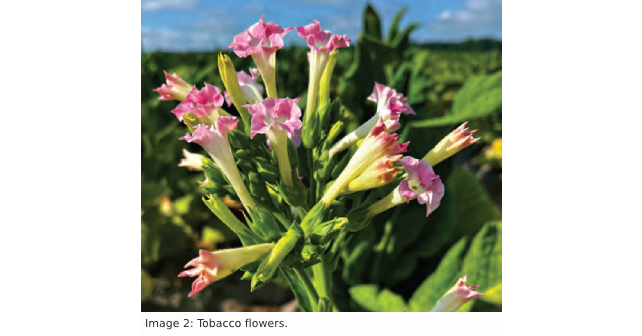
Tobacco (Nicotiana tabacum) is a member of the Nicotiana genus—a relative to the nightshade family (potato, tomato, eggplant, belladonna)—that originated in the Americas. It was used for medical, social, and religious purposes by Native Americans for millennia, and introduced to Europeans in 1492 through Columbus’ exchanged gifts of fruit, food, and leaves of the tobacco plant during his “discovery.”

Later, Jean Nicot de Villemain (1530-1604) introduced tobacco to the French royal court, and his name became synonymous with the plant—Nicotiana tabacum and “nicotine.” The word “tobacco” is derived from the Caribbean word “tabaco” and Spanish word “tobah”—the device used to inhale smoke from the plant.5

While there are over 75 Nicotiana species, N. tabacum and N. rustica are the major cultivated species for human use. N. rustica, “Aztec” or “Indian” tobacco, is considered to be the original species (evidence of its use has been found from over 8,000 years ago) from which other tobaccos were cultivated. The first commercial crop of N. tabacum, grown in Jamestown, Va., in 1612 by the colonist John Rolfe (Pocahontas’ husband), spread first to eastern North Carolina and quickly became an agricultural foundation of this country. George Washington’s 1765 complaint letter to his London agent about the low prices he was getting for his tobacco harvest is evidence of the founding father’s involvement in the crop: “… it be … a little mortifying … [to] raise none but Sweetscented Tobacco, and … meet with such unprofitable returns.”13 Tobacco remains today one of the most economically important industrial crops worldwide—about six trillion cigarettes worldwide are smoked each year; 6.68 million metric tons of tobacco were produced in 2019.12

Pages: 1 2 3 4 | Single Page

Topics: nicotinePoisonTobaccoToxin

Related

  • Toxicology Answer: Oil of Wintergreen

    October 28, 2025 - 0 Comment
  • Toxicology Question: What Minty Plant Oil Can Cause Poisoning and Death in Children?

    October 28, 2025 - 0 Comment
  • Toxin-Induced Hypotension Treatment Tips

    July 3, 2025 - 0 Comment

Current Issue

ACEP Now: November 2025

Download PDF

Read More

No Responses to “Toxicology Answer: The Pretty and Toxic Tobacco”

Leave a Reply Cancel Reply

Your email address will not be published. Required fields are marked *


*
*


Wiley
  • Home
  • About Us
  • Contact Us
  • Privacy
  • Terms of Use
  • Advertise
  • Cookie Preferences
Copyright © 2025 by John Wiley & Sons, Inc. All rights reserved, including rights for text and data mining and training of artificial technologies or similar technologies. ISSN 2333-2603
