
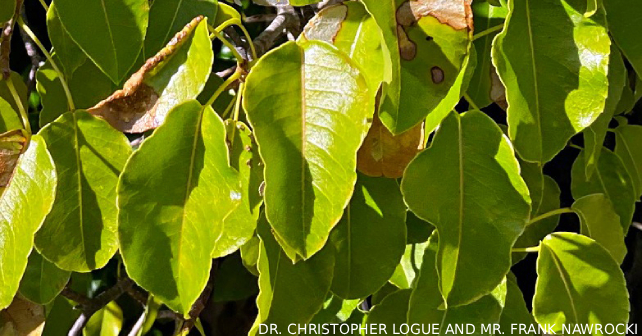
See the original question here.
Explore This Issue
ACEP Now: March 2026ANSWER: Manchineel tree
The manchineel tree (Hippomane mancinella, Manchineel, Tree of Death) is an aptly named tropical tree designated by the Guinness Book of World Records in 2011 as The Most Dangerous Tree — a plant whose bark is as bad as its bite.
H. mancinella is found widely in the Caribbean, coastal Mexico, West Africa, Puerto Rico, and some areas of Florida and the Virgin Islands. It forms dense groves primarily on beaches or in mangroves where its roots limit coastal erosion and provide nesting for birds and insects.
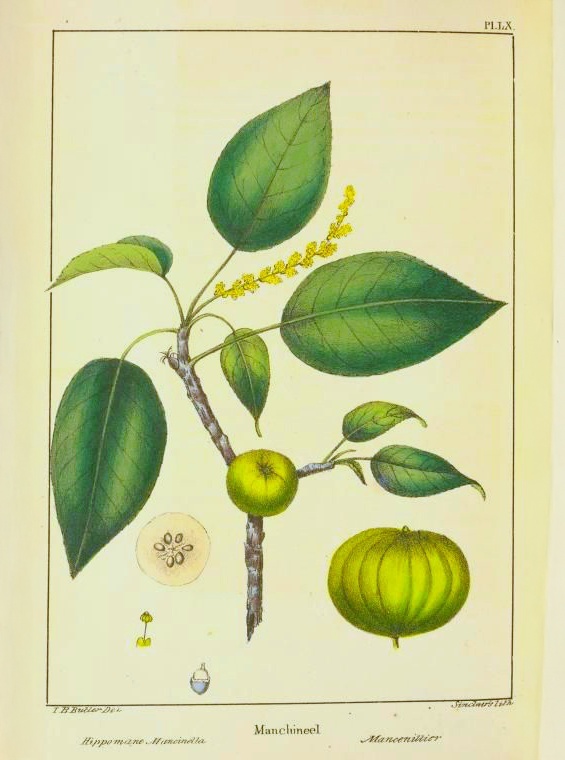
Leaves of the manchineel tree are deep green, pointed and oval, about 2-3 inches long with a deep central vein sulcus. Click to enlarge. (THOMAS NUTTALL, COURTESY OF THE NEW YORK PUBLIC LIBRARY.)
Plant description: The manchineel tree is an attractive tall shrub or round-topped tree that can reach 30 to 40 feet in height and grows in high-salt environments. The plant is identified by: bark that is brownish-grey, deeply furrowed, and smooth; leaves that are deep green, pointed, 2- to 3-inch ovate with a deep central vein sulcus; milky white sap or latex that leaks from any cuts or breaks in the plant; and fruits that are deeply green when ripe, often clustered, walnut-sized and round, and have a sweet smell if you take a whiff (but don’t do it).
Exposure
“The manchineel is one of the most notorious of all irritant trees…”.9 Every part of this plant is extremely toxic. Not only is this plant “don’t touch,” it is also a “don’t be near” organism. The sap is so irritating that people have sustained blistering and burns after seeking shelter under the tree from the rain by contact with the water-soluble diterpene ester-containing latex contaminating the leaf run-off or in the puddles beneath the tree; burning the wood or leaves results in ocular and pulmonary injury from the downwind exposure to the smoke and ash. The sawdust from fresh wood causes severe rhinitis and cough, and many cabinetmakers refuse to work with it.4
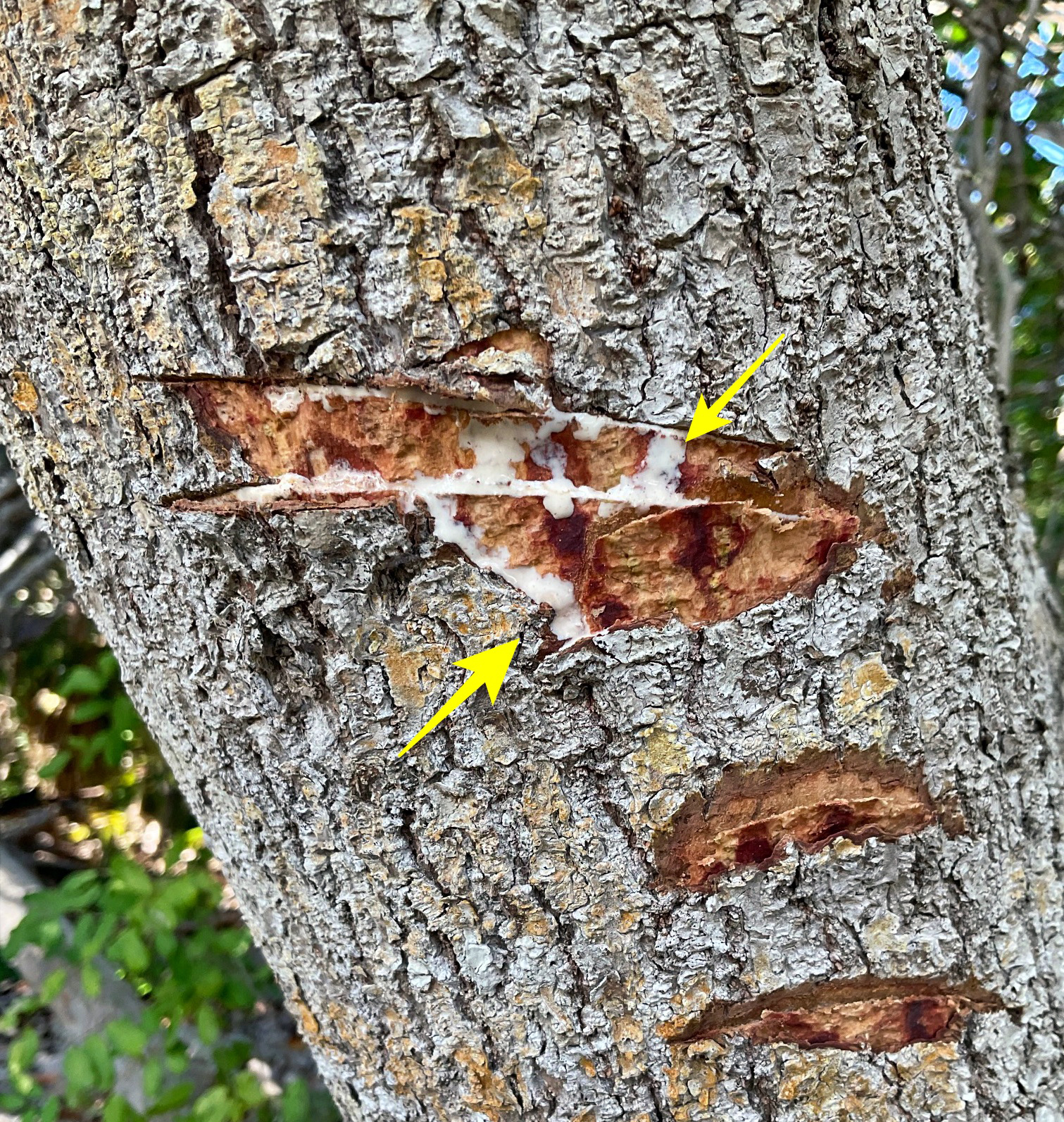
Beware the tree of death’s white, milky sap. Click to enlarge.
At Risk
The most frequently manchineel-exposed people described in the literature are 1) tourists, 2) woodcutters, 3) military troops, 4) manchineel researchers.
Toxins
Although many are listed, the most cited chemicals or compounds found in the manchineel includes diterpene esters (responsible for skin and eye irritation) and huratoxin, hippomanin A and B, and various phenolic compounds responsible for gastrointestinal (GI) and systemic toxicity. Physostigmine was initially thought to be present in the manchineel fruits, but this has not been borne out in subsequent reports.6 An analysis of the fruits in a study of 97 cases of manchineel fruit poisoning failed to identify physostigmine.2
Results of Exposure
Skin: Intense burning and itching begins within minutes of contact. The extent of subsequent injuries varies from “red swaths with pustulation” to bullous dermatitis.5 Because thickness of the skin (calluses) can delay onset of symptoms, asymptomatic sap-contaminated hands can transmit the latex to other sensitive areas; Bodeau reported two men having “…severe burning pain of the penis, [followed by] … total sphacelation of the skin and mucous membrane of the preputial sac … [followed later by] … desquamation in shreds of the mucous membrane of the glans penis.” This can last for weeks.1
Eyes: Immediate symptoms of lacrimation and burning pain with conjunctival irritation and lid swelling occur with transfer from hands or sweat tainted with the sap. More severe toxicity occurs with direct ocular exposure resulting in keratoconjunctivitis through direct epithelial cytotoxicity. A review article followed 19 patients with ocular injuries; 14 had both eyes affected; with corneal damage seen in most — varying from large corneal epithelial defects to superficial punctate keratitis. Most eye injuries healed completely, with only one exposure causing persistent corneal opacity.8
Aerodigestive tract: Eating the small, round, sweet-smelling green fruits is associated with severe GI effects, mucosal blistering, pharyngeal edema (requiring intubation or tracheostomy), vomiting, abdominal pain, diarrhea, and death.
Cardiovascular: Hypotension has been documented in animal models of exposure and bradycardia lasting up to 10 days from exposure has been documented, with one patient requiring a pacemaker.3, 7
Prevention
Key to prevention is broad public awareness campaigns primarily targeted at people unfamiliar with the tree (e.g., tourists) — warning signs, fences, and literature.
Treatment
The opportunity to limit toxicity is immediately after contact to shorten the time of exposure as much as possible. The most effective acute treatment is copious irrigation with soap and water or seawater if freshwater is unavailable.
Antidote: There are no known antidotes.
Historical Interest
The sap of this tree has been used to poison hunting and war darts and arrows, and the leaves were used to poison the water supply of enemies. Used as a form of torture; with victims tied to the tree. Explorer Christopher Columbus reportedly named it the “manzanilla de la muerte” (“little apple of death”) after several of his hungry sailors suffered severe symptoms after tasting the fruits.
 Dr. Hack is chief of the division of medical toxicology and vice chair for research at East Carolina University in Greenville, N.C.
References
- Bodeau. Apropos de quelques accidents dus au mancenillier. Arch. Med. Pharm. nay., 1936;126, 122.
- Boucaud-Maitre D, Cachet X, Bouzidi C, Riffault-Valois L, Dupuy C, Garnier R, Langrand J. Severity of manchineel fruit (Hippomane mancinella) poisoning: A retrospective case series of 97 patients from French Poison Control Centers. Toxicon. April 1, 2019;161:28-32. doi: 10.1016/j.toxicon.2019.02.014. Epub: February 28, 2019. PMID: 30826471.
- Carroll MN, Fox LE, Ariail WT . Investigation of the toxic principles of Hippomane mancinella L. III. Toxic actions of extracts of Hippomane mancinella L. Journal of the American Pharmaceutical Association. American Pharmaceutical Association.1957.
- Earle, KV Toxic effects of Hippomane mancinella. Transactions of the Royal Society for Tropical Medicine and Hygiene. 1938;32, 363.
- Howard RA, Arboretum A. Three Experiences with the Manchineel (Hippomane spp., Euphorbiaceae). Biotropica. 1981;13, 224.
- Lauter WM, Foote PA . Investigation of the toxic principles of Hippomane mancinella L. II. Preliminary isolation of a toxic principle of the fruit. J. Am. Pharm. Assoc. 1955;44, 361–363. doi:10.1002/jps.3030440616.
- Naranjo-Lara MJ, Naranjo-Lara P. Intoxicación por fruta de Hippomane mancinella, reporte de caso clínico. The Ecuador Journal of Medicine. 2021; 3(1):126-134.
- Pitts JF, Barker NH, Gibbons DC, Jay JL. Manchineel keratoconjunctivitis. Br J Ophthalmol. 1993;77(5):284-288. doi: 10.1136/bjo.77.5.284. PMID: 8318464; PMCID: PMC504506.
- Woods B, Calnan CD. Toxic woods. Br J Dermatol. 1976;94 (Suppl. 13):1-97.



No Responses to “Toxicology Answer: the Manchineel Tree”