Logo

Log In Sign Up |  An official publication of: American College of Emergency Physicians
Navigation
  • Home
  • Multimedia
    • Podcasts
    • Videos
  • Clinical
    • Airway Managment
    • Case Reports
    • Critical Care
    • Guidelines
    • Imaging & Ultrasound
    • Pain & Palliative Care
    • Pediatrics
    • Resuscitation
    • Trauma & Injury
  • Resource Centers
    • mTBI Resource Center
  • Career
    • Practice Management
      • Benchmarking
      • Reimbursement & Coding
      • Care Team
      • Legal
      • Operations
      • Quality & Safety
    • Awards
    • Certification
    • Compensation
    • Early Career
    • Education
    • Leadership
    • Profiles
    • Retirement
    • Work-Life Balance
  • Columns
    • ACEP4U
    • Airway
    • Benchmarking
    • Brief19
    • By the Numbers
    • Coding Wizard
    • EM Cases
    • End of the Rainbow
    • Equity Equation
    • FACEPs in the Crowd
    • Forensic Facts
    • From the College
    • Images in EM
    • Kids Korner
    • Medicolegal Mind
    • Opinion
      • Break Room
      • New Spin
      • Pro-Con
    • Pearls From EM Literature
    • Policy Rx
    • Practice Changers
    • Problem Solvers
    • Residency Spotlight
    • Resident Voice
    • Skeptics’ Guide to Emergency Medicine
    • Sound Advice
    • Special OPs
    • Toxicology Q&A
    • WorldTravelERs
  • Resources
    • ACEP.org
    • ACEP Knowledge Quiz
    • Issue Archives
    • CME Now
    • Annual Scientific Assembly
      • ACEP14
      • ACEP15
      • ACEP16
      • ACEP17
      • ACEP18
      • ACEP19
    • Annals of Emergency Medicine
    • JACEP Open
    • Emergency Medicine Foundation
  • About
    • Our Mission
    • Medical Editor in Chief
    • Editorial Advisory Board
    • Awards
    • Authors
    • Article Submission
    • Contact Us
    • Advertise
    • Subscribe
    • Privacy Policy
    • Copyright Information

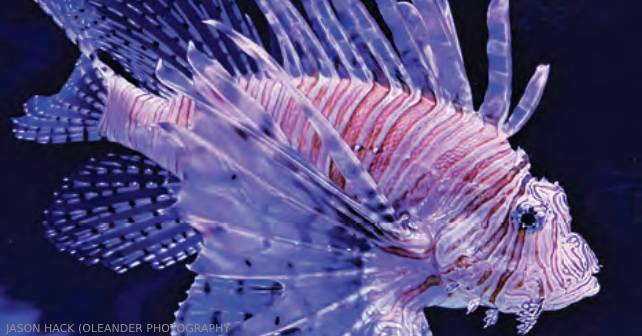
Toxicology Answer: the Lionfish, a Dangerous, Non-Native Invader

By Jason Hack, MD, FACEP | on August 9, 2024 | 0 Comment
Toxicology Q&A
  • Tweet
  • Click to email a link to a friend (Opens in new window) Email
Print-Friendly Version

Symptoms of Envenomation
You Might Also Like
  • Toxicology Q&A Answer: Beware the Black Widow!
  • Emergen-Sea Medicine Part 2: Overview of Marine Envenomations
  • Toxicology Answer: Milkweed (Asclepias)
Explore This Issue
ACEP Now: Vol 43 – No 08 – August 2024

People are most commonly stung in the

hand by the lionfish.

Local effects: Local effects of lionfish envenomation include severe localized pain, swelling, and potential tissue necrosis. Dermal wounds are classified into:

  • Grade I: local erythema, pallor, or cyanosis
  • Grade II: vesicles at the sting site
  • Grade III: local necrosis

Sensory alterations, such as anesthesia, paresthesia, or hypesthesia, can occur and may persist for weeks.8

Systemic Effects

Systemic effects are infrequent but can include nausea, diaphoresis, dyspnea, weakness, hypotension, and chills. More severe systemic reactions like delirium, seizures, limb paralysis, blood pressure changes, respiratory distress, dysrhythmia, myocardial ischemia, and syncope are rare.9

Pain

Extreme pain is a universal symptom of lionfish stings; it’s described as one of the most painful stings a person can receive from a marine creature.10

A survey study of more than 500 lionfish sting victims revealed that the immediate and intense pain caused by the sting extends radially from the wound, reaching its full potency after about one to two hours, and can continue for 24 hours or even weeks. This excruciating pain is described by many victims as a continuous burning, tingling, and numbness.1

Mechanism of Action

The pain-producing (algogenic) mechanisms of the lionfish venom are interesting. While bradykinin (found in the venom of the Hymenoptera order of insects) and capsaicin receptors (found in the venom of several tarantulas) do not contribute to the pain caused by the lionfish venom, it does contain hyaluronidases, acetylcholine (which causes swelling and inflammation), and other heat-labile peptides that have a specific excitatory effect in the central and peripheral nervous system and act almost exclusively on small-diameter nonpeptidergic nociceptors while nearby large-diameter neurons are unaffected.10 This nociceptor specificity likely developed evolutionarily as a defense mechanism to deter predators, not as a means to immobilize prey.11

Treatment for Lionfish Envenomation

Atkinson and colleagues performed a literature review on traditional treatments of marine envenomations, including vinegar, fig juice, boiled cactus, heated stones, hot urine, hot water, and ice.12 They concluded that the only effective pain treatment for fish spine injuries is to immerse the affected area in hot water.

Although not standardized, the most commonly suggested method is hot water (42-45 °C) immersion (hot but not scalding shower) for 30- 90 minutes or until the pain resolves.13 The heat is thought to either denature the venom, lessen the discomfort by causing a modulation of pain receptors, or both.

Pages: 1 2 3 4 | Single Page

Topics: PoisonToxinVenom

Related

  • Toxicology Answer: Oil of Wintergreen

    October 28, 2025 - 0 Comment
  • Toxicology Question: What Minty Plant Oil Can Cause Poisoning and Death in Children?

    October 28, 2025 - 0 Comment
  • Toxin-Induced Hypotension Treatment Tips

    July 3, 2025 - 0 Comment

Current Issue

ACEP Now: November 2025

Download PDF

Read More

No Responses to “Toxicology Answer: the Lionfish, a Dangerous, Non-Native Invader”

Leave a Reply Cancel Reply

Your email address will not be published. Required fields are marked *


*
*


Wiley
  • Home
  • About Us
  • Contact Us
  • Privacy
  • Terms of Use
  • Advertise
  • Cookie Preferences
Copyright © 2025 by John Wiley & Sons, Inc. All rights reserved, including rights for text and data mining and training of artificial technologies or similar technologies. ISSN 2333-2603
