
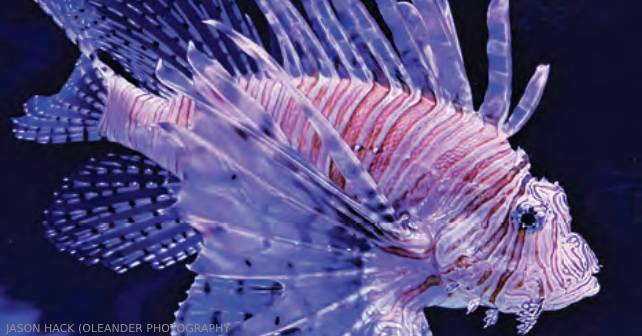
Lionfish (Pterois species) are members of the family Scorpaenidae, which includes lionfish (Pterois), scorpionfish (Scorpaena), and stonefish (Synanceia). They also are commonly called butterfly cod, firefish, peacock lionfish, and turkeyfish in some places.
Explore This Issue
ACEP Now: Vol 43 – No 08 – August 2024They deliver one of the most painful stings a human can receive from a marine creature. People are most commonly stung in the hand while snorkeling, diving, spearfishing, cooking them, or feeding them in aquaria.1
They are venomous, voracious piscivores that prey on small reef fish and crustaceans up to their own body size, and they naturally inhabit the Indo-Pacific oceans, living near corals, sea grass, or hard-bottomed areas. In 1985, they were spotted in Dania Beach, Fla., and have spread invasively with the sea currents up the East Coast of the United States (spotted in North Carolina in 2000) and into the Caribbean.2 The Pterois miles and volitans invasion exemplifies a bioinvasive species that was inadvertently introduced through anthropogenic corridors, such as trade, ballast water dumping, and unwanted pet disposal, into non-native areas where they have profound effects.
Lionfish are “perfect storm” invaders: Females can lay two million eggs a year; they grow faster than other species in the area; they have a very broad generalist diet and more tolerance for fasting than their competition; they are adaptable to many living environments, tolerating varying salinities and temperatures, for example; they have few to no natural predators in new areas that can bypass their anatomic defenses; and they have parasite resistance.3 These attributes allow them to kill or displace native species, causing profound changes and damage in these novel regional coastal ecosystems.4 Lionfish are one of the most ecologically harmful marine fish invasions to date.
Lionfish Anatomy
The dramatic striped fins of the lionfish hide a painful surprise for anyone who unwisely tries to pet or grab one of them. The red lionfish has 18 venomous spines (13 dorsal spines, two pelvic spines, and three anal spines). When threatened, the fish turns its back to the threat and assumes a defensive head down posture, frilling the dorsal spines. The pectoral (lateral chest) spines are not venomous.5
Spine Anatomy
In nature, spines are multifunctional biological materials that assist organisms in gripping, injecting, damaging, and defending. In lionfish, each spine consists of a rigid core spike that has three longitudinal grooves—in cross section, it’s tri-lobed and looks like a three-leaf clover—that contain embedded venom-producing glands wrapped in a “sheath” of tissue, presumably so the venom isn’t washed away. Unlike the keratin spines found in porcupines, hedgehogs, and echidnas, these central, needle-sharp, hard spikes are made of hydroxyapatite and collagen.5,6 When a spine punctures soft tissue, the pointy tip of the rigid core depresses, piercing the thin tissue sheath and jabbing the venom-filled grooves into the flesh.7 Depending on velocity of contact, this action can fracture the spike and leave foreign body fragments of the spine within the tissue.5,8 Interestingly, the break forms a new point that can be used for future defense.
Pages: 1 2 3 4 | Single Page



No Responses to “Toxicology Answer: the Lionfish, a Dangerous, Non-Native Invader”