Logo

Log In Sign Up |  An official publication of: American College of Emergency Physicians
Navigation
  • Home
  • Multimedia
    • Podcasts
    • Videos
  • Clinical
    • Airway Managment
    • Case Reports
    • Critical Care
    • Guidelines
    • Imaging & Ultrasound
    • Pain & Palliative Care
    • Pediatrics
    • Resuscitation
    • Trauma & Injury
  • Resource Centers
    • mTBI Resource Center
  • Career
    • Practice Management
      • Benchmarking
      • Reimbursement & Coding
      • Care Team
      • Legal
      • Operations
      • Quality & Safety
    • Awards
    • Certification
    • Compensation
    • Early Career
    • Education
    • Leadership
    • Profiles
    • Retirement
    • Work-Life Balance
  • Columns
    • ACEP4U
    • Airway
    • Benchmarking
    • Brief19
    • By the Numbers
    • Coding Wizard
    • EM Cases
    • End of the Rainbow
    • Equity Equation
    • FACEPs in the Crowd
    • Forensic Facts
    • From the College
    • Images in EM
    • Kids Korner
    • Medicolegal Mind
    • Opinion
      • Break Room
      • New Spin
      • Pro-Con
    • Pearls From EM Literature
    • Policy Rx
    • Practice Changers
    • Problem Solvers
    • Residency Spotlight
    • Resident Voice
    • Skeptics’ Guide to Emergency Medicine
    • Sound Advice
    • Special OPs
    • Toxicology Q&A
    • WorldTravelERs
  • Resources
    • ACEP.org
    • ACEP Knowledge Quiz
    • Issue Archives
    • CME Now
    • Annual Scientific Assembly
      • ACEP14
      • ACEP15
      • ACEP16
      • ACEP17
      • ACEP18
      • ACEP19
    • Annals of Emergency Medicine
    • JACEP Open
    • Emergency Medicine Foundation
  • About
    • Our Mission
    • Medical Editor in Chief
    • Editorial Advisory Board
    • Awards
    • Authors
    • Article Submission
    • Contact Us
    • Advertise
    • Subscribe
    • Privacy Policy
    • Copyright Information

Toxicology Answer: The Fig Tree

By Jason Hack, MD | on June 7, 2023 | 0 Comment
Toxicology Q&A
  • Tweet
  • Click to email a link to a friend (Opens in new window) Email
Print-Friendly Version

Favorites

My second favorite thing about the fig is that they are simple-appearing, but amazingly complex—very few things about this plant are straightforward.

You Might Also Like
  • Toxicology Answer: What Are the Side Effects of Chewing This Beautiful Bloom?
  • Toxicology Answer: What Flower Did the Greek Army Use Against a City?
  • Toxicology Answer: What toxin makes this pretty plant one to watch for—and avoid?
Explore This Issue
ACEP Now: Vol 42 – No 06 – June 2023

Its complexity is reflected in the descriptions one encounters when reading the scientific literature about figs. The volume and variety of strange, wonderful terms brings me back to the first year in medical school—a straight-up learning curve to try and wrap your head around.

Plant leaves are boring, except when it’s a fig leaf. A quote from Giordano’s 2020 paper about the fig’s leaf is a case in point. They analyzed leaves with light, confocal laser scanning, and electronic microscopes which revealed “Protective trichomes are located on both [leaf] surfaces while capitate secretive hairs and stomata appear only abaxially.” The fig uses ground-water-absorbed silicate to create a crystalline scaffolding “armor” (assisted by the calcium oxalate inclusions) that strengthen the leaf, protect delicate cells from the sun, and act as defense for hungry insects and herbivores.2

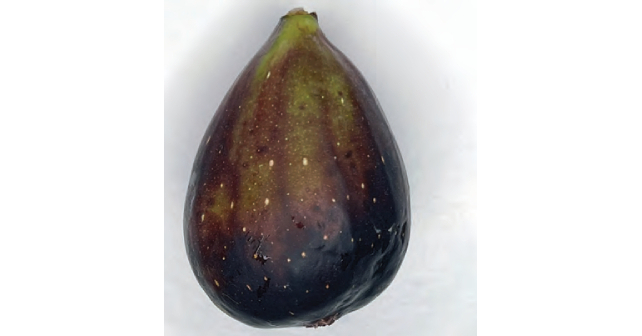
FIGURE 2: The fruit itself is

anatomically a hollow-ended stem that swells

to contain many flowers. (Click to enlarge.)

The fig “fruit” is another example of simple hidden complexity. Although called a fruit, it is actually an infructescence (an urn-like structure lined internally with tiny flowers that develop into multiple ovaries on the inside surface), also known as a false fruit or multiple fruit. The fruit itself is anatomically a hollow-ended stem that swells to contain many flowers. Think of that next time you take a bite! (see Figure 2)

And don’t get me started on how the fig is pollinated in the wild—no fuzzy bumblebee for this plant. Instead, it is a classic example of obligate mutualism, where each type of fig relies on a specific type of fig wasp (Blastophaga psenes) for their mutual survival. A female wasp, attracted to the plant by the odor that the leaves emit, enters the fruiting body with pollen attached to her from her hatchery, fertilizes the internal flowers, and lays her eggs; but it’s a one-way trip, because her wings and antennae are ripped off as she enters the fig’s infructescence due to the narrow entry passage.

She lives out the rest of her days inside the fruit. The eggs hatch and the males mate with their sisters and tunnel out of the fruit; the newly hatched and fertilized females leave through these open tunnels carrying their incubator’s pollen and begin to search for their own fig fruit. Any remaining wasps are digested and absorbed by the fruit using ficin (a special fig-produced wasp dissolvent) for nutrients.

Pages: 1 2 3 | Single Page

Topics: PoisonToxin

Related

  • Toxicology Answer: Oil of Wintergreen

    October 28, 2025 - 0 Comment
  • Toxicology Question: What Minty Plant Oil Can Cause Poisoning and Death in Children?

    October 28, 2025 - 0 Comment
  • Toxin-Induced Hypotension Treatment Tips

    July 3, 2025 - 0 Comment

Current Issue

ACEP Now: November 2025

Download PDF

Read More

No Responses to “Toxicology Answer: The Fig Tree”

Leave a Reply Cancel Reply

Your email address will not be published. Required fields are marked *


*
*


Wiley
  • Home
  • About Us
  • Contact Us
  • Privacy
  • Terms of Use
  • Advertise
  • Cookie Preferences
Copyright © 2025 by John Wiley & Sons, Inc. All rights reserved, including rights for text and data mining and training of artificial technologies or similar technologies. ISSN 2333-2603
