Logo

Log In Sign Up |  An official publication of: American College of Emergency Physicians
Navigation
  • Home
  • Multimedia
    • Podcasts
    • Videos
  • Clinical
    • Airway Managment
    • Case Reports
    • Critical Care
    • Guidelines
    • Imaging & Ultrasound
    • Pain & Palliative Care
    • Pediatrics
    • Resuscitation
    • Trauma & Injury
  • Resource Centers
    • mTBI Resource Center
  • Career
    • Practice Management
      • Benchmarking
      • Reimbursement & Coding
      • Care Team
      • Legal
      • Operations
      • Quality & Safety
    • Awards
    • Certification
    • Compensation
    • Early Career
    • Education
    • Leadership
    • Profiles
    • Retirement
    • Work-Life Balance
  • Columns
    • ACEP4U
    • Airway
    • Benchmarking
    • Brief19
    • By the Numbers
    • Coding Wizard
    • EM Cases
    • End of the Rainbow
    • Equity Equation
    • FACEPs in the Crowd
    • Forensic Facts
    • From the College
    • Images in EM
    • Kids Korner
    • Medicolegal Mind
    • Opinion
      • Break Room
      • New Spin
      • Pro-Con
    • Pearls From EM Literature
    • Policy Rx
    • Practice Changers
    • Problem Solvers
    • Residency Spotlight
    • Resident Voice
    • Skeptics’ Guide to Emergency Medicine
    • Sound Advice
    • Special OPs
    • Toxicology Q&A
    • WorldTravelERs
  • Resources
    • ACEP.org
    • ACEP Knowledge Quiz
    • Issue Archives
    • CME Now
    • Annual Scientific Assembly
      • ACEP14
      • ACEP15
      • ACEP16
      • ACEP17
      • ACEP18
      • ACEP19
    • Annals of Emergency Medicine
    • JACEP Open
    • Emergency Medicine Foundation
  • About
    • Our Mission
    • Medical Editor in Chief
    • Editorial Advisory Board
    • Awards
    • Authors
    • Article Submission
    • Contact Us
    • Advertise
    • Subscribe
    • Privacy Policy
    • Copyright Information

Toxicology Answer: The Capsaicin Found in Hot Peppers and Chilis

By Jason Hack, MD | on April 2, 2024 | 0 Comment
Toxicology Q&A
  • Tweet
  • Click to email a link to a friend (Opens in new window) Email
Print-Friendly Version

You Might Also Like
  • Toxicology Answer: What Are the Side Effects of Chewing This Beautiful Bloom?
  • Toxicology Answer: What toxin makes this pretty plant one to watch for—and avoid?
  • Toxicology Answer: The Periwinkle
Explore This Issue
ACEP Now: Vol 43 – No 04 – April 2024

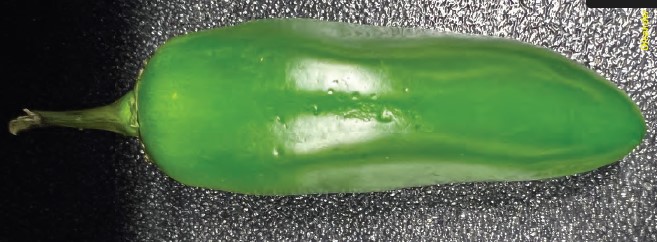
A jalapeno pepper.


The concentration of these chemicals determines degree of the sensation and depends not only on the kind of chili, but on other factors including what part of the fruit you eat—the hottest part is the placenta (white part in the middle), followed by the flesh (exocarp, mesocarp, endocarp) and the seeds; fruit maturity and water content of the chili also affect pungency (unripe—ripe—dried).

In nature, the capsaicin is primarily used by the plant for defense to inhibit herbivorous mammals from eating it—the spice does not affect birds who eat the fruit and spread the seeds.

Mechanism of Action

Capsaicinoids are irritants and inflammatory molecules that interact with transient receptor potential vanilloid 1 (TRPV1) that reside on the ends of nociceptive A-delta and C- sensory fibers. These receptors are activated by capsaicinoids, noxious heat (greater than 109.4 degress Fahrenheit), caustics (low pH), and voltage—causing a Ca++ and Na+ action potential influx that confers the sensation of pain and burning to the brain. They are found in large numbers in the mouth, throat, and stomach, as well as throughout the body.3

Sensation, Not Taste

Capsaicin and the capsaicinoids are not detected by our taste buds and have no flavor—not salt, bitter, sweet, sour, or umami. They create a chemesthesis stimulus we interpret as “spiciness,” which is a multimodal somatic sensation (not just taste, olfaction, pain, temperature, or itch). The resultant “heat” we feel after exposure is not thermally hot (a thermometer in my scorched mouth would read normal), but a result of the cross-stimulation of these vanilloid molecules binding to a thermal receptor—the sensory experience transmitted centrally is interpreted as ‘burning.4

Despite not being a taste, a five part standardized lexicon for chili pepper hotness exists:1

  • Development (how fast it comes on)
  • Duration (how long the burn lasts)
  • Location (where in mouth/throat)
  • Feeling (“sharp” vs. “flat” heat)
  • Intensity (analytically measured heat level)

Capsaicin has a unique attribute among natural irritants—the excitation it evokes is followed by a period of decline or cessation in sensory transmission (called defunctionalisation) for a variety of other stimuli. This attribute is exploited by frequent eaters of spicy foods (they don’t feel it as much as novices), and pharmaceutical products.5

Human Effects

The human response to capsaicin exposure ranges from enhancing food enjoyment to uncomfortable to unbearable depending on the dose of exposure and resultant receptor agonism. Oral exposure creates a spicy burning sensation (or pungency) in the mouth that can extend to the throat and stomach (and eventually the rectum—“fire tuchus”). This is frequently accompanied by diaphoresis, facial flushing, lacrimation, and rhinorrhea. Higher dose exposures to the irritant can result in nausea, vomiting, chest, and abdominal pain.

Pages: 1 2 3 4 | Single Page

Topics: capsaicinpeppers

Related

  • Toxicology Question: What Fiery Ingredient Brings Tears to Your Eyes and Irritation Upon Exposure?

    April 1, 2024 - 0 Comment
  • Drugs for Immediate Relief of Cannabinoid Hyperemesis Syndrome

    February 24, 2021 - 3 Comments

Current Issue

ACEP Now: November 2025

Download PDF

Read More

No Responses to “Toxicology Answer: The Capsaicin Found in Hot Peppers and Chilis”

Leave a Reply Cancel Reply

Your email address will not be published. Required fields are marked *


*
*


Wiley
  • Home
  • About Us
  • Contact Us
  • Privacy
  • Terms of Use
  • Advertise
  • Cookie Preferences
Copyright © 2025 by John Wiley & Sons, Inc. All rights reserved, including rights for text and data mining and training of artificial technologies or similar technologies. ISSN 2333-2603
