Logo

Log In Sign Up |  An official publication of: American College of Emergency Physicians
Navigation
  • Home
  • Multimedia
    • Podcasts
    • Videos
  • Clinical
    • Airway Managment
    • Case Reports
    • Critical Care
    • Guidelines
    • Imaging & Ultrasound
    • Pain & Palliative Care
    • Pediatrics
    • Resuscitation
    • Trauma & Injury
  • Resource Centers
    • mTBI Resource Center
  • Career
    • Practice Management
      • Benchmarking
      • Reimbursement & Coding
      • Care Team
      • Legal
      • Operations
      • Quality & Safety
    • Awards
    • Certification
    • Compensation
    • Early Career
    • Education
    • Leadership
    • Profiles
    • Retirement
    • Work-Life Balance
  • Columns
    • ACEP4U
    • Airway
    • Benchmarking
    • Brief19
    • By the Numbers
    • Coding Wizard
    • EM Cases
    • End of the Rainbow
    • Equity Equation
    • FACEPs in the Crowd
    • Forensic Facts
    • From the College
    • Images in EM
    • Kids Korner
    • Medicolegal Mind
    • Opinion
      • Break Room
      • New Spin
      • Pro-Con
    • Pearls From EM Literature
    • Policy Rx
    • Practice Changers
    • Problem Solvers
    • Residency Spotlight
    • Resident Voice
    • Skeptics’ Guide to Emergency Medicine
    • Sound Advice
    • Special OPs
    • Toxicology Q&A
    • WorldTravelERs
  • Resources
    • ACEP.org
    • ACEP Knowledge Quiz
    • Issue Archives
    • CME Now
    • Annual Scientific Assembly
      • ACEP14
      • ACEP15
      • ACEP16
      • ACEP17
      • ACEP18
      • ACEP19
    • Annals of Emergency Medicine
    • JACEP Open
    • Emergency Medicine Foundation
  • About
    • Our Mission
    • Medical Editor in Chief
    • Editorial Advisory Board
    • Awards
    • Authors
    • Article Submission
    • Contact Us
    • Advertise
    • Subscribe
    • Privacy Policy
    • Copyright Information

Toxicology Answer: Can This Toxic Plant Treat Certain Illnesses?

By Jason Hack, MD | on September 25, 2018 | 0 Comment
Toxicology Q&A
  • Tweet
  • Click to email a link to a friend (Opens in new window) Email
Print-Friendly Version
Pokeweed Phytolacca americana Common names: Poke, pokebush, pokeberry, pokeroot, poke sallet, inkberry, cancer root, American nightshade, pigeon berry.

You Might Also Like
  • Toxicology Question: Can This Toxic Plant Treat Certain Illnesses?
  • Toxicology Q&A Answer: Yes, the Amanita Muscaria Mushroom Is Toxic
  • Toxicology Q&A Answer: Castor Beans Can Kill, and the Oil Is Iffy, Too
Explore This Issue
ACEP Now: Vol 37 – No 09 – September 2018

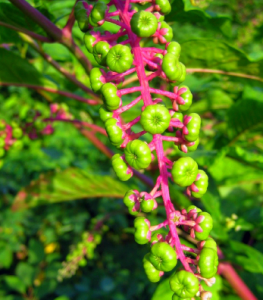
Pokeweed
Phytolacca americana
Common names: Poke, pokebush, pokeberry, pokeroot, poke sallet, inkberry, cancer root, American nightshade, pigeon berry.
PHOTO: Jason Hack (Oleander Photography)

Click here for question.

Answer: Yes. Pokeweed has been shown in nonhuman studies to have anti-tumor properties and to have activity against herpes viruses and HIV.

Toxins

All parts of the mature pokeweed plant contain toxins, but the root is most toxic. The effects of this plant on biological systems are many due to the large number of toxins present. These include:

  • Alkaloids: betanidine, betanine, phytolaccine, and prebetanine
  • Lectins: pokeweed mitogen glycoproteins
  • Saponins: phytolaccosides, jaligonic acid, phytolaccagenic acid, and aesculentic acid
  • Isoamericanin A
  • Pokeweed antiviral protein (PAP)
  • Alpha-spinasterol
  • Histamine
  • GABA phytolaccatoxin and related triterpene saponins

Symptoms

Ingestion can cause nausea, vomiting, diarrhea, abdominal cramps, headaches, blurred vision, confusion, dermatitis, dizziness, and weakness. Convulsions, low blood pressure, rapid heartbeat, heart block, and death may occur. Children have been poisoned by eating raw pokeweed berries, and although rare, death may occur.

Facts

Used by Native Americans as an herbal cure, pokeweed has been found to contain PAP, which has anti-tumor effects in mice and laboratory studies.

Pokeweed mitogen (mitogens are substances that stimulate cell division, or mitosis) is a lectin that causes both an increase in the numbers of lymphocytes and erythrocyte agglutination (clumping). These glycoproteins are used to study white blood cell function.

In test tube studies, PAP has also shown action against viruses such as herpes and HIV. Clinical trials have not yet determined whether these effects are seen in humans.

Young pokeweed shoots, which contain very low levels of toxins, are eaten as poke salad (poke salat) in traditional southern U.S. cuisine. It is thoroughly boiled in water that is changed twice during cooking to remove the toxins.

Pokeweed is found growing wild throughout many areas of the United States.

It goes through a rainbow of colors during its maturation. Young fruiting stems are initially white with green buttons. Fruits become mottled and finally turn black while the stems turn a striking red-pink color. All of this is contrasted by deep green leaves.

Topics: nightshadepigeon berryPoisonpokebushpokeweedToxicology

Related

  • Case Report: Massive Amitriptyline and Bupropion Ingestion

    October 29, 2025 - 0 Comment
  • Toxicology Answer: Oil of Wintergreen

    October 28, 2025 - 0 Comment
  • Toxicology Question: What Minty Plant Oil Can Cause Poisoning and Death in Children?

    October 28, 2025 - 0 Comment

Current Issue

ACEP Now: November 2025

Download PDF

Read More

About the Author

Jason Hack, MD

Dr. Hack (Oleander Photography) is chief of the division of medical toxicology and vice chair for research at East Carolina University in Greenville, North Carolina. He enjoys taking photographs of beautiful toxic, medicinal, and benign flowers that he stumbles upon or grows in his garden. Contact him at ToxInRI@gmail.com, www.toxinRI.com, or on Instagram @oleanderphotography.

View this author's posts »

No Responses to “Toxicology Answer: Can This Toxic Plant Treat Certain Illnesses?”

Leave a Reply Cancel Reply

Your email address will not be published. Required fields are marked *


*
*


Wiley
  • Home
  • About Us
  • Contact Us
  • Privacy
  • Terms of Use
  • Advertise
  • Cookie Preferences
Copyright © 2025 by John Wiley & Sons, Inc. All rights reserved, including rights for text and data mining and training of artificial technologies or similar technologies. ISSN 2333-2603