Logo

Log In Sign Up |  An official publication of: American College of Emergency Physicians
Navigation
  • Home
  • Multimedia
    • Podcasts
    • Videos
  • Clinical
    • Airway Managment
    • Case Reports
    • Critical Care
    • Guidelines
    • Imaging & Ultrasound
    • Pain & Palliative Care
    • Pediatrics
    • Resuscitation
    • Trauma & Injury
  • Resource Centers
    • mTBI Resource Center
  • Career
    • Practice Management
      • Benchmarking
      • Reimbursement & Coding
      • Care Team
      • Legal
      • Operations
      • Quality & Safety
    • Awards
    • Certification
    • Compensation
    • Early Career
    • Education
    • Leadership
    • Profiles
    • Retirement
    • Work-Life Balance
  • Columns
    • ACEP4U
    • Airway
    • Benchmarking
    • Brief19
    • By the Numbers
    • Coding Wizard
    • EM Cases
    • End of the Rainbow
    • Equity Equation
    • FACEPs in the Crowd
    • Forensic Facts
    • From the College
    • Images in EM
    • Kids Korner
    • Medicolegal Mind
    • Opinion
      • Break Room
      • New Spin
      • Pro-Con
    • Pearls From EM Literature
    • Policy Rx
    • Practice Changers
    • Problem Solvers
    • Residency Spotlight
    • Resident Voice
    • Skeptics’ Guide to Emergency Medicine
    • Sound Advice
    • Special OPs
    • Toxicology Q&A
    • WorldTravelERs
  • Resources
    • ACEP.org
    • ACEP Knowledge Quiz
    • Issue Archives
    • CME Now
    • Annual Scientific Assembly
      • ACEP14
      • ACEP15
      • ACEP16
      • ACEP17
      • ACEP18
      • ACEP19
    • Annals of Emergency Medicine
    • JACEP Open
    • Emergency Medicine Foundation
  • About
    • Our Mission
    • Medical Editor in Chief
    • Editorial Advisory Board
    • Awards
    • Authors
    • Article Submission
    • Contact Us
    • Advertise
    • Subscribe
    • Privacy Policy
    • Copyright Information

Toxicology Answer: An Illustrated Case of Ethylene Glycol, Direct and Indirect

By Jason Hack, MD | on October 10, 2023 | 0 Comment
Toxicology Q&A
  • Tweet
  • Click to email a link to a friend (Opens in new window) Email
Print-Friendly Version

Anion gap metabolic acidosis: if this is large—very bad (indirect evidence). The toxic metabolites of EG ingestions are what cause the acidosis (glycolic, glyoxylic, and oxalic acids as well as lactate) and present later in the ingestion after EG is metabolized to these bad actors. Once there is an anion gap, the horse has left the barn and the remaining definitive treatment is hemodialysis. Additionally, anion gap acidoses occur for other reasons (recall the mnemonic MUDPILES: methanol, uremia, diabetic or alcoholic ketoacidosis, paraldehyde, isoniazid, lactic acidosis, ethanol/ethylene glycol, or salicylates).

You Might Also Like
  • Toxicology Q&A Answer: Castor Beans Can Kill, and the Oil Is Iffy, Too
  • Toxicology Q&A Answer: Yes, the Amanita Muscaria Mushroom Is Toxic
  • Toxicology Answer: the Lovely Lily of the Valley
Explore This Issue
ACEP Now: Vol 42 – No 10 – October 2023

Urine crystals: presence of octahedral or needle-shaped calcium oxalate crystals in the urine—very bad (direct finding). The precipitation of oxalate crystals in the renal tubular lumen resulting in blockage is the primary cause of renal injury. Unfortunately, urinary crystal absence does not rule out EG ingestion.5
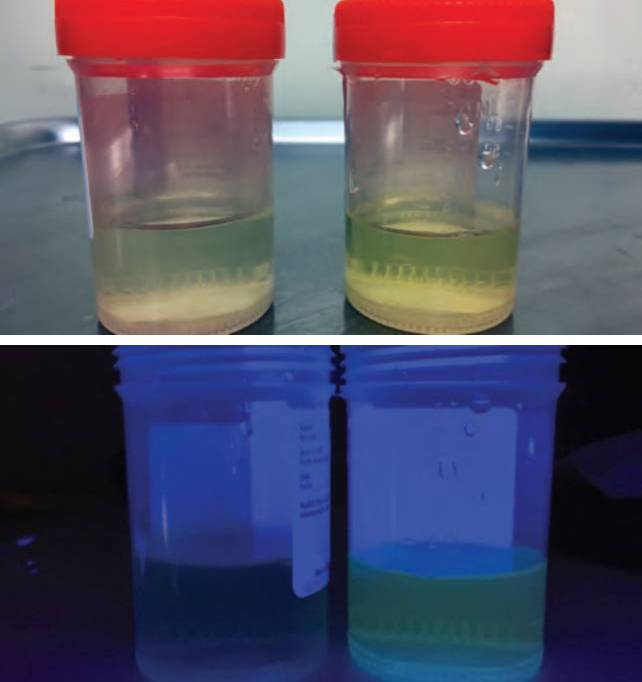
FIGURES 1A and 1B: Comparison of physician’s (LEFT) and patient’s urine (RIGHT) under normal light (TOP) and under Wood’s lamp (ABOVE) in urine cups. (Click to enlarge.)


Urine fluorescence: if the urine is fluorescent—very bad (direct finding). Sodium fluorescein (uranine yellow), is a fluorescent dye that is added to some commercial antifreeze preparations to assist in the location of engine coolant leaks. It is found in concentrations typically between 15 and 20 μg/mL.6 It causes a yellowish-green fluorescence that is visually detectable to a lower limit of 20 ng/mL in liquid when exposed to ultraviolet light.7

In medicine, the application of Wood’s lamp produces light photons in the ultraviolet light wavelength spectrum, in a range between 320 nm and 400 nm with a peak at 365 nm. When a substance absorbs light or energy (photons) from one source, its own photons get excited; when these excited photons relax they produce (emit) light of a different color. The re-emitted photons, or fluorescence, have no heat, a longer wavelength, lower energy, and a different color that disappears when the exciting light is removed. This light reaction is used in medicine for many purposes, including detection of dermatologic abnormalities in skin and nails by making them glow, such as dermatophytes (Tinea versicolor, etc.), bacterial infections (Pseudomonas, etc.) and porphyria (porphyria cutanea tarda, etc.). It is also used in ophthalmologic diagnostics of retinal vasculature imaging and corneal insult assessment. Other uses include detection of scorpions and semen. Urine may also fluoresce under this “blacklight” after ingestion of riboflavin and niacin, amoxicillin, and carbamazepine.8

Pages: 1 2 3 4 | Single Page

Topics: antifreezeCase ReportsClinicalpolyethylene glycol

Related

  • Non-Invasive Positive Pressure Ventilation in the Emergency Department

    October 1, 2025 - 0 Comment
  • Emergency Department Management of Prehospital Tourniquets

    October 1, 2025 - 0 Comment
  • ACEP’s October 2025 Poll: How Often Do You Read Your Own X-Rays?

    September 30, 2025 - 0 Comment

Current Issue

ACEP Now: November 2025

Download PDF

Read More

No Responses to “Toxicology Answer: An Illustrated Case of Ethylene Glycol, Direct and Indirect”

Leave a Reply Cancel Reply

Your email address will not be published. Required fields are marked *


*
*


Wiley
  • Home
  • About Us
  • Contact Us
  • Privacy
  • Terms of Use
  • Advertise
  • Cookie Preferences
Copyright © 2025 by John Wiley & Sons, Inc. All rights reserved, including rights for text and data mining and training of artificial technologies or similar technologies. ISSN 2333-2603
