
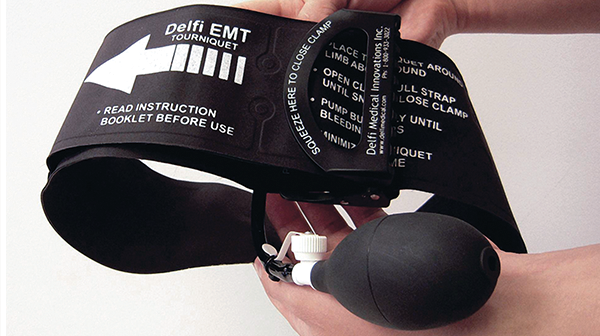
We recommend the use of tourniquets in the prehospital setting for the control of significant extremity hemorrhage if direct pressure is ineffective or impractical.1
Explore This Issue
ACEP Now: Vol 34 – No 08 – August 2015The guidelines stated that “the panel believes that tourniquets used to treat severe extremity hemorrhage have a clear survival benefit, demonstrated by a large and consistent effect size across several studies.”1 This was the only recommendation that the ACS Committee on Trauma identified as a strong recommendation based on the available evidence.
The remainder of the tourniquet-focused recommendations addressed differences in tourniquet efficiency, safety, and practice procedures. The following were all classified as weak recommendations with low quality of evidence to support the statements:
We suggest using commercially produced windlass, pneumatic, or ratcheting devices that have been demonstrated to occlude arterial flow.
We suggest against the use of narrow, elastic, or bungee-type devices.
We suggest that improvised tourniquets be applied only if no commercial device is available.
We suggest against releasing a tourniquet that has been properly applied in the prehospital setting until the patient has reached definitive care.1
Because there are no studies that directly address differences between tourniquets or timing for removal, the evidence quality was graded as low and the resulting recommendations were classed weak recommendations.
The committee also sought to provide recommendations on prehospital use of hemostatic agents. In the seven studies identified, gunshot wounds dominated as the primary source of bleeding requiring hemostatic control. The following recommendations are also classified as weak recommendations with a low quality of evidence.
We suggest the use of topical hemostatic agents, in combination with direct pressure, for the control of significant hemorrhage in the prehospital setting in anatomic areas where tourniquets cannot be applied and where sustained direct pressure alone is ineffective or impractical.
We suggest that topical hemostatic agents be delivered in a gauze format that supports wound packing.
Only products determined effective and safe in a standardized laboratory injury model should be used.1
Overall, the ACS Committee on Trauma clearly favors use of tourniquets and hemostatic agents for extremity and junctional hemorrhage that is uncontrollable with direct pressure. There is still much research that needs to be performed to enhance our knowledge of the risks and benefits of tourniquet use.
Dr. Pierce is a new attending at St. Thomas Rutherford Hospital in Murfreesboro, Tennessee. He wrote this article as the 2014–2015 EMRA representative to the ACEP Clinical Policies Committee while finishing residency at the University of Virginia.
References
- Bulger EM, Snyder D, Schoelles K, et al. An evidence-based prehospital guideline for external hemorrhage control: American College of Surgeons Committee on Trauma. Prehosp Emerg Care. 2014;18:163-173.
- Kauvar DS, Sarfati MR, Kraiss LW. National trauma databank analysis of mortality and limb loss in isolated lower extremity vascular trauma. J Vasc Surg. 2011;53:1598-1603.
- American Academy of Pediatrics; American College of Emergency Physicians; American College of Surgeons Committee on Trauma; Emergency Medical Services for Children; Emergency Nurses Association; National Association of EMS Physicians; National Association of State EMS Officials. Equipment for ground ambulances. Prehosp Emerg Care. 2014;18;92-97.
Pages: 1 2 3 | Single Page



No Responses to “Tourniquet Use Recommendations from the American College of Surgeons”