Logo

Log In Sign Up |  An official publication of: American College of Emergency Physicians
Navigation
  • Home
  • Multimedia
    • Podcasts
    • Videos
  • Clinical
    • Airway Managment
    • Case Reports
    • Critical Care
    • Guidelines
    • Imaging & Ultrasound
    • Pain & Palliative Care
    • Pediatrics
    • Resuscitation
    • Trauma & Injury
  • Resource Centers
    • mTBI Resource Center
  • Career
    • Practice Management
      • Benchmarking
      • Reimbursement & Coding
      • Care Team
      • Legal
      • Operations
      • Quality & Safety
    • Awards
    • Certification
    • Compensation
    • Early Career
    • Education
    • Leadership
    • Profiles
    • Retirement
    • Work-Life Balance
  • Columns
    • ACEP4U
    • Airway
    • Benchmarking
    • Brief19
    • By the Numbers
    • Coding Wizard
    • EM Cases
    • End of the Rainbow
    • Equity Equation
    • FACEPs in the Crowd
    • Forensic Facts
    • From the College
    • Images in EM
    • Kids Korner
    • Medicolegal Mind
    • Opinion
      • Break Room
      • New Spin
      • Pro-Con
    • Pearls From EM Literature
    • Policy Rx
    • Practice Changers
    • Problem Solvers
    • Residency Spotlight
    • Resident Voice
    • Skeptics’ Guide to Emergency Medicine
    • Sound Advice
    • Special OPs
    • Toxicology Q&A
    • WorldTravelERs
  • Resources
    • ACEP.org
    • ACEP Knowledge Quiz
    • Issue Archives
    • CME Now
    • Annual Scientific Assembly
      • ACEP14
      • ACEP15
      • ACEP16
      • ACEP17
      • ACEP18
      • ACEP19
    • Annals of Emergency Medicine
    • JACEP Open
    • Emergency Medicine Foundation
  • About
    • Our Mission
    • Medical Editor in Chief
    • Editorial Advisory Board
    • Awards
    • Authors
    • Article Submission
    • Contact Us
    • Advertise
    • Subscribe
    • Privacy Policy
    • Copyright Information

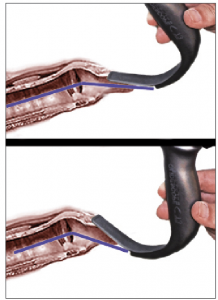
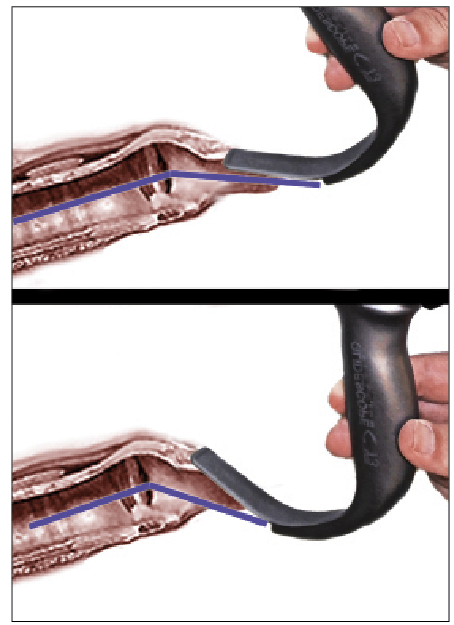
Figure 2 (Right). Schematic representation of the angle of approach. The top image shows ideal placement of a hyperangulated blade—in this case, a GlideScope Titanium blade—compared to overinsertion (bottom image). Note that the approach angle is more acute and that there is less room for tube delivery between the blade and the larynx.
By Joseph Harrington | on December 15, 2015 | 0 Comment
Print-Friendly Version

Figure 2 (Right). Schematic representation of the angle of approach. The top image shows ideal placement of a hyperangulated blade—in this case, a GlideScope Titanium blade—compared to overinsertion (bottom image). Note that the approach angle is more acute and that there is less room for tube delivery between the blade and the larynx.

You Might Also Like
  • Tips for Using a Hyperangulated Video Laryngoscope
  • Four Techniques for Handling the Omega-Shaped Epiglottis
  • Use Bolt Cutters to Remove a Constricted Titanium Ring

Figure 2 (Right). Schematic representation of the angle of approach. The top image shows ideal placement of a hyperangulated blade—in this case, a GlideScope Titanium blade—compared to overinsertion (bottom image). Note that the approach angle is more acute and that there is less room for tube delivery between the blade and the larynx.

Current Issue

ACEP Now: December 2025 (Digital)

Read More

About the Author

Joseph Harrington

View this author's posts »

No Responses to “Figure 2 (Right). Schematic representation of the angle of approach. The top image shows ideal placement of a hyperangulated blade—in this case, a GlideScope Titanium blade—compared to overinsertion (bottom image). Note that the approach angle is more acute and that there is less room for tube delivery between the blade and the larynx.”

Leave a Reply Cancel Reply

Your email address will not be published. Required fields are marked *


*
*


Current Issue

ACEP Now: December 2025 (Digital)

Read More

Wiley
  • Home
  • About Us
  • Contact Us
  • Privacy
  • Terms of Use
  • Advertise
  • Cookie Preferences
Copyright © 2025 by John Wiley & Sons, Inc. All rights reserved, including rights for text and data mining and training of artificial technologies or similar technologies. ISSN 2333-2603