Logo

Log In Sign Up |  An official publication of: American College of Emergency Physicians
Navigation
  • Home
  • Multimedia
    • Podcasts
    • Videos
  • Clinical
    • Airway Managment
    • Case Reports
    • Critical Care
    • Guidelines
    • Imaging & Ultrasound
    • Pain & Palliative Care
    • Pediatrics
    • Resuscitation
    • Trauma & Injury
  • Resource Centers
    • mTBI Resource Center
  • Career
    • Practice Management
      • Benchmarking
      • Reimbursement & Coding
      • Care Team
      • Legal
      • Operations
      • Quality & Safety
    • Awards
    • Certification
    • Compensation
    • Early Career
    • Education
    • Leadership
    • Profiles
    • Retirement
    • Work-Life Balance
  • Columns
    • ACEP4U
    • Airway
    • Benchmarking
    • Brief19
    • By the Numbers
    • Coding Wizard
    • EM Cases
    • End of the Rainbow
    • Equity Equation
    • FACEPs in the Crowd
    • Forensic Facts
    • From the College
    • Images in EM
    • Kids Korner
    • Medicolegal Mind
    • Opinion
      • Break Room
      • New Spin
      • Pro-Con
    • Pearls From EM Literature
    • Policy Rx
    • Practice Changers
    • Problem Solvers
    • Residency Spotlight
    • Resident Voice
    • Skeptics’ Guide to Emergency Medicine
    • Sound Advice
    • Special OPs
    • Toxicology Q&A
    • WorldTravelERs
  • Resources
    • ACEP.org
    • ACEP Knowledge Quiz
    • Issue Archives
    • CME Now
    • Annual Scientific Assembly
      • ACEP14
      • ACEP15
      • ACEP16
      • ACEP17
      • ACEP18
      • ACEP19
    • Annals of Emergency Medicine
    • JACEP Open
    • Emergency Medicine Foundation
  • About
    • Our Mission
    • Medical Editor in Chief
    • Editorial Advisory Board
    • Awards
    • Authors
    • Article Submission
    • Contact Us
    • Advertise
    • Subscribe
    • Privacy Policy
    • Copyright Information

Tips for Managing Active Seizures in the Emergency Department

By Anton Helman, MD, CCFP(EM), FCFP | on July 21, 2020 | 0 Comment
EM Cases
  • Tweet
  • Click to email a link to a friend (Opens in new window) Email
Print-Friendly Version
Anton Helman

You Might Also Like
  • Broaden the Differential for Seizures
  • Tips for Updating Your Approach to Pediatric Seizures
  • Best Practices for Seizure Management In the Emergency Department
Explore This Issue
ACEP Now: Vol 39 – No 07 – July 2020

Anton Helman

Second-Line Agents

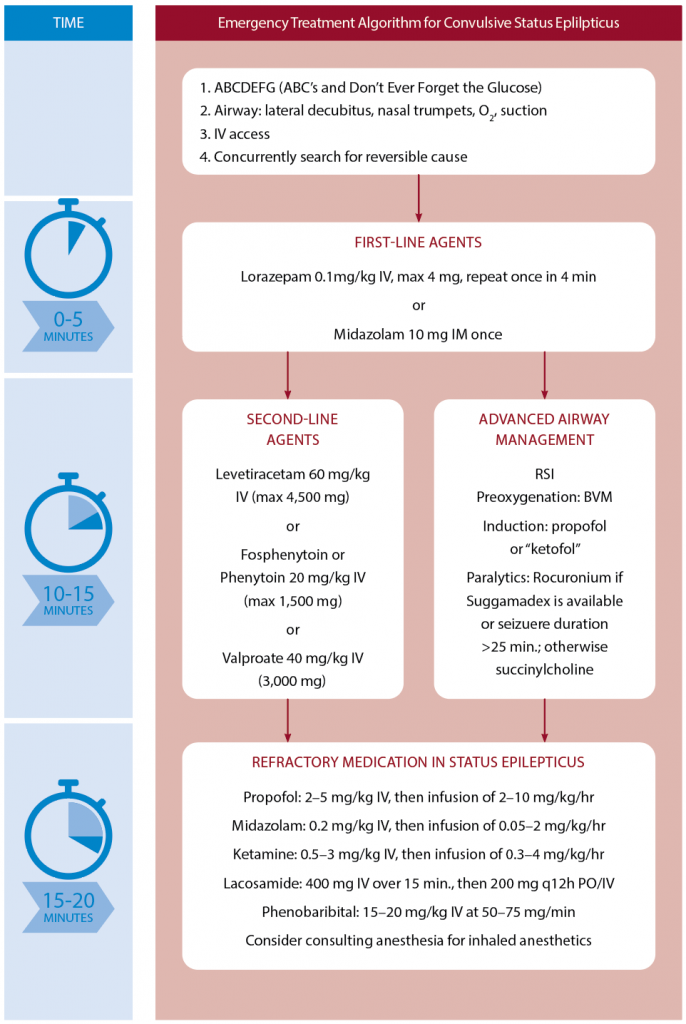
After two adequate doses of IV lorazepam have been given two to four minutes apart, the drug you should reach for may surprise you. It’s propofol. Propofol should be considered concurrently with a traditional second-line agent such as levetiracetam, fosphenytoin, or valproic acid.9 It is important to understand that the goal of using propofol is to achieve seizure cessation, while the goal of traditional antiepileptic medications is to prevent seizure recurrence. Multiple trials have demonstrated unacceptable seizure durations of 30–45 minutes using traditional second-line agents without use of a sedative-hypnotic drug.10,11 Propofol use is familiar to emergency clinicians in other conditions and has been shown in recent meta-analysis to have a better disease control rate and faster results and reduced tracheal intubation time compared to barbiturates.12 The recommended dose is propofol IV bolus 2 mg/kg, followed by 50–80 mcg/kg/min (3–5 mg/kg/hr) infusion.

We should approach seizing patients in the emergency department swiftly and aggressively, with the goal of immediate seizure cessation.

Turning to intubation, some experts recommend ketofol (ketamine plus propofol) based on the theoretical benefit of blocking both N-methyl-D-aspartate and gamma-aminobutyric acid receptors with ketamine and propofol, respectively.13 I also recommend using a paralytic agent to maximize the chance of first-pass success. Long-term neuromuscular blockade should be avoided whenever possible so patients can be monitored for ongoing seizure activity and serial neurological exams can be conducted until EEG monitoring is available.

The choice of paralytic agent depends on patient factors, duration of seizure activity, and access to the rocuronium reversal agent sugammadex. If there are no clear contraindications for using succinylcholine and the patient has been seizing for less than 20–25 min, it is reasonable to use succinylcholine given its short duration of action. If sugammadex is available, consider rocuronium. Sugammadex should only be used in a controlled fashion to reverse the rocuronium after the airway has been secured and the patient has been stabilized. Its purpose in status epilepticus is only to reveal underlying physical seizure activity to aid in titrating sedative infusions rather than as a tool used for an anticipated difficult/challenging airway.

Choosing among antiepileptic drugs is less about any upsides and more about avoiding contraindications. The recent ESETT trial, which included adults and children with persistent benzodiazepine refractory generalized convulsive status epilepticus, found no difference between the use of levetiracetam, fosphenytoin, and valproate in seizure cessation and improved alertness by 60 minutes.14 However, phenytoin and fosphenytoin have sodium channel blockade effects, similar to the mechanism of action of certain toxidromes such as tricyclic antidepressant and cocaine overdose. The additional sodium channel blockade of phenytoin/fosphenytoin could therefore result in dangerous and even fatal cardiac dysrhythmias. These drugs should generally be avoided in toxicological causes of seizure for this reason. Although controversial, valproate should be avoided in pregnant patients.15 Perhaps the safest medication is levetiracetam dosed at 60 mg/kg IV (maximum 4.5 g).

Pages: 1 2 3 4 | Single Page

Topics: BenzodiazepinesfosphenytoinketofollevetiracetamlorazepammidazolamphenobarbitalPropofolrocuroniumSeizurestatus epilepticussuccinylcholinesugammadexvalproic acid

Related

  • Case Report: Massive Amitriptyline and Bupropion Ingestion

    October 29, 2025 - 0 Comment
  • Code Eclampsia: Navigating the Storm in ED Management

    August 25, 2025 - 2 Comments
  • Push-Dose Pressors in the Emergency Department

    June 29, 2025 - 1 Comment

Current Issue

ACEP Now: November 2025

Download PDF

Read More

About the Author

Anton Helman, MD, CCFP(EM), FCFP

Dr. Helman is an emergency physician at North York General Hospital in Toronto. He is an assistant professor at the University of Toronto, Division of Emergency Medicine, and the education innovation lead at the Schwartz/Reisman Emergency Medicine Institute. He is the founder and host of Emergency Medicine Cases podcast and website (www.emergencymedicinecases.com).

View this author's posts »

No Responses to “Tips for Managing Active Seizures in the Emergency Department”

Leave a Reply Cancel Reply

Your email address will not be published. Required fields are marked *


*
*


Wiley
  • Home
  • About Us
  • Contact Us
  • Privacy
  • Terms of Use
  • Advertise
  • Cookie Preferences
Copyright © 2025 by John Wiley & Sons, Inc. All rights reserved, including rights for text and data mining and training of artificial technologies or similar technologies. ISSN 2333-2603