Logo

Log In Sign Up |  An official publication of: American College of Emergency Physicians
Navigation
  • Home
  • Multimedia
    • Podcasts
    • Videos
  • Clinical
    • Airway Managment
    • Case Reports
    • Critical Care
    • Guidelines
    • Imaging & Ultrasound
    • Pain & Palliative Care
    • Pediatrics
    • Resuscitation
    • Trauma & Injury
  • Resource Centers
    • mTBI Resource Center
  • Career
    • Practice Management
      • Benchmarking
      • Reimbursement & Coding
      • Care Team
      • Legal
      • Operations
      • Quality & Safety
    • Awards
    • Certification
    • Compensation
    • Early Career
    • Education
    • Leadership
    • Profiles
    • Retirement
    • Work-Life Balance
  • Columns
    • ACEP4U
    • Airway
    • Benchmarking
    • Brief19
    • By the Numbers
    • Coding Wizard
    • EM Cases
    • End of the Rainbow
    • Equity Equation
    • FACEPs in the Crowd
    • Forensic Facts
    • From the College
    • Images in EM
    • Kids Korner
    • Medicolegal Mind
    • Opinion
      • Break Room
      • New Spin
      • Pro-Con
    • Pearls From EM Literature
    • Policy Rx
    • Practice Changers
    • Problem Solvers
    • Residency Spotlight
    • Resident Voice
    • Skeptics’ Guide to Emergency Medicine
    • Sound Advice
    • Special OPs
    • Toxicology Q&A
    • WorldTravelERs
  • Resources
    • ACEP.org
    • ACEP Knowledge Quiz
    • Issue Archives
    • CME Now
    • Annual Scientific Assembly
      • ACEP14
      • ACEP15
      • ACEP16
      • ACEP17
      • ACEP18
      • ACEP19
    • Annals of Emergency Medicine
    • JACEP Open
    • Emergency Medicine Foundation
  • About
    • Our Mission
    • Medical Editor in Chief
    • Editorial Advisory Board
    • Awards
    • Authors
    • Article Submission
    • Contact Us
    • Advertise
    • Subscribe
    • Privacy Policy
    • Copyright Information

Tips for Diagnosing Occult Fractures in the Emergency Department

By Arun Sayal, MD, CCFP(EM) | on September 19, 2018 | 0 Comment
Casted
  • Tweet
  • Click to email a link to a friend (Opens in new window) Email
Print-Friendly Version
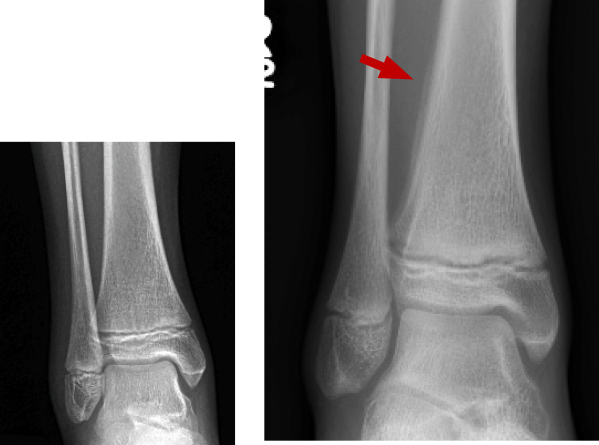
BELOW: Day 1 – normal RIGHT: Week 3 – subtle periosteal reaction lateral aspect distal tibia

You Might Also Like
  • Tips for Emergency Physicians on Spotting Occult Knee Dislocation
  • Emergency Medicine Pearls, Pitfalls for Treatment of Pediatric Distal Radius Fractures
  • When to Use Point-of-Care Ultrasound for Skull Fractures
Explore This Issue
ACEP Now: Vol 37 – No 09 – September 2018

Left: Day 1 – normal
Right: Week 3 – subtle periosteal reaction lateral aspect distal tibia

Case 3: occult distal radius fracture

The 69-year-old woman who fell on her outstretched hand: When she returned one week later, she was still tender and swollen and looked like she had a distal radius fracture. She was kept in a splint, and X-rays repeated at four weeks revealed the fracture.
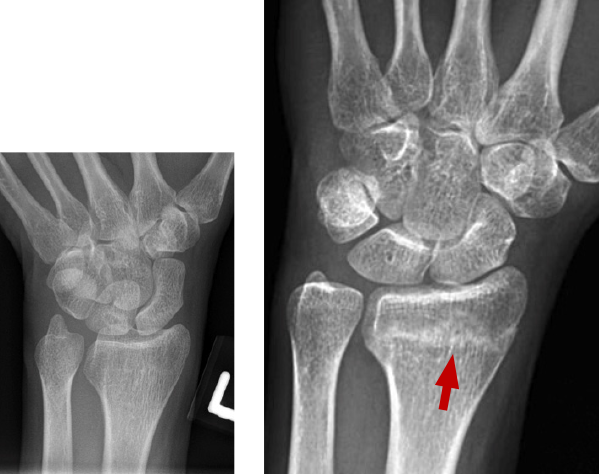
BELOW: Day 1 – normal RIGHT: Week 4 – sclerosis across distal radius

Left: Day 1 – normal
Right: Week 4 – sclerosis across distal radius

Case 4: occult lateral tibial plateau fracture

The 72-year-old woman who twisted her knee: When she returned one week later, she was still unable to bear weight on the knee, and she was swollen and tender over the lateral joint line. Follow-up imaging revealed a lateral tibial plateau fracture.
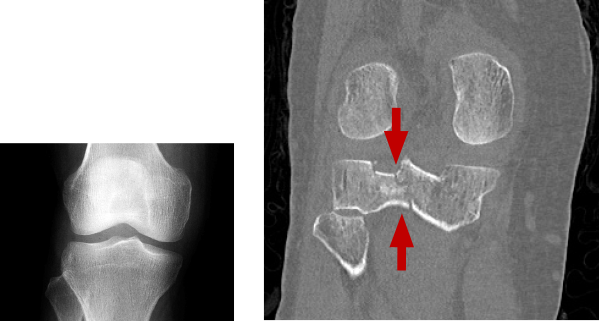
BELOW: Day 1 – no definite fracture RIGHT: Day 5 – CT: mildly depressed lateral tibial plateau

Left: Day 1 – normal
Right: Week 4 – sclerosis across distal radius

Key points

  1. Determine the force and mechanism of injury
  2. Appreciate the “quality of bone” to which that force was applied
  3. Examine patients to determine tenderness, range of motion, etc.
  4. Then look at the x-rays
  5. Keep in mind, if there is a higher pre-test probability and a negative X-ray, the patient still may have a fracture

Our next column will deal with management strategies for suspected occult fractures in the emergency department.


Dr. SayalDr. Sayal is a staff physician in the emergency department and fracture clinic at North York General Hospital in Toronto, Ontario; creator and director of CASTED ‘Hands-On’ Orthopedic Courses; and associate professor in the department of family and community medicine at the University of Toronto.

References

  1. Wheeless CR. Scaphoid frx: non diagnositic X-ray. Wheeless’ Textbook of Orthopaedics website. Accessed Aug. 17, 2017.
  2. Mallee WH, Wang J, Poolman RW, et al. Computed tomography versus magnetic resonance imaging versus bone scintigraphy for clinically suspected scaphoid fractures in patients with negative plain radiographs. Cochrane Database Syst Rev. 2015;(6):CD010023.
  3. Lin M. Beware the hidden tibia plateau fracture. Academic Life in Emergency Medicine website. Accessed Aug. 17, 2017.
  4. Mustonen AO, Koskinen SK, Kiuru MJ. Acute knee trauma: Analysis of multidetector computed tomography findings and comparison with conventional radiography. Acta Radiol. 2005;46(8):866-874.
  5. Likelihood ratios. Centre for Evidence-Based Medicine website. Accessed Aug. 17, 2017.

Pages: 1 2 3 4 | Single Page

Topics: BonesfractureImaging & UltrasoundX-Ray

Related

  • Patterns of Injury in Elder Abuse

    November 6, 2025 - 0 Comment
  • Poll: Emergency Physicians Read Their Own X-Rays More Often Than Not

    November 6, 2025 - 0 Comment
  • ACEP’s October 2025 Poll: How Often Do You Read Your Own X-Rays?

    September 30, 2025 - 0 Comment

Current Issue

ACEP Now: November 2025

Download PDF

Read More

No Responses to “Tips for Diagnosing Occult Fractures in the Emergency Department”

Leave a Reply Cancel Reply

Your email address will not be published. Required fields are marked *


*
*


Wiley
  • Home
  • About Us
  • Contact Us
  • Privacy
  • Terms of Use
  • Advertise
  • Cookie Preferences
Copyright © 2025 by John Wiley & Sons, Inc. All rights reserved, including rights for text and data mining and training of artificial technologies or similar technologies. ISSN 2333-2603
