

Explore This Issue
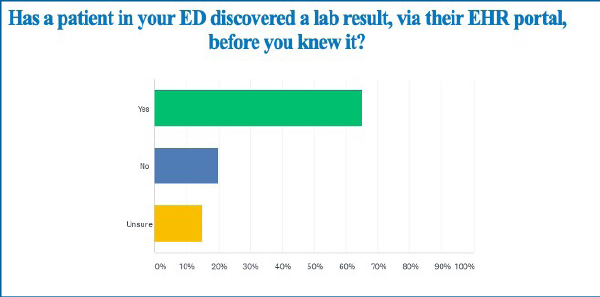
ACEP Now: Vol 41 – No 03 – March 2022Percentage of physicians who have liability concerns.

Percentage of physicians who may or may not spend more time on documentation.
Although Dr. Genes believes that note sharing is generally a good thing, he would like to see ED patients’ notes digitally released toward the conclusion of their visit, after the physician has had an opportunity to review results and explain them. In efforts to enact a change, he has worked with Jeff Davis, ACEP’s director of regulatory and external affairs, on outreach to the ONC. They formally requested that regulations be altered to allow for emergency departments to delay sharing lab results and clinical notes with patients for a 24-hour period or at the least until the patient is discharged from the emergency department. The recommendation was not accepted, however, and ACEP’s effort to advocate for regulations that support the unique needs of the emergency department continues.
Although there are provisions written into the Cures Act that allow doctors to censor information and prevent a patient from seeing it, many physicians are either not aware of this option or do not know how to use it. “There are often no clear guidelines on when censoring is appropriate,” Dr. Gowda said. “For example, there are exceptions to patients having immediate access to their chart if it would result in harm to the patient, but harm is not clearly defined and doesn’t always refer to emotional harm—as in learning that you had a miscarriage via a radiology report or ED note.
“I think increased awareness of what patients may access and knowing the appropriate steps physicians can take to censor information when needed will help improve communication,” Dr. Gowda continued. “I think this responsibility often falls on the hospital administration to clearly distribute these guidelines.”
Charting in a New Climate

Dr. Nicholas Genes
Now that patients can view physicians’ clinical notes, should doctors adjust their charting habits? Most say little change should be necessary, as clinical notes are still meant for multiple audiences, including other clinicians as well as billing, compliance and medicolegal departments. “I still chart from a medicolegal perspective and to help other providers understand my decision-making process,” said Dr. Gowda.
In charting, accuracy has always been paramount. With the new law in place, patients are more inclined to scour their charts in search of errors to report. “There is literature out there, a primary care physicians study, regarding patients who do this,” said Dr. Yore.1 “We need to be aware of that those patients are going to contact us to say, ‘This is wrong, please fix it.’ And if it is wrong, we need to be open to amending our charts.”
Some physicians have expressed concern that patient accessibility to their notes may open them up to harsh and unjustified criticism as every recorded remark and observation is scrutinized. Dr. Yore’s advice: “If you’re not comfortable with your chart being blown up into a 4 × 6 poster in front of a jury, you shouldn’t be putting it in the medical record.” She cautions colleagues to be mindful of the language used in charts and how people are going to perceive it. “This is particularly relevant in the emergency department, where we see a lot of people with substance abuse issues and mental health issues, marginalized people, homeless people, people of different racial, gender/sexual identities, etc.,” she said. “It’s easy to inadvertently—or even as a result of not caring—use language that isn’t appropriate. For instance, you can describe someone as being ‘drunk,’ but that’s not exactly neutral language. A suitable description of this patient might read, ‘They had a wide, shuffling gait, and speech was slurred.’ This way, you haven’t exposed yourself as coming into that interaction with a set of implicit biases.”
Some inappropriate word choices for charting are not quite so obvious. Dr. Yore cites the phrase “frequent flier,” a common term her department uses to refer to patients who visit the emergency department regularly, often with the same complaint. “That phrase should never find its way into a chart, but it does,” she said, suggesting that writing “this patient is well-known to this emergency department” would be a better choice. Along these same lines, Dr. Gowda now refrains from using certain descriptors: “For example, instead of stating that a patient is obese/overweight, I state the patient’s BMI.”
Some physicians express concerns about patients’ inability to understand the medical jargon used in charts, but “this is the age of Google,” reminded Dr. Yore. “People who are invested in their care and motivated to understand their condition can look up the terms and learn more than they would ever want. To the degree that the jargon is useful for precise and concise communication with other members of a health care team, I am okay with it.”
Linda Kossoff is a freelance medical writer based in Woodland Hills, California.
Pages: 1 2 3 | Single Page




No Responses to “Tips for Adjusting to the New Cures Act Rules in Emergency Departments”