Logo

Log In Sign Up |  An official publication of: American College of Emergency Physicians
Navigation
  • Home
  • Multimedia
    • Podcasts
    • Videos
  • Clinical
    • Airway Managment
    • Case Reports
    • Critical Care
    • Guidelines
    • Imaging & Ultrasound
    • Pain & Palliative Care
    • Pediatrics
    • Resuscitation
    • Trauma & Injury
  • Resource Centers
    • mTBI Resource Center
  • Career
    • Practice Management
      • Benchmarking
      • Reimbursement & Coding
      • Care Team
      • Legal
      • Operations
      • Quality & Safety
    • Awards
    • Certification
    • Compensation
    • Early Career
    • Education
    • Leadership
    • Profiles
    • Retirement
    • Work-Life Balance
  • Columns
    • ACEP4U
    • Airway
    • Benchmarking
    • Brief19
    • By the Numbers
    • Coding Wizard
    • EM Cases
    • End of the Rainbow
    • Equity Equation
    • FACEPs in the Crowd
    • Forensic Facts
    • From the College
    • Images in EM
    • Kids Korner
    • Medicolegal Mind
    • Opinion
      • Break Room
      • New Spin
      • Pro-Con
    • Pearls From EM Literature
    • Policy Rx
    • Practice Changers
    • Problem Solvers
    • Residency Spotlight
    • Resident Voice
    • Skeptics’ Guide to Emergency Medicine
    • Sound Advice
    • Special OPs
    • Toxicology Q&A
    • WorldTravelERs
  • Resources
    • ACEP.org
    • ACEP Knowledge Quiz
    • Issue Archives
    • CME Now
    • Annual Scientific Assembly
      • ACEP14
      • ACEP15
      • ACEP16
      • ACEP17
      • ACEP18
      • ACEP19
    • Annals of Emergency Medicine
    • JACEP Open
    • Emergency Medicine Foundation
  • About
    • Our Mission
    • Medical Editor in Chief
    • Editorial Advisory Board
    • Awards
    • Authors
    • Article Submission
    • Contact Us
    • Advertise
    • Subscribe
    • Privacy Policy
    • Copyright Information

Tips for Emergency Physicians on Spotting Occult Knee Dislocation

By Anton Helman, MD, CCFP(EM), FCFP | on May 15, 2017 | 0 Comment
EM Cases
  • Tweet
  • Click to email a link to a friend (Opens in new window) Email
Print-Friendly Version

Three days later, the patient returned to the emergency department with severe foot pain and a cold, pulseless foot. Emergency vascular surgery was performed for a massive popliteal thrombosis; he never recovered full function of his right lower extremity.

You Might Also Like
  • Tips for Diagnosing Occult Fractures in the Emergency Department
  • Ovarian Vein Thrombosis Diagnosis, Management Tips for Emergency Physicians
  • What Emergency Physicians Need to Know About Complex Regional Pain Syndrome
Explore This Issue
ACEP Now: Vol 36 – No 05 – May 2017

When to Suspect an Occult Knee Dislocation
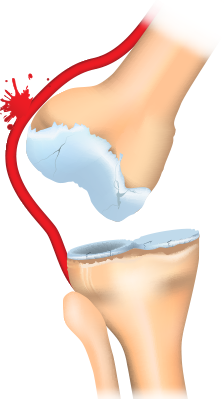
Anterior knee dislocation.

Anterior knee dislocation.
ILLUSTRATION: Chris Whissen & shutterstock.com

About 20 percent to 50 percent of all knee dislocations spontaneously reduce before patients arrive at the emergency department, and while patients may feel a shift of the knee joint, they may not recognize that their knee is dislocated. One pitfall in the history is assuming that a low-energy mechanism cannot cause a knee dislocation. A low-energy mechanism such as stepping off a curb in patients with a body mass index greater than 40 accounts for a significant proportion of missed occult knee dislocations. One study found that 47 percent of knee dislocations were due to low-energy trauma (eg, slips and falls), with 75 percent being in obese patients. Obese patients with low-energy trauma were more likely to have associated neurovascular injury than high-energy trauma patients in this cohort.

If patients have severe knee pain and a large effusion, check for a “loose knee.” Sometimes it is obvious that there is multidirectional ligamentous laxity when the examiner stabilizes the thigh and attempts to move the lower leg with the knee slightly flexed. A helpful rule of thumb is three of four knee ligament disruptions should be considered a knee dislocation until proven otherwise. Another clue: if patients complain of the knee buckling and are found to have a foot drop, then a knee dislocation should be suspected as the dislocation can cause a common peroneal nerve palsy. Lastly, upon lifting the patients’ legs by their heels, the dislocated knee may fall into hyperextension compared to the contralateral knee.

Workup of Suspected Knee Dislocation

The presence of normal distal pulses does not preclude occult popliteal artery injury as this has been shown to have a rate of 5 percent to 15 percent when normal pulses are present.

Ankle brachial index (ABI) and Doppler ultrasound imaging may miss small intimal injuries that clot after a few days. The gold standard is an arteriogram, but CT angiogram is more readily available.

Until recently, all patients with suspected knee dislocation underwent CT angiogram to assess for vascular injury. However, since the vast majority of patients who do have a vascular injury but have normal serial neurovascular exams and normal serial ABIs have intimal tears that do not require surgery, some experts recommend simply administering anticoagulants and admitting patients for observation without performing a CT angiogram.

Pages: 1 2 3 | Single Page

Topics: AccidentDiagnosisED Critical CareEmergency DepartmentEmergency MedicineEmergency PhysiciansExamImaging & UltrasoundJoint PainKneePatient CareTrauma & InjuryTreatment

Related

  • Let Core Values Help Guide Patient Care

    November 5, 2025 - 0 Comment
  • Event Medicine: Where Fun and Safety Sing in Perfect Harmony

    October 9, 2025 - 1 Comment
  • ACEP’s October 2025 Poll: How Often Do You Read Your Own X-Rays?

    September 30, 2025 - 0 Comment

Current Issue

ACEP Now: November 2025

Download PDF

Read More

No Responses to “Tips for Emergency Physicians on Spotting Occult Knee Dislocation”

Leave a Reply Cancel Reply

Your email address will not be published. Required fields are marked *


*
*


Wiley
  • Home
  • About Us
  • Contact Us
  • Privacy
  • Terms of Use
  • Advertise
  • Cookie Preferences
Copyright © 2025 by John Wiley & Sons, Inc. All rights reserved, including rights for text and data mining and training of artificial technologies or similar technologies. ISSN 2333-2603
