Logo

Log In Sign Up |  An official publication of: American College of Emergency Physicians
Navigation
  • Home
  • Multimedia
    • Podcasts
    • Videos
  • Clinical
    • Airway Managment
    • Case Reports
    • Critical Care
    • Guidelines
    • Imaging & Ultrasound
    • Pain & Palliative Care
    • Pediatrics
    • Resuscitation
    • Trauma & Injury
  • Resource Centers
    • mTBI Resource Center
  • Career
    • Practice Management
      • Benchmarking
      • Reimbursement & Coding
      • Care Team
      • Legal
      • Operations
      • Quality & Safety
    • Awards
    • Certification
    • Compensation
    • Early Career
    • Education
    • Leadership
    • Profiles
    • Retirement
    • Work-Life Balance
  • Columns
    • ACEP4U
    • Airway
    • Benchmarking
    • Brief19
    • By the Numbers
    • Coding Wizard
    • EM Cases
    • End of the Rainbow
    • Equity Equation
    • FACEPs in the Crowd
    • Forensic Facts
    • From the College
    • Images in EM
    • Kids Korner
    • Medicolegal Mind
    • Opinion
      • Break Room
      • New Spin
      • Pro-Con
    • Pearls From EM Literature
    • Policy Rx
    • Practice Changers
    • Problem Solvers
    • Residency Spotlight
    • Resident Voice
    • Skeptics’ Guide to Emergency Medicine
    • Sound Advice
    • Special OPs
    • Toxicology Q&A
    • WorldTravelERs
  • Resources
    • ACEP.org
    • ACEP Knowledge Quiz
    • Issue Archives
    • CME Now
    • Annual Scientific Assembly
      • ACEP14
      • ACEP15
      • ACEP16
      • ACEP17
      • ACEP18
      • ACEP19
    • Annals of Emergency Medicine
    • JACEP Open
    • Emergency Medicine Foundation
  • About
    • Our Mission
    • Medical Editor in Chief
    • Editorial Advisory Board
    • Awards
    • Authors
    • Article Submission
    • Contact Us
    • Advertise
    • Subscribe
    • Privacy Policy
    • Copyright Information

Tips for Catching Commonly Missed Ankle Injuries
By Arun Sayal, MD, CCFP(EM) | on February 20, 2018 | 2 Comments
Casted
  • Tweet
  • Click to email a link to a friend (Opens in new window) Email
Print-Friendly Version
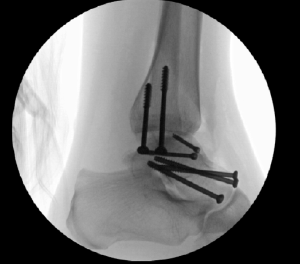
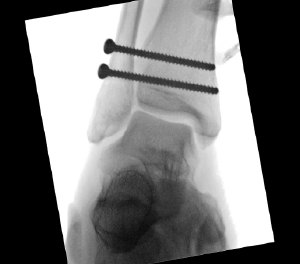
Case 1, Figure 2: 22-year-old female

You Might Also Like
  • Emergency Medicine Pearls, Pitfalls for Treatment of Pediatric Distal Radius Fractures
  • Identify and Treat Lisfranc Injuries
  • Tips for Diagnosing Occult Fractures in the Emergency Department
Explore This Issue
ACEP Now: Vol 37 – No 02 – February 2018

Case 1, Figure 2: 22-year-old female

Case 2, Figure 2: 45-year-old male

Case 2, Figure 2: 45-year-old male

Case 3, Figure 2: 13-year-old female

Case 3, Figure 2: 13-year-old female

Case 1

The emergency physician noted the patient fell and injured her ankle. The ankle was swollen and tender laterally, but there was no emergency department assessment of her anterior ankle. Diagnosis: severe lateral ankle sprain. She was given a walking boot and crutches, with follow-up in a week.

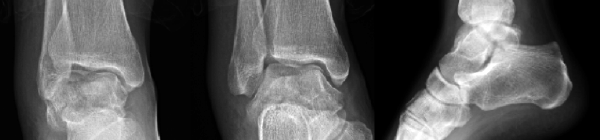
A few extra details: In fact, she jumped from a wall about six to seven feet high, landed on her feet, then fell over. Unable to walk, she presented to the emergency department the same evening. No anterior joint/talar pain was documented in the emergency department note on the initial visit. However, she was noted to be quite tender there when she returned the next day (after she was called back to the emergency department for an X-ray discrepancy). The original emergency department X-rays (cropped) are in Case 1, Figure 3.

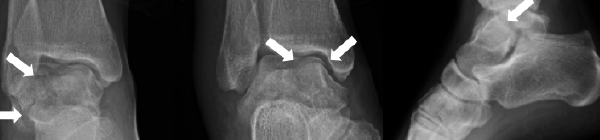
Case 1, Figure 4 includes arrows to show some of the fracture lines visible throughout the talus.

The X-ray study was read as “no fracture” by the emergency physician. The radiologist identified the fractured talus. The patient returned to the emergency department the next day, and a CT scan in Case 1, Figure 5 showed the shattered talus.

The patient was admitted for surgical management, as shown in Case 1, Figure 2.

Case 1 highlights the importance of the history (eg, mechanism, force, and events after) and physical examination (eg, examining the anterior aspect of the ankle). Once the patient’s story is understood, the physician will then look at the X-rays with more focus and should also search for known associated injuries (eg, calcaneus, other foot, knees, hips, and the thoracolumbar spine).
Case 1, Figure 3
Case 1, Figure 3

Case 1, Figure 4

Case 1, Figure 4

Case 1, Figure 5

Case 1, Figure 5

Case 2

The emergency department report showed the patient had mild tenderness laterally and no tenderness over the medial malleolus. He was diagnosed with a STI of the ankle, placed in an air-stirrup, given crutches, and provided with follow-up in the clinic in a week.

He came back on day 10. He was quite specific about the mechanism. He caught the instep of his right foot, and as his left foot went forward, his injured right foot clearly turned out. The mechanism was external rotation, a red flag mechanism. He was unable to bear weight up. At the patient’s follow-up exam, the emergency physician stated, “The patient had very mild tenderness laterally, and he was non-tender over the medial malleolus.” However, as images Case 2, Figure 3A–C show, he also had pain at three other points (points the OAR do not ask us to examine).

Pages: 1 2 3 4 5 6 | Single Page

Topics: AnkleClinicalEmergency DepartmentEmergency MedicineEmergency PhysiciansfractureImaging and UltrasoundOrthopedicsOutcomePearlsPractice ManagementRadiologyTrauma & InjuryTreatmentX-Ray

Related

  • Florida Emergency Department Adds Medication-Dispensing Kiosk

    November 7, 2025 - 1 Comment
  • Patterns of Injury in Elder Abuse

    November 6, 2025 - 0 Comment
  • Poll: Emergency Physicians Read Their Own X-Rays More Often Than Not

    November 6, 2025 - 0 Comment

Current Issue

ACEP Now: November 2025

Download PDF

Read More

2 Responses to “Tips for Catching Commonly Missed Ankle Injuries”

  1. March 3, 2018

    abw Reply

    Excellent article. Thank you.

    • July 30, 2018

      Arun Sayal Reply

      Thanks abw!

      Happy to share these earls from our orthopedic surgeons – and from our patients.

      Thanks to both groups for teaching me!

      Arun

Leave a Reply Cancel Reply

Your email address will not be published. Required fields are marked *


*
*


Wiley
  • Home
  • About Us
  • Contact Us
  • Privacy
  • Terms of Use
  • Advertise
  • Cookie Preferences
Copyright © 2025 by John Wiley & Sons, Inc. All rights reserved, including rights for text and data mining and training of artificial technologies or similar technologies. ISSN 2333-2603
