Logo

Log In Sign Up |  An official publication of: American College of Emergency Physicians
Navigation
  • Home
  • Multimedia
    • Podcasts
    • Videos
  • Clinical
    • Airway Managment
    • Case Reports
    • Critical Care
    • Guidelines
    • Imaging & Ultrasound
    • Pain & Palliative Care
    • Pediatrics
    • Resuscitation
    • Trauma & Injury
  • Resource Centers
    • mTBI Resource Center
  • Career
    • Practice Management
      • Benchmarking
      • Reimbursement & Coding
      • Care Team
      • Legal
      • Operations
      • Quality & Safety
    • Awards
    • Certification
    • Compensation
    • Early Career
    • Education
    • Leadership
    • Profiles
    • Retirement
    • Work-Life Balance
  • Columns
    • ACEP4U
    • Airway
    • Benchmarking
    • Brief19
    • By the Numbers
    • Coding Wizard
    • EM Cases
    • End of the Rainbow
    • Equity Equation
    • FACEPs in the Crowd
    • Forensic Facts
    • From the College
    • Images in EM
    • Kids Korner
    • Medicolegal Mind
    • Opinion
      • Break Room
      • New Spin
      • Pro-Con
    • Pearls From EM Literature
    • Policy Rx
    • Practice Changers
    • Problem Solvers
    • Residency Spotlight
    • Resident Voice
    • Skeptics’ Guide to Emergency Medicine
    • Sound Advice
    • Special OPs
    • Toxicology Q&A
    • WorldTravelERs
  • Resources
    • ACEP.org
    • ACEP Knowledge Quiz
    • Issue Archives
    • CME Now
    • Annual Scientific Assembly
      • ACEP14
      • ACEP15
      • ACEP16
      • ACEP17
      • ACEP18
      • ACEP19
    • Annals of Emergency Medicine
    • JACEP Open
    • Emergency Medicine Foundation
  • About
    • Our Mission
    • Medical Editor in Chief
    • Editorial Advisory Board
    • Awards
    • Authors
    • Article Submission
    • Contact Us
    • Advertise
    • Subscribe
    • Privacy Policy
    • Copyright Information

The Ultrasound-Guided Genicular Nerve Block

By Joseph Stegeman, MD; Carlos Mikell, MD; David Martin, MD; and Arun Nagdev, MD | on May 10, 2024 | 0 Comment
Sound Advice
  • Tweet
  • Click to email a link to a friend (Opens in new window) Email
Print-Friendly Version

Chronic knee pain is common and debilitating. Patients often seek care in the emergency department (ED) setting when flares of pain affect their ability to ambulate, climb stairs, or even stand up from sitting.1 In many cases, these patients have been dealing with pain for years and have already exhausted the standard analgesic cocktail of acetaminophen, NSAIDs, and/or topical agents. Patients and clinicians are both aware of the obvious downstream risks of adding opioids to this multimodal regimen. Intra-articular steroid injections can be an excellent option but come with their own risks given they violate the joint space and are not commonly performed in the ED setting. The genicular nerve block offers a simplified, safe alternative for treating severe knee pain. In conjunction with multimodal oral and topical pain regimens, this motor sparing block can provide both acute pain control and lasting relief for weeks to months following the injection for patients with severe knee pain.2,3

You Might Also Like
  • Ultrasound-Guided Posterior Tibial Nerve Block
  • How to Perform Ultrasound-Guided Distal Sciatic Nerve Block in the Popliteal Fossa
  • Ultrasound-Guided Femoral Nerve Block
Explore This Issue
ACEP Now: Vol 43 – No 05 – May 2024

Sonoanatomy

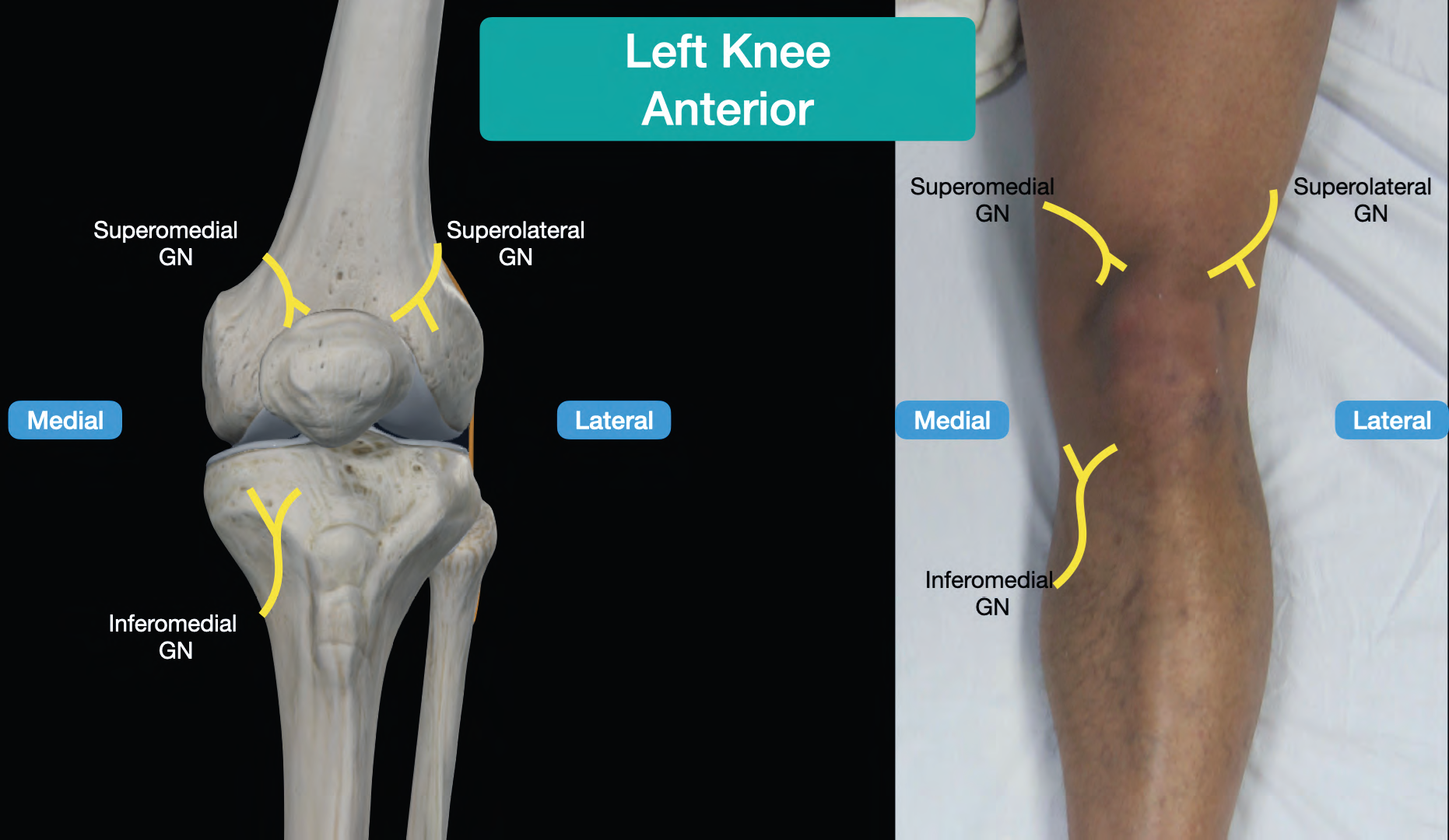
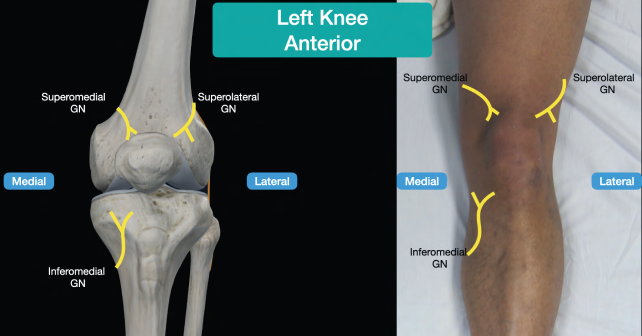
FIGURE 1. Bony and surface anatomy of the knee with the superomedial, superolateral, and inferomedial nerves shown. Note that the inferolateral genicular nerve is omitted as this is not blocked to avoid foot drop from the nearby superficial peroneal nerve. (Click to enlarge.)

The innervation of the knee is complex, but much of its sensory innervation is supplied by the genicular nerves, which are easy targets for ultrasound-guided nerve blocks. The genicular nerves are a group of four sensoryonly branches (off of the sciatic nerve) that wrap around the femoral condyles superiorly and the proximal tibia and fibula inferiorly. The genicular nerves are named based on their corresponding quadrant of the knee joint (superolateral, superomedial, inferomedial, and inferolateral) and run immediately adjacent to the bone, following the course of the genicular arteries. Their proximity to the bone allows us to use the bone as a backstop for the needle, making this a particularly easy block to perform. The genicular nerve block targets the superolateral, superomedial and inferomedial genicular nerves. We recommend not blocking the inferolateral nerve because of its close proximity to the superficial peroneal nerve and possibility of inadvertently causing a foot drop.

How to Perform the Block

Supplies

  • High frequency linear transducer
  • Chlorhexidine
  • Block needle
  • Probe cover
  • Sterile gel
  • 3 mL lidocaine 1 percent for skin with 25g needle
  • 10 mL bupivacaine 0.5 percent mixed with 10 mg dexamethasone

Step 1

Prepare a 5 mL syringe with 3-5 mL of lidocaine 1 percent for skin wheals at each site of needle entry. Prepare another syringe with 10 mL of bupivacaine 0.5 percent and 10 mg dexamethasone. Place the patient supine with the knee exposed. Disinfect the anterior aspect of the knee with chlorhexidine and place a transparent adhesive cover on the probe.

Pages: 1 2 3 | Single Page

Topics: Clinicalgenicular nerve blockImaging & UltrasoundNerve BlocksUltrasound-Guided Nerve Block

Related

  • Non-Invasive Positive Pressure Ventilation in the Emergency Department

    October 1, 2025 - 0 Comment
  • Emergency Department Management of Prehospital Tourniquets

    October 1, 2025 - 0 Comment
  • ACEP’s October 2025 Poll: How Often Do You Read Your Own X-Rays?

    September 30, 2025 - 0 Comment

Current Issue

ACEP Now: November 2025

Download PDF

Read More

No Responses to “The Ultrasound-Guided Genicular Nerve Block”

Leave a Reply Cancel Reply

Your email address will not be published. Required fields are marked *


*
*


Wiley
  • Home
  • About Us
  • Contact Us
  • Privacy
  • Terms of Use
  • Advertise
  • Cookie Preferences
Copyright © 2025 by John Wiley & Sons, Inc. All rights reserved, including rights for text and data mining and training of artificial technologies or similar technologies. ISSN 2333-2603