

You work as the medical director at a suburban, community emergency department (ED). At your monthly meeting with the chief medical officer (CMO) and chief nursing officer (CNO), they inform you of the hospital’s plan to start a Sexual Assault Nurse Examiner (SANE) Program. They ask you if you would be willing to serve as the team’s medical director. As expected, you have several questions. Do you know what you need to know to make an informed decision?
Explore This Issue
ACEP Now: March 02Discussion
SANE programs started in the early 1970s to provide medical forensic examinations to patients after sexual assault. There are approximately 1,000 current SANE programs in the United States.1 There are many program models including ED-based, non-ED hospital-based, hospital, and community-based programs. Regardless of the type of program, one key to the success of the program is its management team. The program is typically led by a nursing program director and a medical director.
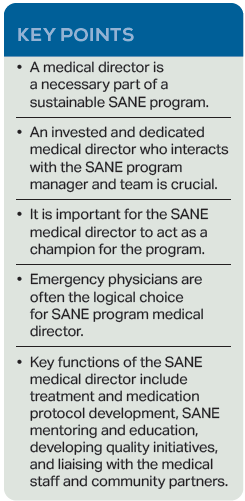
A SANE program medical director is generally responsible for several aspects of the program including developing policies and protocols, mentoring and educating the team by providing guidance and assistance, helping to develop and implement quality initiatives, championing the program and sharing the program’s mission and values, and developing high-quality, cost-effective care for victims of sexual violence.
Because of the close relationship with emergency medicine and SANE programs, emergency physicians often serve in the role of SANE medical director. Often, the role and responsibilities are added to the ED medical director job description, though other specialists including family practitioners, obstetricians and gynecologists, and pediatrics may serve as medical directors. For pediatric programs, it is preferred that the medical director be trained as a child abuse pediatrician.
The medical director’s actual responsibilities can vary by program, but may include:
- Signing and developing care protocols, especially those for care of the pregnant sexually assaulted patient, sexually transmitted infections, and HIV prophylaxis
- Medication standing orders
- Protocol development regarding provider involvement, medical screening examination, and strangulation
- Ordering tests
- Participating in patient care issues and care questions
- Participating in quality assurance and improvement processes
- Participating in staff clinical education
- Participating in administrative aspects of the program
- Participating in strategic planning and benchmarking processes
- Assisting with clinical expansion and implementation of new programs
- Serving as a liaison to other providers in the ED, hospital, or community
Click to enlarge.
What makes a good SANE medical director? Program managers should look for someone who is enthusiastic about the work, has excellent collaboration skills, especially with nursing staff, and has a passion for teaching. The medical director should share the mission and values of the program and understand the importance of trauma-informed, victim-centered care. Other typical standards include board certification or eligibility and experience and knowledge of the medical forensic examination. Some states may require the medical director to be an accredited forensic examiner or to have additional training and knowledge in sexual assault care. In some instances, an advanced practice provider may fulfill the medical director role. A sample job description can be found here.
Pages: 1 2 | Single Page



No Responses to “The Medical Director’s Role in Sexual Assault Nurse Examiner Programs”