
Scientific and Educational Highlights
Explore This Issue
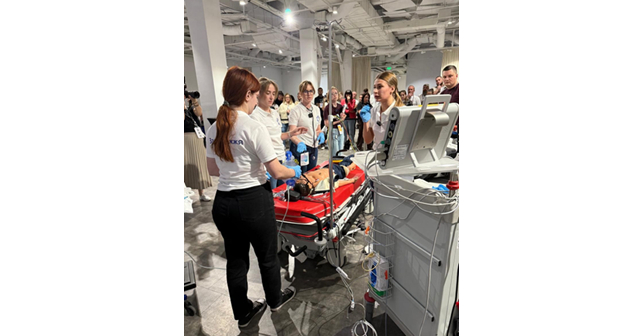
ACEP Now: December 2025 (Digital)Resuscitation team competition. (Click to enlarge.)
The program blended plenary lectures, workshops, and simulation competitions.
Plenary topics included trauma system design, mass-casualty triage, hemorrhage control (including out-of-hospital blood transfusion), advanced airway management, prolonged access to blood products in damage-control resuscitation, telemedicine support for out-of-hospital providers, and evacuation and repatriation protocols.
“Preparing for mass casualty management solely in the hospital setting is an insufficient focus on saving the living,” Dr. Tintinalli added. “Control of bleeding, splinting, and recognizing danger signs of treatable injuries can be taught to the community. Expansion of the community mass-training concept is a fundamental base of the only population-based specialty — emergency medicine.”
Workshops allowed Ukrainian teams to practice advanced interventions under the supervision of international faculty. Simulation competitions between regional ambulance and disaster teams tested readiness, promoted collaboration, and highlighted areas for improvement. Policy sessions focused on outcome metrics, data systems, and the development of national registries to track performance and guide system-level change.
Themes and Innovations
Several unifying themes emerged: Resilience under fire, Civil-military interoperability, International knowledge exchange, and Commitment to outcome-driven practice.
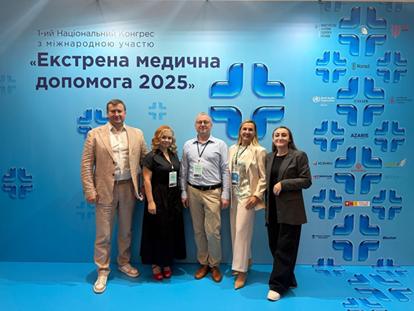
Dr. Vitaliy Krylyuk, ACEP Liaison, Ukraine MoH (center) and colleagues. (Click to enlarge.)
Ukrainian clinicians continue to innovate and adapt despite targeted strikes on the health care system. Ministries, emergency services, and the armed forces collaborated to design a model of care aligned with Western standards of care and NATO doctrine.
Faculty from the U.S., Canada, Japan and Europe provided insights into Western models of pre- and in-hospital emergency medicine but also learned from Ukraine’s unique experience in disaster and frontline medicine.
New protocols emphasized measurable reductions in preventable death and disability, supported by data collection and continuous quality improvement.
“International partnership is critically important for the development of Ukraine’s emergency medical care system. Our main goal is to build a system like those already established in EU countries and the United States,” explained Dr. Krylyuk. “At the same time, Ukraine’s experience is unique…[it] can help the world better understand how to respond to prolonged emergencies under limited resources. Such cooperation benefits everyone: It allows us not only to evaluate the quality of emergency medical care, but also to continuously improve it.”
Significance for Ukraine and Beyond
This Congress positioned Ukraine as a leader in out-of-hospital and disaster medicine. It institutionalized Ukraine’s voice in shaping NATO-aligned emergency systems and showcased the moral courage of clinicians working under direct threat. Next steps include developing national clinical guidelines, expanding data-driven outcome monitoring, and establishing this Congress as a recurring event. Regional workshops could extend lessons across the country, ensuring that both frontline teams and policymakers continue to benefit.
Pages: 1 2 3 | Single Page


No Responses to “The First National Congress on Emergency Medical Care in Ukraine”