
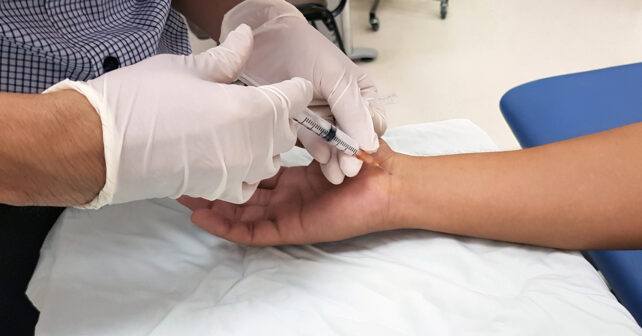
Around the world, acute pain is the most common reason for patients to present to the emergency department (ED).1 Regional anesthesia services are typically provided by anesthesiologists; however, there are various reasons why not all hospital models can support a dedicated service line run by anesthesiologists including physician shortage.2 As the ACEP considers ultrasound guided regional anesthesia a core skill, this leaves a unique opportunity for hospital systems to leverage emergency physicians to provide these services in the inpatient and outpatient setting.
Explore This Issue
ACEP Now: Feb Digital 01-DMultiple emergency medicine programs across the United States provide regional anesthesia in the ED; however, to our knowledge, no established programs run by emergency physicians provide regional anesthesia services as consultants to inpatients. We propose a novel concept for the implementation of a regional anesthesia service aimed at providing pain relief to both ED patients and those admitted to the hospital.
Proving Cost Savings
Our ED is a community Level II Trauma Center, Stroke Center, and STEMI [ST-elevation myocardial infarction] Receiving Center with 4,500 trauma activations, 569 hip fractures, and 450 rib fractures per year. Initially when we established this service line, we felt that the hospital itself would benefit directly from the revenue generated by the volume of procedures and the associated reimbursement from these procedures. The actual amount of financial reimbursement is significantly depreciated, however, when inpatient regional anesthesia procedures are “bundled” together with other services performed during a patient’s hospital stay. Therefore, our rationale for establishing this service line was the cost savings associated with decreased length of stay (LOS).
When we first established this service line, we needed to submit a business proposal to justify funding the physicians who would be performing the procedures. Regional anesthesia has been shown to decrease hospital LOS for hip fractures up to 0.9 days.3-8 The average cost per day of hospitalization in our state is estimated to be $2,813/day.9 The previous year’s volume of hip fractures was 569 patients. Therefore, we calculated yearly cost savings of more than $1.4 million.
The additional amount of procedural revenue was extremely difficult to estimate as it is related to the complexity of the patient’s admission, hospital LOS, and insurance carrier.
Rib fractures are a condition that we commonly treat with ultrasound-guided nerve blocks. Studies indicate that blocks improve respiratory mechanics and decreased opioid consumption, but the actual translation to cost savings was more difficult to ascertain.10-12 Anecdotally, we have noticed a trend in trauma patients who have fewer than three rib fractures and receive ultrasound-guided nerve blocks either being discharged home or placed in ED observation as opposed to being admitted to the inpatient setting. The monetary effect of a regional anesthesia service in terms of decreased length of hospitalization, increased patient satisfaction, decreased opioid complications, need for readmission, and earlier mobilization is more difficult to extrapolate.
Pages: 1 2 3 | Single Page



2 Responses to “The Business Aspects of Establishing a Novel Service Line in the Emergency Department”
February 16, 2025
David LeonAn interesting concept but troubling in its implementation. I applaud the effort and encourage the expansion of regional anesthesia in the ED. However, as a dual trained EM-Anesthesiologist, I see several issues not mentioned in the approach to this concept:
1. A block service already exists in most institutions, often labeled APS, i.e. Acute Pain Service. While often they do not perform many, if any, consults in the ED, it is substantially easier, more diplomatic and lore streamlined to simply discuss with the existing APS to extend consults in the ED. If there is resistance, then there is the case to be made about allowing EM physicians to join APS and help cover consults, especially those in the ED.
2. There is no mention of the additional staffing needed for such a service. These blocks are never done by a solo provider and need nursing +/- additional provider support.
3. There is no discussion of the ED willing to sacrifice their staff to help man this service. Especially since the only EM providers appropriate for this would be US fellowship trained physicians, at least until regional anesthesia is a core curriculum component of residency training.
4. There is no mention of the service following patients post block. APS typically rounds on patients they have placed blocks or catheters daily for a portion of their inpatient stay.
5. EM clinicians are not trained as of yet for catheter placement.
Overall this concept is appreciated but in its infancy and should be approached with significant more thought and consideration, as well as collaboration with anesthesia and inpatient teams.
February 18, 2025
Ricahrd SlamaDave,
Thank you so much for your reply, and I think these are all issues that we tried to address but unfortunately ran out of room. It is of utmost importance to us to collaborate with our anesthesiology colleagues to do what is best for patients. Would love to touch base with you to discuss more if you want but in summary:
1. We are a medium community academic center and like many other centers in our situation there is no APS (other than us). There are other background issues that I can discuss with you in regards to this.
2. We actually have dedicated block nurses that assist us with our procedures and monitoring of patients. There are multiple members of our team.
3. I can discuss our staffing model with you if you like.
4. We do follow our inpatients and select outpatients that we have blocked and also have a follow-up process in the rare case of nerve injury.
5. That is correct many are not! However, there are some EM physicians who perform these and often times we are able to significantly help patients by other means. We are excited about the potential to expand to catheter options in the future.
Most importantly this isn’t about trying to invade the turf or take over for another specialty. This is about trying to fill a gap that exists in many non tertiary academic hospitals. I really look forward to meeting/speaking with you. Feel free to reach out!