
Bougie Pitfalls
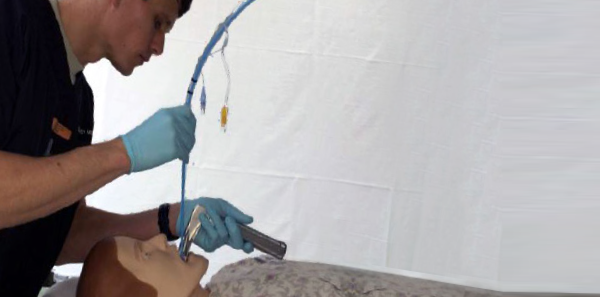
One of the most common mistakes when using a bougie is removing the laryngoscope before railroading the endotracheal tube over the bougie. This will cause the tongue and oropharyngeal structures to collapse posteriorly and potentially inhibit passage of the tube. It is therefore imperative to maintain the laryngoscope in place until the tube has passed through the cords successfully. If resistance is met with the laryngoscope blade still in place, it is likely that the bevel of the ETT has been lodged against the posterior cartilages, thereby prohibiting its progress. This is easily remedied by retracting the tube 1–2 cm, rotating it 90 degrees counterclockwise, and subsequently advancing the tube again.15
Explore This Issue
ACEP Now: Vol 40 – No 02 – February 2021Conclusion
The best way to master the bougie is practice. While the bougie has been around for almost three quarters of a century, it is still widely seen as a backup “adjunct.” However, recent evidence and forward-thinking emergency physicians are starting to change that paradigm. The widespread use of “bougie first” has the potential to revolutionize emergency airway management, leading to better outcomes for patients.
 Dr. Cunningham is a PGY2 emergency medicine resident at Maricopa Medical Center in Phoenix, Arizona, with interests in airway management and critical care. In his free time, he is a mediocre mountain biker and wannabe polyglot.
References
- Driver BE, Prekker ME, Klein LR, et al. Effect of use of a bougie vs endotracheal tube and stylet on first-attempt intubation success among patients with difficult airways undergoing emergency intubation: a randomized clinical trial. JAMA. 2018;319(21):2179-2189.
- Macintosh RR. An aid to oral intubation (letter). BMJ. 1949;1:28.
- El-Orbany MI, Salem MR, Joseph NJ. The Eschmann tracheal tube introducer is not gum, elastic, or a bougie. Anesthesiology. 2004;101(5):1240
- Kidd JF, Dyson A, Latto IP. Successful difficult intubation. Use of the gum elastic bougie. Anaesthesia. 1988;43(6):437-438. Erratum in: Anaesthesia. 1988;43(9):822.
- Nolan JP, Wilson ME. Orotracheal intubation in patients with potential cervical spine injuries. An indication for the gum elastic bougie. Anaesthesia. 1993;48(7):630-633.
- Cormack RS, Lehane J. Difficult tracheal intubation in obstetrics. Anaesthesia. 1984;39(11):1105-1111.
- Rich JM. Successful blind digital intubation with a bougie introducer in a patient with an unexpected difficult airway. Proc (Bayl Univ Med Cent). 2008;21(4):397-399.
- Gottlieb M, Sharma V, Field J, et al. Utilization of a gum elastic bougie to facilitate single lung intubation. Am J Emerg Med. 2016;34(12):2408-2410.
- Price TM, McCoy EP. Emergency front of neck access in airway management. BJA Educ. 2019;19(8):246-253.
- Brown CA 3rd, Bair AE, Pallin DJ, et al; NEAR III Investigators. Techniques, success, and adverse events of emergency department adult intubations. Ann Emerg Med. 2015;65(4):363-370.e1.
- Hodzovic I, Latto IP, Henderson JJ. Bougie trauma—what trauma? Anaesthesia. 2003;58(2):192-193.
- Kadry M, Popat M. Pharyngeal wall perforation—an unusual complication of blind intubation with a gum elastic bougie. Anaesthesia. 1999;54(4):404-405.
- Marty-Ané CH, Picard E, Jonquet O, et al. Membranous tracheal rupture after endotracheal intubation. Ann Thorac Surg. 1995;60(5):1367-1371.
- Miñambres E, Burón J, Ballesteros MA, et al. Tracheal rupture after endotracheal intubation: a literature systematic review. Eur J Cardiothorac Surg. 2009;35(6):1056-1062.
- Dogra S, Falconer R, Latto IP. Successful difficult intubation. Tracheal tube placement over a gum-elastic bougie. Anaesthesia. 1990;45(9):774-776.
Pages: 1 2 3 4 | Single Page



2 Responses to “The Bougie as an Airway Savior”
March 9, 2021
Robert ProsserAMEN. I’be been practicing EM for 45 years, residency trained, etc, trauma centers, etc. Especially in this covid where rapid intubation is important to limit contamination, it can be slipped in much quicker than the tube and reduces failures. In C-L IV, you can slip the bougie under the epiglottis without seeing the cords and feel the clicking to know the location is correct. I ALWAYS have one open when I intubate, and usually use one. Every time I have had to help someone with a failed airway, this has saved us.
March 14, 2021
George KovacsThanks for your nice review. Your readers may be interested in recently released deep dive into bougie use we posted to support our AIME programming (A Canadian, National airway program) that has been supporting airway learners and practitioners for over 20 years. It’s all FOAM materials:
1. Laryngoscopy and Bougie Pearls and Pitfalls Part 1: When and Why:
https://www.youtube.com/watch?v=hjF0KgQVLvA&ab_channel=AIMEAirway
2. Laryngoscopy and Bougie Pearls and Pitfalls Part 2: How to
https://www.youtube.com/watch?v=CfU_ZdJ9hzA&ab_channel=AIMEAirway
Note website is being modified