
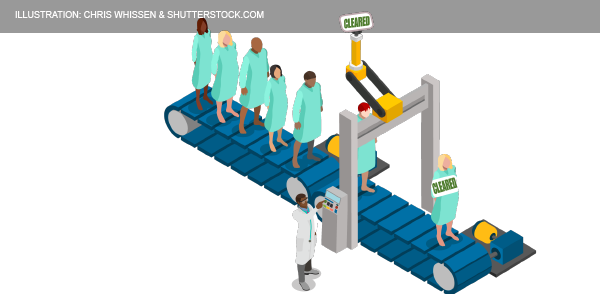
Several factors favor psychiatric illness including history of psychiatric illness, younger age, and onset over weeks to months. Factors favoring organic illness include no history of psychiatric illness, age older than 40 years, onset over hours to days, complaint of headache, and any recent new medication.5
Explore This Issue
ACEP Now: Vol 36 – No 09 – September 2017A detailed extensive mental status exam is not necessary in every patient with a behavioral problem. A study in the American Journal of Emergency Medicine showed that the Quick Confusion Scale is as reliable as a full Mini-Mental Status Examination in revealing an altered level of awareness that may help pick up organic pathology.6
The three key elements of the mental status exam are orientation, memory, and judgment, which can often be gleaned from the patient encounter by an experienced EM provider without using a validated scale.
Generally speaking, auditory hallucinations are more indicative of a psychiatric illness, whereas visual hallucinations are more indicative of an organic illness. While about 15 percent of patients with schizophrenia are said to experience visual hallucinations, these tend to occur in those schizophrenics with severe illness and usually in addition to auditory hallucinations.
Physical Exam Clues to Differentiate Organic Versus Psychiatric Illness
As always, vital signs are vital! Any abnormality in vital signs should be addressed and accounted for.
Hypoglycemia can mimic many psychiatric illnesses, from catatonic schizophrenia to severe depression, and could be considered as “the sixth vital sign”: blood glucose (ABC Don’t Ever Forget Glucose).
Look for fluctuating level of awareness as it is rare in isolated psychiatric illness and often signifies delirium with an underlying toxin, metabolic abnormality, or central nervous system lesions. Scrutinize the patient’s eyes. Any abnormality in gaze, nystagmus, pupillary dilation, etc. may signify organic pathology. Ask the patient to protrude their tongue. If you see a laceration, think about a postictal state. Take a moment to look up the patient’s nose; you might be surprised to find cocaine, crushed bupropion, or any number of toxins that the patient has insufflated.
Screening Lab Tests or Head CT Scan?
There is no evidence-based list or panel of investigations or order set that can be applied to all psychiatric patients requiring medical clearance.
Routine lab test screening: Several retrospective studies suggest that for psychiatric patients presenting to the emergency department with a behavioral chief complaint, almost all acute medical illnesses requiring treatment could have been identified if a thorough history and physical were performed and that routine laboratory screening has a very low yield for clinically significant acute medical illness.7-9
Urine drug screens are not required routinely in the psychiatric patients, as supported by the ACEP guidelines. Most patients, if asked in a nonaccusatory manner, will tell you what drugs they have recently taken. Olshaker et al found that the reliability of self-reported drug use had a sensitivity of 92 percent and specificity of 91 percent.4 The reliability of self-reported alcohol use was 96 percent sensitive and 87 percent specific. In addition, urine drug screens have many false positives and negatives, which can be misleading.
Pages: 1 2 3 4 | Single Page



No Responses to “How to Tell Whether a Psychiatric Emergency is Due to Disease or Psychological Illness”