
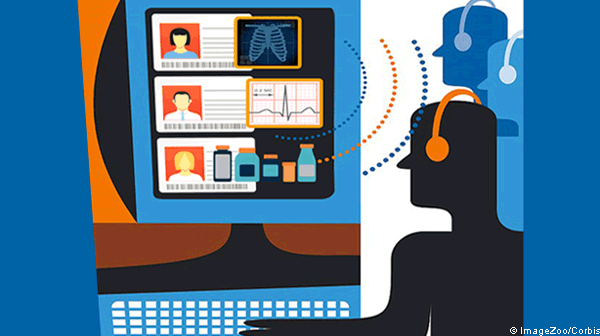
According to Jonathan D. Linkous, chief executive officer, ATA, Washington, DC, among telemedicine’s newer uses is having EMS personnel send information, such as an initial diagnosis and vital signs, to emergency physicians prior to a patient’s arrival. And because there are a limited number of burn centers equipped with specialists, this is a growing area for telemedicine, as well. Telemedicine is also increasing in popularity in rural hospitals that do not have access to full-time emergency physicians.
Benefits Abound
For the patient, telemedicine provides access to specialty care that couldn’t be obtained otherwise, resulting in improved patient outcomes and patient satisfaction. In fact, according to a study in Telemedicine Journal, overall patient satisfaction with telemedicine was found to be 98.3 percent.1
For physicians, telemedicine gives access to all of the resources of a tertiary-care hospital so they can provide better patient care. “This is absolutely critical in emergency rooms when patients need very specialized care,” Linkous said. Clinical effectiveness and efficiency also increases.
Dr. Newton said telemedicine allows the hospital to provide patients with a team approach to time-sensitive stroke care. “Our telemedicine partner provides a callback consultation with the emergency department physician within 15 minutes and bedside exam within 30 minutes—and oftentimes sooner,” she said. “It allows us to share the job of informed consent, has improved the emergency department physician’s comfort level with administering tPA in appropriate cases, and has allowed us to have face-to-face team discussions about time-sensitive stroke care in real time.”
Consider ACEP’s Telemedicine Section
 ACEP’s Telemedicine Section brings together emergency medicine practitioners interested in expanding patient care into the digital world. While not much has changed in the ideology behind telehealth since the group’s initial conception, improved access to high-speed technology and a greater cultural acceptance of digital communication are revitalizing the field.
Last year, leaders in the ACEP Telemedicine Section completed a paper that gives an overview of the definition of telehealth, the history of telehealth, current technology, practical uses, cost and reimbursement, quality-improvement measures integrated with telehealth, as well as potential risks and opportunities to its use.
“Telehealth in Emergency Medicine: a Primer” was written by Nel Sikka, MD, FACEP, Sara Paradise, MSIV, and Michael Shu, MSII, from the George Washington University School of Medicine & Health Sciences. Get a link to the paper and contact one of the section officers at www.acep.org/telemedicine.
Collegial support offered by the telemedicine physician team has also resulted in improved physician retention and recruitment in rural facilities. “These physicians feel less isolated with ready access to peers for consultation and additional support on difficult or multiple cases,” said Donald J. Kosiak Jr., MD, MBA, FACEP, eCARE executive medical director and emergency medicine physician of telemedicine provider Avera Health, Sioux Falls, SD.
Pages: 1 2 3 4 | Single Page



No Responses to “From Teleneurology to Telepsychiatry, EDs Increasingly Rely on Telemedicine”