
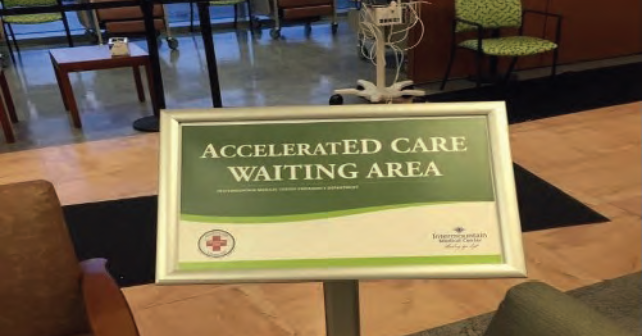
It is important to note that sending a physician alone to the waiting room without proper resources is a failed tactic.
Explore This Issue
ACEP Now: Vol 43 – No 03 – March 2024The physician in the waiting room has no capability to begin the workup and treatments without the right resources. By creating a PIT that is properly staffed and resourced, the diagnostic and treatment phase of the ED encounter can actually begin. Many patients have results posted by the time they are taken to their rooms, making a final disposition quick and efficient.
A second quick fix in the front end that is worth considering in 2024 is the Behavioral Health Team (BHT) program implemented at Lancaster General Hospital (LGH).14 This innovative process helps a department to address the surge of behavioral health patients now presenting in a post-pandemic tidal wave to EDs across the country. With an extraordinarily large waiting room as part of their footprint, the LGH ED was able to create a space for the BHT to evaluate mental-health patients in the front end. Many patients did not need to go back to the main emergency department or even occupy a room. With the exception of regional psychiatric receiving hospital EDs, the percent of all patients presenting with acute psychosis, mood disorders, drug abuse and detox, and suicidality is approaching 13 percent, but only a small and variable fraction of these patients need inpatient care.15,16 The BHT had a small unit established in the waiting room using room using dividers, a desk and lounge chairs. From here the majority of patients were screened, treated and discharged with outpatient referrals. If the patient needed a medical issue addressed, the PIT physician (who was working in an adjacent area) was able to easily drop in to assist the BHT to write a few orders or do a quick medical clearance. These are two of the few quick fixes open to an ED, which use ED resources to continue patient flow when the department is struggling with crushing levels of boarding.
Two additional quick-fix tactics involving the back end are not really new:
- the Admission Holding Unit and
- the Full Capacity Protocol
The former involves dedicating a space (within, adjacent to or outside of the main ED) where admitted patients are localized and managed with special policies and procedures.17 Increasingly, these admitted patients are being managed by inpatient teams. The latter quick-fix strategy was introduced some 20 years ago by Peter Viccellio, MD, FACEP, at the Renaissance School of Medicine at Stony Brook University in Stony Brook, New York. It quite simply involves moving patients from the ED hallways to upstairs inpatient hallways. Using very clear inclusion and exclusion criteria, patients being admitted to floors (not intensive care units) are systematically placed in the hallways adjacent to their designated rooms. The inpatient teams assume care for them while they wait for their assigned beds to be vacated and cleaned. Miraculously, these tasks are seen to occur more expeditiously when the inpatient team is now face-to-face with their newly admitted patient. Its success has been repeated wherever it has been introduced.18



One Response to “Survival Tactics for Emergency Department Boarding”
March 10, 2024
Todd B Taylor, MD, FACEPThank you Shari. Your contribution to addressing this & other serious healthcare issues over the years has been laudable.
The failure of inpatient bed capacity to keep up with population is stark, albeit sameday outpatient surgery with new techniques have changed a 2-day hospital stay into a long afternoon in post-op. And, changes in healthcare funding policy has forced hospitals & others to dramatically change business practices.
In Arizona, in the late 1990’s to late 2000’s the Arizona ACEP Chapter had a huge impact on hospital crowding, to which you alluded.
But, now, here we are again & what appears to be worse & more wide-spread. So once again, the Arizona Chapter Board is taking action to draw attention to & impact this serious issue.
This time, we have chosen to employ data (not readily available in the past) to incentivize hospitals to take appropriate action & join with the EM community to lobby for policy changes. Anyone interested may contact me for a summary.
Thanks again for summarizing this timely topic.