
Logo

Log In Sign Up |  An official publication of: American College of Emergency Physicians
Navigation
  • Home
  • Multimedia
    • Podcasts
    • Videos
  • Clinical
    • Airway Managment
    • Case Reports
    • Critical Care
    • Guidelines
    • Imaging & Ultrasound
    • Pain & Palliative Care
    • Pediatrics
    • Resuscitation
    • Trauma & Injury
  • Resource Centers
    • mTBI Resource Center
  • Career
    • Practice Management
      • Benchmarking
      • Reimbursement & Coding
      • Care Team
      • Legal
      • Operations
      • Quality & Safety
    • Awards
    • Certification
    • Compensation
    • Early Career
    • Education
    • Leadership
    • Profiles
    • Retirement
    • Work-Life Balance
  • Columns
    • ACEP4U
    • Airway
    • Benchmarking
    • Brief19
    • By the Numbers
    • Coding Wizard
    • EM Cases
    • End of the Rainbow
    • Equity Equation
    • FACEPs in the Crowd
    • Forensic Facts
    • From the College
    • Images in EM
    • Kids Korner
    • Medicolegal Mind
    • Opinion
      • Break Room
      • New Spin
      • Pro-Con
    • Pearls From EM Literature
    • Policy Rx
    • Practice Changers
    • Problem Solvers
    • Residency Spotlight
    • Resident Voice
    • Skeptics’ Guide to Emergency Medicine
    • Sound Advice
    • Special OPs
    • Toxicology Q&A
    • WorldTravelERs
  • Resources
    • ACEP.org
    • ACEP Knowledge Quiz
    • Issue Archives
    • CME Now
    • Annual Scientific Assembly
      • ACEP14
      • ACEP15
      • ACEP16
      • ACEP17
      • ACEP18
      • ACEP19
    • Annals of Emergency Medicine
    • JACEP Open
    • Emergency Medicine Foundation
  • About
    • Our Mission
    • Medical Editor in Chief
    • Editorial Advisory Board
    • Awards
    • Authors
    • Article Submission
    • Contact Us
    • Advertise
    • Subscribe
    • Privacy Policy
    • Copyright Information

Superficial Venous Thromboses, Intracranial Aneurysms, and Treating High Glucose Levels: More Myths in Emergency Medicine

By Kevin M. Klauer, DO, EJD, FACEP | on January 10, 2017 | 0 Comment
Myths in EM
  • Tweet
  • Click to email a link to a friend (Opens in new window) Email
Print-Friendly Version

1.All Superficial Venous Thromboses Are Created Equal?
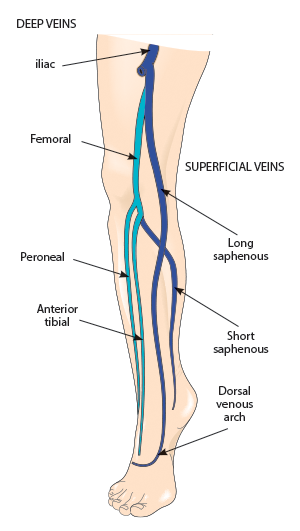
Deep and superficial veins

You Might Also Like
  • Sutures for Skin Tears, Oxygen Therapy for STEMI Patients, and Blood Alcohol Levels to Assess Intoxication: More Myths in Emergency Medicine
  • Myths in Emergency Medicine: Computed Tomography Pulmonary Angiograms as Imaging Standard, and Radiographs for Pelvic Trauma
  • Myths in Emergency Medicine: 24-Hour Treatment with Antibiotics for Strep Throat
Explore This Issue
ACEP Now: Vol 36 – No 01 – January 2017

Figure 1: Deep and superficial veins
Credit: SHUTTERSTOCK.COM

It is very easy to take the ultrasound report at face value and treat superficial venous thrombosis (SVT) as a benign entity distinctly different from deep venous thrombosis (DVT). However, that reasoning may result in missed or delayed diagnosis of DVT or inadequate treatment of at-risk patients. The belief that SVT is benign and DVT is potentially serious is an oversimplification of the disease process. The fact is that venous thrombosis is a continuum, and SVT and DVT are directly linked and not distinctly different. The key is in the location of the clot and the patient’s risk profile. Emergency physicians, and patients, can be victimized by limited data on an ultrasound report. All SVTs are not created equal. It’s just like real estate—location, location, location.

In an enlightening review article, Litzendorf and Satiani report that the incidence of DVT from SVT ranges from 6 percent to 40 percent (those with a history of prior DVT) and that the incidence of symptomatic pulmonary embolism (PE) associated with SVT ranges from 2 percent to 13 percent.1 In short, an isolated distal lesser saphenous vein SVT is not the same as one at or approaching the saphenopopliteal junction or, worse, the saphenofemoral junction (see Figure 1). Despite the usual limitations of a review article, it provides some nice insight into recognition of those at risk for clot propagation and development of DVT or even PE. Nonsteroidal anti-inflammatory drugs and heat are probably fine for inconsequential SVTs. However, systemic anticoagulation (just like a DVT), repeat ultrasound to look for propagation, and investigation of risk factors (eg, prior DVT, a history of malignancy, the presence of varicosities, and hypercoagulable disorders [up to 35 percent of patients with SVT]) are important considerations with a precariously placed proximal SVT. This article provided a nice flowchart (see Figure 2), prompting treatment options based on several factors. Concomitant DVT is also common. Binder et al, in a prospective, observational study, noted that in 46 consecutive patients with SVT, 24 percent had concomitant DVT, with 73 percent in the affected leg, 9 percent in the contralateral leg, and 18 percent in both legs.2

There is no single right answer because so many variables may impact the treatment plan. However, recognizing the significance of proximal SVT, compared to other locations, and considering concomitant DVT are critical to ensuring a good outcome.

Pages: 1 2 3 4 | Single Page

Topics: CardiovascularClinicalED Critical CareEmergency DepartmentEmergency MedicineEmergency PhysicianGlucoseIntracranial AneurysmsMythNeurologicalPatient CareQuality & SafetyStrokeSuperficial Venous ThrombosesTreatment

Related

  • Let Core Values Help Guide Patient Care

    November 5, 2025 - 0 Comment
  • Non-Invasive Positive Pressure Ventilation in the Emergency Department

    October 1, 2025 - 0 Comment
  • Emergency Department Management of Prehospital Tourniquets

    October 1, 2025 - 0 Comment

Current Issue

ACEP Now: November 2025

Download PDF

Read More

About the Author

Kevin M. Klauer, DO, EJD, FACEP

Kevin M. Klauer, DO, EJD, FACEP, is Chief Medical Officer–hospital-based services and Chief Risk Officer for TeamHealth as well as the Executive Director of the TeamHealth Patient Safety Organization. He is a clinical assistant professor at the University of Tennessee and Michigan State University College of Osteopathic Medicine. Dr. Klauer served as editor-in-chief for Emergency Physicians Monthly publication for five years and is the co-author of two risk management books: Emergency Medicine Bouncebacks: Medical and Legal and Risk Management and the Emergency Department: Executive Leadership for Protecting Patients and Hospitals. Dr. Klauer also serves on the ACEP Board.

View this author's posts »

No Responses to “Superficial Venous Thromboses, Intracranial Aneurysms, and Treating High Glucose Levels: More Myths in Emergency Medicine”

Leave a Reply Cancel Reply

Your email address will not be published. Required fields are marked *


*
*


Wiley
  • Home
  • About Us
  • Contact Us
  • Privacy
  • Terms of Use
  • Advertise
  • Cookie Preferences
Copyright © 2025 by John Wiley & Sons, Inc. All rights reserved, including rights for text and data mining and training of artificial technologies or similar technologies. ISSN 2333-2603