Logo

Log In Sign Up |  An official publication of: American College of Emergency Physicians
Navigation
  • Home
  • Multimedia
    • Podcasts
    • Videos
  • Clinical
    • Airway Managment
    • Case Reports
    • Critical Care
    • Guidelines
    • Imaging & Ultrasound
    • Pain & Palliative Care
    • Pediatrics
    • Resuscitation
    • Trauma & Injury
  • Resource Centers
    • mTBI Resource Center
  • Career
    • Practice Management
      • Benchmarking
      • Reimbursement & Coding
      • Care Team
      • Legal
      • Operations
      • Quality & Safety
    • Awards
    • Certification
    • Compensation
    • Early Career
    • Education
    • Leadership
    • Profiles
    • Retirement
    • Work-Life Balance
  • Columns
    • ACEP4U
    • Airway
    • Benchmarking
    • Brief19
    • By the Numbers
    • Coding Wizard
    • EM Cases
    • End of the Rainbow
    • Equity Equation
    • FACEPs in the Crowd
    • Forensic Facts
    • From the College
    • Images in EM
    • Kids Korner
    • Medicolegal Mind
    • Opinion
      • Break Room
      • New Spin
      • Pro-Con
    • Pearls From EM Literature
    • Policy Rx
    • Practice Changers
    • Problem Solvers
    • Residency Spotlight
    • Resident Voice
    • Skeptics’ Guide to Emergency Medicine
    • Sound Advice
    • Special OPs
    • Toxicology Q&A
    • WorldTravelERs
  • Resources
    • ACEP.org
    • ACEP Knowledge Quiz
    • Issue Archives
    • CME Now
    • Annual Scientific Assembly
      • ACEP14
      • ACEP15
      • ACEP16
      • ACEP17
      • ACEP18
      • ACEP19
    • Annals of Emergency Medicine
    • JACEP Open
    • Emergency Medicine Foundation
  • About
    • Our Mission
    • Medical Editor in Chief
    • Editorial Advisory Board
    • Awards
    • Authors
    • Article Submission
    • Contact Us
    • Advertise
    • Subscribe
    • Privacy Policy
    • Copyright Information

Stories from the Ukrainian War: How Doctors and Refugees are Surviving

By Sophia Görgens, MD, Svetlana Zakharchenko, MD, and Tanya Bucierka, MD | on November 8, 2022 | 0 Comment
Resident Voice
  • Tweet
  • Click to email a link to a friend (Opens in new window) Email
Print-Friendly Version

Across the border and in the heart of Ukraine, the refugee situation is no better. School gymnasiums and classrooms, monasteries, fitness studios, and other storefronts have all been re-appropriated to house the ever-growing number of refugees fleeing eastern Ukraine for the relative safety of western Ukraine. Tanya Bucierka, DO, an emergency physician from Oregon with deep Ukrainian roots, has made the perilous journey across the border by bus twice already, with plans for a third trip this fall.

You Might Also Like
  • Updates from EM Physicians in Ukraine and Poland
  • News From the Frontline: How Emergency Physicians in Ukraine Are Coping
  • Television Show Untold Stories Seeks Anecdotes from Emergency Physicians
Explore This Issue
ACEP Now: Vol 41 – No 11 – November 2022

Ukrainian refugees are examined by physician volunteers in Poland.

“It’s a lot of primary care, but more than headache cures or blood pressure medications, many of the patients just want someone to hear their stories,” Dr. Bucierka said. “They may be resilient, but they’re still traumatized.”

She remembers meeting Petro, a Russian-speaking refugee who lived in Luhansk in eastern Ukraine. A hacking, wet cough interrupted him whenever he tried to speak—after spending a month underground in a bomb shelter, hardly ever venturing above ground, his untreated respiratory symptoms sounded suspiciously like pneumonia. When Petro and his wife Anna finally fled Luhansk, they had to dig their car out of the debris, finding that everything was covered in ashes. Anna, who had similar symptoms, minimized it as a simple chest cold and at first refused the medication offered.

“The soldiers on the frontlines need it more than us. Send it to them,” she said, apologizing for speaking in Russian. She and Petro are Ukrainian but don’t speak the language—it never seemed important before, but now they are taking a free class, trying desperately to learn. The war forced them from eastern to western Ukraine, but no matter how much the fighting intensifies, they are determined to flee no further. “This is our home.”

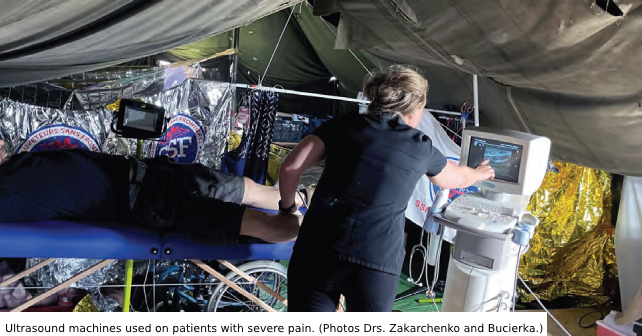
When Dr. Bucierka is not braving the road in a car heaped full of donated medical supplies to make rounds among the refugees, she can be found in the local medical university’s simulation lab, where she teaches point of care ultrasound to a group of Ukrainian doctors while in another classroom her surgical colleague demonstrates trauma surgery techniques on pig cadavers. Before the war, many civilian physicians had limited experience with trauma medicine. The Ukrainian emergency physicians learn eFAST, cardiac, ocular, and musculoskeletal ultrasound exams, cramming years of knowledge into a few short days so that they can return to the frontlines, bringing the new techniques—and the new donated ultrasound machines—with them.

Pages: 1 2 3 | Single Page

Topics: battlefield medicineInternationalUkraineVolunteer

Related

  • The First National Congress on Emergency Medical Care in Ukraine

    December 4, 2025 - 0 Comment
  • Emergency Physicians Volunteer to Deliver Care

    December 4, 2024 - 0 Comment
  • April 2023 News From the College

    April 3, 2023 - 0 Comment

Current Issue

ACEP Now: November 2025

Download PDF

Read More

No Responses to “Stories from the Ukrainian War: How Doctors and Refugees are Surviving”

Leave a Reply Cancel Reply

Your email address will not be published. Required fields are marked *


*
*


Wiley
  • Home
  • About Us
  • Contact Us
  • Privacy
  • Terms of Use
  • Advertise
  • Cookie Preferences
Copyright © 2025 by John Wiley & Sons, Inc. All rights reserved, including rights for text and data mining and training of artificial technologies or similar technologies. ISSN 2333-2603
