Logo

Log In Sign Up |  An official publication of: American College of Emergency Physicians
Navigation
  • Home
  • Multimedia
    • Podcasts
    • Videos
  • Clinical
    • Airway Managment
    • Case Reports
    • Critical Care
    • Guidelines
    • Imaging & Ultrasound
    • Pain & Palliative Care
    • Pediatrics
    • Resuscitation
    • Trauma & Injury
  • Resource Centers
    • mTBI Resource Center
  • Career
    • Practice Management
      • Benchmarking
      • Reimbursement & Coding
      • Care Team
      • Legal
      • Operations
      • Quality & Safety
    • Awards
    • Certification
    • Compensation
    • Early Career
    • Education
    • Leadership
    • Profiles
    • Retirement
    • Work-Life Balance
  • Columns
    • ACEP4U
    • Airway
    • Benchmarking
    • Brief19
    • By the Numbers
    • Coding Wizard
    • EM Cases
    • End of the Rainbow
    • Equity Equation
    • FACEPs in the Crowd
    • Forensic Facts
    • From the College
    • Images in EM
    • Kids Korner
    • Medicolegal Mind
    • Opinion
      • Break Room
      • New Spin
      • Pro-Con
    • Pearls From EM Literature
    • Policy Rx
    • Practice Changers
    • Problem Solvers
    • Residency Spotlight
    • Resident Voice
    • Skeptics’ Guide to Emergency Medicine
    • Sound Advice
    • Special OPs
    • Toxicology Q&A
    • WorldTravelERs
  • Resources
    • ACEP.org
    • ACEP Knowledge Quiz
    • Issue Archives
    • CME Now
    • Annual Scientific Assembly
      • ACEP14
      • ACEP15
      • ACEP16
      • ACEP17
      • ACEP18
      • ACEP19
    • Annals of Emergency Medicine
    • JACEP Open
    • Emergency Medicine Foundation
  • About
    • Our Mission
    • Medical Editor in Chief
    • Editorial Advisory Board
    • Awards
    • Authors
    • Article Submission
    • Contact Us
    • Advertise
    • Subscribe
    • Privacy Policy
    • Copyright Information

Stethoscopes & Hearing Aids: Choosing the Right Devices for You

By David Baehren, MD, FACEP | on September 2, 2020 | 1 Comment
Features
  • Tweet
  • Click to email a link to a friend (Opens in new window) Email
Print-Friendly Version
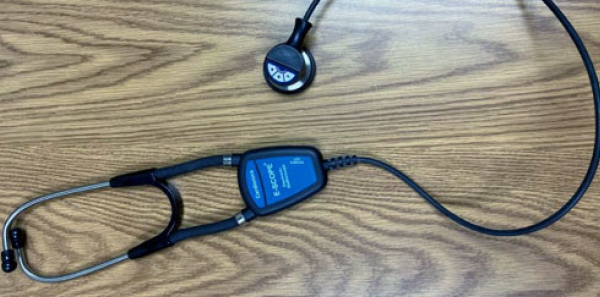
Figure 1: An amplified stethoscope.

DB: What hearing aid features are best for physicians?

You Might Also Like
  • Published Clinical Decision Aids May Lack Validation
  • The Internet of Medical Things, Useful Devices for Emergency Physicians
  • Interpreting Pediatric Breathing Issues
Explore This Issue
ACEP Now: Vol 39 – No 08 – August 2020

CP: Different physicians have different communication needs depending on their specialty and lifestyle, so as with any patient, the audiologist must work with the physician to find the right solution. The emergency department physician typically works in a noisy environment. Noise-reduction signal processing may make this environment more comfortable, but that will compromise the physician’s ability to hear speech, so this feature may need to be reduced. The directional microphone, which is a signal-processing technique that helps the hearing aid user hear what is directly in front of them, helps people hear in noise. The ED physician, however, may not want sound to the sides and rear reduced in their work environment. The audiologist will work with the ED physician to select and tune these features and may provide more than one listening program so the physician will have options depending on the listening environment.

DB: What are some advanced features in the latest generation of hearing aids?

CP: The most recent hearing aid features are focused on connectivity to cellphones so calls, music, and podcasts can transfer wirelessly to the hearing aids. The cellphone can be used as a remote control as well, allowing the user to make changes in specific listening environments. In addition, we are starting to see hearing aids that track steps and detect falls. Some hearing aids can be set to change programming based on GPS location.

DB: Could my hearing loss be related to ED noise?

CP: Whether a particular sound exposure can damage hearing is based on dose, which consists of sound level and length of exposure. If you are worried about the level of sound in your ED, you can download a free app to measure the sound level around you. Most of the available apps are reasonably accurate. OSHA suggests you should not be exposed to sound higher than 90 dB SPL (sound pressure level) for eight hours. Louder sounds are dangerous in shorter amounts of time.

[/fullbar]


Dr. Baehren is an emergency physician in Ohio.

Pages: 1 2 3 4 5 | Single Page

Topics: careerhearing aidshearing lossstethoscopes

Related

  • Choose Your Shift: The Freedom of a Locum Tenens Career in EM

    September 2, 2025 - 1 Comment
  • The 2025 Emergency Physician Compensation Report

    August 29, 2025 - 0 Comment
  • Aerospace Medicine Residency Program Pushes the Envelope

    June 25, 2025 - 1 Comment

Current Issue

ACEP Now: December 2025 (Digital)

Read More

One Response to “Stethoscopes & Hearing Aids: Choosing the Right Devices for You”

  1. June 28, 2021

    rahul kumar Reply

    Where I can buy a amplified stethoscope..

Leave a Reply Cancel Reply

Your email address will not be published. Required fields are marked *


*
*


Careers Center
  • Emergency Medicine Physician - Kansas City - Forbes' list of the 20 Happiest Cities to Work in 2025

    Research Medical Center offers high-tech care in a beautiful, comfortable setting designed to exceed the expectations of those we serve.

    Kansas City

    < $656,000 + Benefits + Sign On Bonus + Relocation + Forbes' list of the 20 Happiest Cities to work

    HCA Healthcare

    Read More
  • Physician - Emergency Medicine with Mercy Hospital Ardmore, Oklahoma

    Mercy Hospital Ardmore is actively seeking a Board Certified or Board Eligible Emergency Medicine Physician to join our Level III Trauma Center...

    Ardmore, Oklahoma

    Compensation & Benefits

    Mercy Hospital Ardmore, Oklahoma

    Read More
  • Healing a Nation, One Heartbeat at a Time - Emergency Medicine - Tahlequah, OK

    Cherokee Nation Health Services is committed to providing the highest quality of care and the most advanced, effective treatments for our patients.

    Tahlequah, Oklahoma

    Competitive standard shift rate per 12-hour shift

    Cherokee Nation

    Read More
More Jobs
Wiley
  • Home
  • About Us
  • Contact Us
  • Privacy
  • Terms of Use
  • Advertise
  • Cookie Preferences
Copyright © 2026 by John Wiley & Sons, Inc. All rights reserved, including rights for text and data mining and training of artificial technologies or similar technologies. ISSN 2333-2603

