
Several months ago, I stepped into the role of attending. No more safety-net superior to catch my resident mistakes. I became the sole decision maker. Yet venturing out on my own did not worry me, because as a senior resident nearing the end of residency, my confidence was at an all-time high. One might say I was a little cocky. However, patients are the ultimate teachers, and that cockiness would soon disappear.
Explore This Issue
ACEP Now: Vol 38 – No 02 – February 2019It was during one of my first moonlighting shifts after graduating residency when the experience of being a single-coverage provider truly set in. The patient was a middle-aged man who presented to the emergency department for arm pain. As I looked at his chart on my computer screen, I noticed he was tachycardic and febrile, with a relatively low blood pressure. As I went to assess him, he actually looked better than his vitals indicated. He told me that he had a history of a chronic nonunion fracture in his left arm and, over the last three days, had worsening swelling and pain in that same arm. On exam, he had fairly prominent swelling, erythema, and tenderness over his arm. In my mind, I knew he was septic, likely from an overlying cellulitis, but I kept things like osteomyelitis and necrotizing fasciitis in my differential. I initiated sepsis orders, started him on IV fluids and antibiotics, and ordered a CT scan of his arm. I left that room thinking it would be a straightforward case, and that I had a clear plan in sight. I was woefully wrong.
Twenty minutes later, I got called by the nurse to assess the patient because she thought he might have ventricular tachycardia (V-tach) on the monitor. I raced to the patient’s room to assess the situation. He looked at me, bewildered as to why I looked so frantic. I looked at the monitor, , and it was definitely V-tach. I asked him how he was feeling, and he said he felt fine. I took his blood pressure and it was stable. I turned to the nurse and told her to place cardioversion pads on the patient, transfer him to a resuscitation room, and start a procainamide drip.
“Doctor, we don’t stock procainamide here in the ED,” she told me. “OK, then let’s give him amiodarone instead,” I told her. She came back to say, “Doctor, we ran out of amiodarone earlier today.” “Well what do we have in stock?” “We have lidocaine available,” she responded. Lidocaine? My gut sank even lower because I was entering uncharted territory. I had no prior experience using lidocaine for an unstable patient. I frantically searched for the appropriate dosing on my phone and, with my fingers crossed, started the patient on a lidocaine drip. His rhythm normalized, but the coast was not clear.
Later, the nurse rushed toward me to tell me the patient was trying to leave and was attempting to pull out his IV. I sprinted over to the resuscitation room to find him trying to pull his leads off. I immediately asked him what was wrong and why he wanted to leave. He told me, “I don’t feel comfortable here! I’m going home!” After multiple attempts to get an explanation of what was making him uncomfortable, it became clear to me that something was off. The patient’s significant other, who was at bedside, couldn’t even change his mind. It was now evident delirium had set in. He was diaphoretic, hypotensive, and tachycardic. Despite all that, he still found a way to stand up and attempt to walk out of the emergency department. I was now faced with the choice of allowing this septic man to leave the emergency department against medical advice, perhaps to die, or finding a way to convince him to stay.
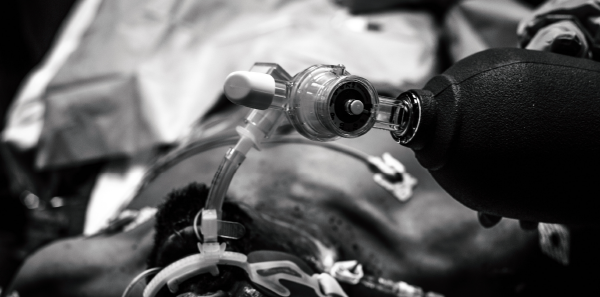
As he tried to walk out of the room, he lunged at one of the emergency department staff members who was in his way. At that point, I made the decision that he did not have the faculty to make his own decisions, given his sepsis and delirium. Luckily, he had not pulled out his IV yet, and the nurse was able to give him some midazolam. The patient was immediately sedated, but as soon as we got him back on the monitor, we found him to be markedly hypoxic. I initiated a crash intubation and was fortunate to intubate him without complication. He was later transferred to the intensive care unit, where he was found to have bacteremia secondary to the cellulitis of his arm.
That experience was a shock to my system and reminded me of how unnerving the decisions we make as emergency physicians can be. Anyone and anything can walk through the doors of the emergency department, and that case humbled me into once again appreciating that reality.
I went to visit the patient three days later in the hospital. He thanked me for my care and actually had no recollection of trying to leave that day. He may not remember, but I will always remember that evening.




No Responses to “Stepping into the Shoes of an Attending Physician”