

Sleep is essential to life. The better we sleep, the better we concentrate, make decisions, and perform.
Explore This Issue
ACEP Now: September 2025Better sleep minimizes the chance of making errors on shift.1 Better sleep makes us learn better because it plays a key role in consolidating both declarative and procedural memory.2 Better sleep means better adaptive capacity to stressful situations, which are plentiful in emergency medicine.3
The better we sleep, the better mood we tend to be in and the better our relationships.4 The better we sleep, the lower our chance of developing cancer, heart disease, depression, and the longer we live—better sleep is associated with a decreased mortality rate!5 So, the better we sleep, the happier and healthier we are.
And, as we’re all too familiar with, shift work disturbs our wonderful sleep, because shift work interrupts our circadian rhythms and our sleep drive, leading to an increased risk for a motor vehicle crash on one’s commute home.6,7 In this column, I endeavor to provide you with some simple evidence-based strategies to improve your sleep architecture, minimize disruptions in circadian rhythm, and improve your sleep so that you can perform better on shift and improve your wellness and long-term health.
The Physiology of Sleep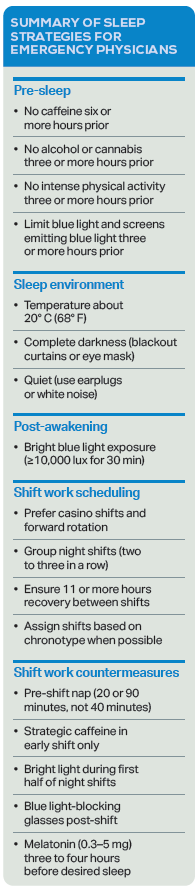
Human sleep is governed by two primary physiologic processes: the homeostatic sleep drive (Process S) and the circadian rhythm (Process C).
Process S reflects the accumulation of adenosine in the brain during wakefulness, increasing the drive to sleep over time. This process accounts for the progressive sleepiness experienced after extended wakefulness or consecutive shifts.8 Process C is regulated by the suprachiasmatic nucleus of the hypothalamus, which responds to environmental light cues—particularly blue-spectrum light—to synchronize the internal circadian rhythm to a roughly 24.2-hour cycle. Light exposure inhibits melatonin secretion via melanopsin-sensitive retinal ganglion cells, thereby promoting wakefulness.9
In contrast, darkness facilitates melatonin release and initiates sleep onset. Cortisol, a diurnal hormone, typically peaks 30–45 minutes after awakening, enhancing alertness during the daytime.10 Disruption of either Process S or Process C—as occurs frequently in shift work—results in impaired sleep duration, efficiency, and architecture. This disruption has both acute consequences (e.g., decreased vigilance, increased errors) and long-term sequelae (e.g., metabolic, psychiatric, and oncologic disease).11
Sleep Hygiene
Optimal sleep hygiene includes interventions across three domains: pre-sleep behavior, sleep environment, and post-sleep routines. These recommendations are grounded in both circadian physiology and empirically supported behavioral strategies.12
Pre-sleep behavior: Avoid vigorous physical activity, cognitively stimulating tasks, and large meals for at least three hours before bedtime. These activities elevate core body temperature and sympathetic arousal, delaying sleep onset and reducing sleep efficiency.13,14
Pages: 1 2 3 4 5 | Single Page



No Responses to “Sleep Concepts, Strategies for Shift Work in the Emergency Dept.”