Logo

Log In Sign Up |  An official publication of: American College of Emergency Physicians
Navigation
  • Home
  • Multimedia
    • Podcasts
    • Videos
  • Clinical
    • Airway Managment
    • Case Reports
    • Critical Care
    • Guidelines
    • Imaging & Ultrasound
    • Pain & Palliative Care
    • Pediatrics
    • Resuscitation
    • Trauma & Injury
  • Resource Centers
    • mTBI Resource Center
  • Career
    • Practice Management
      • Benchmarking
      • Reimbursement & Coding
      • Care Team
      • Legal
      • Operations
      • Quality & Safety
    • Awards
    • Certification
    • Compensation
    • Early Career
    • Education
    • Leadership
    • Profiles
    • Retirement
    • Work-Life Balance
  • Columns
    • ACEP4U
    • Airway
    • Benchmarking
    • Brief19
    • By the Numbers
    • Coding Wizard
    • EM Cases
    • End of the Rainbow
    • Equity Equation
    • FACEPs in the Crowd
    • Forensic Facts
    • From the College
    • Images in EM
    • Kids Korner
    • Medicolegal Mind
    • Opinion
      • Break Room
      • New Spin
      • Pro-Con
    • Pearls From EM Literature
    • Policy Rx
    • Practice Changers
    • Problem Solvers
    • Residency Spotlight
    • Resident Voice
    • Skeptics’ Guide to Emergency Medicine
    • Sound Advice
    • Special OPs
    • Toxicology Q&A
    • WorldTravelERs
  • Resources
    • ACEP.org
    • ACEP Knowledge Quiz
    • Issue Archives
    • CME Now
    • Annual Scientific Assembly
      • ACEP14
      • ACEP15
      • ACEP16
      • ACEP17
      • ACEP18
      • ACEP19
    • Annals of Emergency Medicine
    • JACEP Open
    • Emergency Medicine Foundation
  • About
    • Our Mission
    • Medical Editor in Chief
    • Editorial Advisory Board
    • Awards
    • Authors
    • Article Submission
    • Contact Us
    • Advertise
    • Subscribe
    • Privacy Policy
    • Copyright Information

Serious C-Spine Injuries Are Becoming More Common—and Survivable

By Jordan Stav, MD; Thomas Kopp, MD; Marson Ma III, MD; and Fadi Daouk, MD | on January 11, 2022 | 0 Comment
Uncategorized
  • Tweet
  • Click to email a link to a friend (Opens in new window) Email
Print-Friendly Version
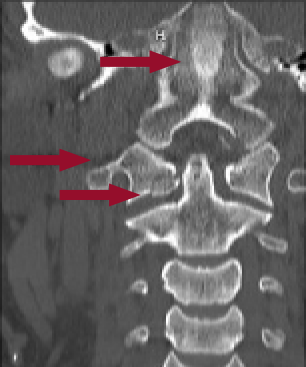
Figure 1: CT showing a C1 fracture with evidence of retroclival hemorrhage extending through foramen magnum. Facets at C1–C2 are no longer aligned.

You Might Also Like
  • Spot Rare and High-Risk Orthopedic Injuries
  • Imaging Not a Necessity for Spine Evaluation in Trauma Patients
  • Identify and Treat Lisfranc Injuries
Explore This Issue
ACEP Now: Vol 41 – No 01 – January 2022

Figure 1: CT showing a C1 fracture with evidence of retroclival hemorrhage extending through foramen magnum. Facets at C1–C2 are no longer aligned.

Atlanto-occipital dissociation (AOD) is often the result of high-velocity trauma injuries.1 It is believed that AOD may have a higher incidence than previously estimated due to the number of cervical spine (C-spine) injuries that resulted in death with AOD having been found on postmortem examinations.

The Case

A 30-year-old woman initially presented to a small community emergency department following a motor vehicle crash. The patient was a restrained driver in a sedan that was T-boned by a pickup truck in an intersection at high speed. The patient had a prolonged extraction, with initial Glasgow Coma Score (GCS) of 5. EMS was unable to intubate with direct laryngoscopy in the field but was able to use a bag valve mask effectively until arrival at the emergency department. C-spine precautions were maintained throughout the prehospital and hospital settings.

During the prompt primary survey, the patient was intubated due to having a GCS of 3. The patient subsequently had a one-view chest X-ray to confirm placement and was quickly transferred to the Level 1 trauma center. Upon arrival to our emergency department, the patient was assessed by an emergency medicine resident, the emergency medicine attending, and the trauma team. The patient was arousable, with a GCS of 10T. She was moving all extremities and demonstrated minimal external signs of trauma; however, she may have had mildly decreased sensation on the right side. The patient was quickly sent to CT following the primary survey, focused assessment with sonography in trauma (FAST), X-rays, and secondary survey. Despite the patient’s well appearance, her C-collar remained on and C-spine precautions were kept.

Following CT, we received an urgent call from the radiologist that the CT demonstrated a retroclival hemorrhage extending through the foramen magnum with mass effect on the medulla and upper cervical spinal cord, as well as a displaced type 3 left occipital condylar fracture and mildly displaced fracture through right anterior C1 arch (See Figure 1). The neurosurgery consult note read, “Atlanto-occipital dissociation injury—extremely unstable, skull is detached from C-spine. Typically, this injury is immediately fatal in about 80% of cases.”

Discussion

Figure 2: MRI showing a subdural hematoma at the cervical medullary junction causing stenosis to the spinal canal just inferior to the foramen magnum Figure 2: MRI showing a subdural hematoma at the cervical medullary junction causing stenosis to the spinal canal just inferior to the foramen magnum

Pages: 1 2 3 | Single Page

Topics: atlanto-occipital dissociation (AOD)c-spineHead and neckSpine

Related

  • Is There Any Way Out for Spinal Epidural Abscess?

    November 7, 2025 - 1 Comment
  • Consider This When Evaluating Mysterious Back Pain

    December 15, 2020 - 1 Comment
  • Emergency Physician’s Neck Pain and Headache Lead to Dissection Diagnosis

    February 13, 2017 - 3 Comments

Current Issue

ACEP Now: November 2025

Download PDF

Read More

No Responses to “Serious C-Spine Injuries Are Becoming More Common—and Survivable”

Leave a Reply Cancel Reply

Your email address will not be published. Required fields are marked *


*
*


Wiley
  • Home
  • About Us
  • Contact Us
  • Privacy
  • Terms of Use
  • Advertise
  • Cookie Preferences
Copyright © 2025 by John Wiley & Sons, Inc. All rights reserved, including rights for text and data mining and training of artificial technologies or similar technologies. ISSN 2333-2603
