
A Loaded Question: Is SLT Obsolete?
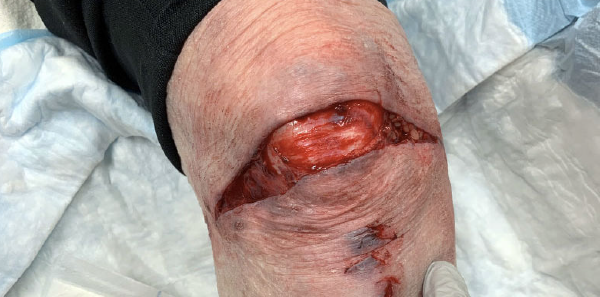
In 2013, Konda et al also published a study investigating CT scan as an alternative to SLT.10 In this study of 62 patients presenting to the emergency department with periarticular knee wounds, the presence of intra-articular air on CT scan had 100 percent sensitivity and 100 percent specificity for diagnosing traumatic knee arthrotomy when direct arthroscopic visualization or septic arthritis at follow-up were used as the gold standard for diagnosis. In this same study, the sensitivity of SLT was measured to be 92 percent. The authors conclude that “CT scan performs better than the conventional SLT to identify traumatic knee arthrotomies.” An important caveat is that the study was underpowered to detect patients who go on to develop septic arthritis after a negative CT scan.
Explore This Issue
ACEP Now: Vol 39 – No 04 – April 2020This leaves emergency physicians in a difficult spot. Currently, SLT is the generally accepted practice when evaluating a patient for a traumatic knee arthrotomy; however, the evidence behind SLT is weak at best. Should we retire SLT in favor of CT scan? How much evidence is needed to change our practice when the current “standard” practice also has only weak evidence behind it?
This is a difficult philosophical question without a clear answer. However, I can offer some advice for the emergency physician facing such a scenario.
First, discuss the scenario with your fellow emergency physicians and subspecialty colleagues. See if there is a generally accepted practice, policy, or protocol at your institution. It is best not to deviate from the generally accepted practices at your institution unless you have a good reason for doing so. Consider crafting a policy or protocol with your colleagues if your institution does not have one.
Second, discuss the scenario with your patient. They may not understand the nuances of evidence-based medicine, but most will understand uncertainty. Explain your thought process, present the patient with options if you feel it is appropriate, reach a decision together, and document as such.
Finally, consider your own philosophy and values. How much evidence do you need to change your practice? What is your risk tolerance? Are you a traditionalist or an early adopter? Do you place more value in the wisdom of collective past experience or the progress that may come with new innovation? This is for you to decide.
Case Resolution
The case is discussed with the on-call orthopedic surgeon, the patient, and her family. Together, it is decided to proceed with CT scan, which shows no intra-articular air. The patient’s wound is irrigated and repaired, and she is discharged from the emergency department. Follow-up several weeks later reveals she has suffered no infection complications.
Pages: 1 2 3 4 | Single Page


One Response to “Saline Load or CT: What’s the Best Test for Traumatic Arthrotomy?”
April 26, 2020
Joel Pasternack, MD, PhD, FACEPGood Article by Dr. Strong.
Clinical judgement can be enhanced as follows: Explore and irrigate wound through full range of motion. Obtain cross table lateral x-ray looking for air under the patella or in supra patella recess, after irrigation. The irrigation process will make the x-ray more sensitive for air without decreasing specificity. Gentle syringe irrigation will force more air into joint than may have entered from original injury.