Logo

Log In Sign Up |  An official publication of: American College of Emergency Physicians
Navigation
  • Home
  • Multimedia
    • Podcasts
    • Videos
  • Clinical
    • Airway Managment
    • Case Reports
    • Critical Care
    • Guidelines
    • Imaging & Ultrasound
    • Pain & Palliative Care
    • Pediatrics
    • Resuscitation
    • Trauma & Injury
  • Resource Centers
    • mTBI Resource Center
  • Career
    • Practice Management
      • Benchmarking
      • Reimbursement & Coding
      • Care Team
      • Legal
      • Operations
      • Quality & Safety
    • Awards
    • Certification
    • Compensation
    • Early Career
    • Education
    • Leadership
    • Profiles
    • Retirement
    • Work-Life Balance
  • Columns
    • ACEP4U
    • Airway
    • Benchmarking
    • Brief19
    • By the Numbers
    • Coding Wizard
    • EM Cases
    • End of the Rainbow
    • Equity Equation
    • FACEPs in the Crowd
    • Forensic Facts
    • From the College
    • Images in EM
    • Kids Korner
    • Medicolegal Mind
    • Opinion
      • Break Room
      • New Spin
      • Pro-Con
    • Pearls From EM Literature
    • Policy Rx
    • Practice Changers
    • Problem Solvers
    • Residency Spotlight
    • Resident Voice
    • Skeptics’ Guide to Emergency Medicine
    • Sound Advice
    • Special OPs
    • Toxicology Q&A
    • WorldTravelERs
  • Resources
    • ACEP.org
    • ACEP Knowledge Quiz
    • Issue Archives
    • CME Now
    • Annual Scientific Assembly
      • ACEP14
      • ACEP15
      • ACEP16
      • ACEP17
      • ACEP18
      • ACEP19
    • Annals of Emergency Medicine
    • JACEP Open
    • Emergency Medicine Foundation
  • About
    • Our Mission
    • Medical Editor in Chief
    • Editorial Advisory Board
    • Awards
    • Authors
    • Article Submission
    • Contact Us
    • Advertise
    • Subscribe
    • Privacy Policy
    • Copyright Information

Saline Load or CT: What’s the Best Test for Traumatic Arthrotomy?

By Jonathan Michael Strong, MD, MPH | on April 13, 2020 | 1 Comment
Features
  • Tweet
  • Click to email a link to a friend (Opens in new window) Email
Print-Friendly Version
PHOTOS: Jonathan Strong
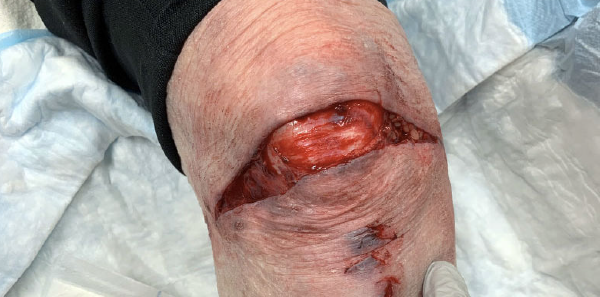
Figure 1: An 81-year-old female with a 10-cm laceration that extends across the anterior surface of the knee. Her patella is exposed but there is no clearly visible intra-articular surface to indicate violation of the joint capsule.

The Case

An 81-year-old female presents to the emergency department with a right knee injury after slipping on uneven pavement. She has a large 10-cm laceration that extends across the anterior surface of the knee (see Figure 1). Her patella is exposed; however, there is no clearly visible intra-articular surface to indicate violation of the joint capsule. Radiographs of the knee show no fractures or foreign bodies. How will you determine whether the laceration extends into the joint capsule? Does she need to go to the operating room (OR) for irrigation and debridement (I&D) to prevent septic arthritis?

You Might Also Like
  • Point-of-Care Hepatitis C Virus RNA Test Shows Good Accuracy
  • Balanced Fluids Better than Saline for IV Hydration
  • Scientists Develop New Type of HIV Test on a USB Stick
Explore This Issue
ACEP Now: Vol 39 – No 04 – April 2020

Looking for Leaks: The Saline Load Test

First described in 1975, the saline load test (SLT) is the traditional test utilized to assess for traumatic arthrotomy associated with periarticular wounds.1 Using sterile technique, an 18-gauge needle, and syringe, the joint capsule is accessed at an area away from the wound using the same approach for performing arthrocentesis. Intra-articular needle placement is confirmed by aspirating a small amount of synovial fluid. Next, sterile saline is slowly injected until the joint capsule becomes distended. The saline should meet little resistance when injected into the joint capsule, as significant resistance suggests extra-articular infiltration. Extravasation of saline from the periarticular wound indicates the joint capsule has been violated, whereas failure of extravasation indicates an intact joint capsule. After injecting the saline, it is important to wait a few minutes and gently move the joint through its range of motion, as this may make slowly leaking saline more apparent. Finally, aspirate the saline from the joint capsule and withdraw the needle from the patient’s knee.

Adding methylene blue to the sterile saline previously was thought to improve visualization of leakage; however, this practice is not necessary or currently recommended.2 Further, the methylene blue may cause a local inflammatory reaction and interfere with knee arthroscopy should the patient need to go to the OR for I&D.3
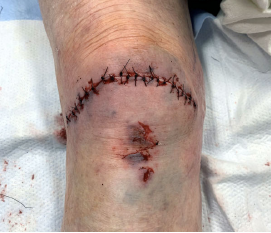
Figure 2: The patient’s knee following wound irrigation and repair.

Figure 2: The patient’s knee following wound irrigation and repair.
PHOTOS: Jonathan Strong

How much saline should you inject? Enough to visibly distend the joint capsule or until you meet resistance, indicating the capsule is nearly full. The amount of saline will vary by the size of the joint and the size of the patient, but Roberts and Hedges’ Clinical Procedures in Emergency Medicine and Acute Care generally recommends 100–200 mL for the knee, 40–60 mL for the shoulder, 20–30 mL for the ankle and elbow, and 5 mL for the wrist.3 Fully loading the joint is very important, as an insufficient amount of saline may lead to false-negative test results.

Pages: 1 2 3 4 | Single Page

Topics: Computer TomographyKneesaline load test

Related

  • How To Identify and Treat Patellar Dislocation Versus Knee Dislocation

    March 23, 2021 - 0 Comment
  • Tips for Emergency Physicians on Spotting Occult Knee Dislocation

    May 15, 2017 - 0 Comment

Current Issue

ACEP Now: November 2025

Download PDF

Read More

One Response to “Saline Load or CT: What’s the Best Test for Traumatic Arthrotomy?”

  1. April 26, 2020

    Joel Pasternack, MD, PhD, FACEP Reply

    Good Article by Dr. Strong.
    Clinical judgement can be enhanced as follows: Explore and irrigate wound through full range of motion. Obtain cross table lateral x-ray looking for air under the patella or in supra patella recess, after irrigation. The irrigation process will make the x-ray more sensitive for air without decreasing specificity. Gentle syringe irrigation will force more air into joint than may have entered from original injury.

Leave a Reply Cancel Reply

Your email address will not be published. Required fields are marked *


*
*


Wiley
  • Home
  • About Us
  • Contact Us
  • Privacy
  • Terms of Use
  • Advertise
  • Cookie Preferences
Copyright © 2025 by John Wiley & Sons, Inc. All rights reserved, including rights for text and data mining and training of artificial technologies or similar technologies. ISSN 2333-2603
