
Logo

Log In Sign Up |  An official publication of: American College of Emergency Physicians
Navigation
  • Home
  • Multimedia
    • Podcasts
    • Videos
  • Clinical
    • Airway Managment
    • Case Reports
    • Critical Care
    • Guidelines
    • Imaging & Ultrasound
    • Pain & Palliative Care
    • Pediatrics
    • Resuscitation
    • Trauma & Injury
  • Resource Centers
    • mTBI Resource Center
  • Career
    • Practice Management
      • Benchmarking
      • Reimbursement & Coding
      • Care Team
      • Legal
      • Operations
      • Quality & Safety
    • Awards
    • Certification
    • Compensation
    • Early Career
    • Education
    • Leadership
    • Profiles
    • Retirement
    • Work-Life Balance
  • Columns
    • ACEP4U
    • Airway
    • Benchmarking
    • Brief19
    • By the Numbers
    • Coding Wizard
    • EM Cases
    • End of the Rainbow
    • Equity Equation
    • FACEPs in the Crowd
    • Forensic Facts
    • From the College
    • Images in EM
    • Kids Korner
    • Medicolegal Mind
    • Opinion
      • Break Room
      • New Spin
      • Pro-Con
    • Pearls From EM Literature
    • Policy Rx
    • Practice Changers
    • Problem Solvers
    • Residency Spotlight
    • Resident Voice
    • Skeptics’ Guide to Emergency Medicine
    • Sound Advice
    • Special OPs
    • Toxicology Q&A
    • WorldTravelERs
  • Resources
    • ACEP.org
    • ACEP Knowledge Quiz
    • Issue Archives
    • CME Now
    • Annual Scientific Assembly
      • ACEP14
      • ACEP15
      • ACEP16
      • ACEP17
      • ACEP18
      • ACEP19
    • Annals of Emergency Medicine
    • JACEP Open
    • Emergency Medicine Foundation
  • About
    • Our Mission
    • Medical Editor in Chief
    • Editorial Advisory Board
    • Awards
    • Authors
    • Article Submission
    • Contact Us
    • Advertise
    • Subscribe
    • Privacy Policy
    • Copyright Information

Risk of Sudden Cardiac Arrest from Lyme Carditis Underscores Need for Timely Diagnosis, Treatment

By Joseph D. Forrester, MD, MSc | on August 14, 2014 | 0 Comment
Features
  • Tweet
  • Click to email a link to a friend (Opens in new window) Email
Print-Friendly Version
Risk of Sudden Cardiac Arrest from Lyme Carditis Underscores Need for Timely Diagnosis, Treatment

You Might Also Like
  • Hypothermia Therapy for Cardiac Arrest: Not Enough Proof
  • Post-Cardiac Arrest Care System in Arizona Improves Patient Outcomes
  • Tick, Mosquito-Borne Infections Surge in United States
Explore This Issue
ACEP Now: Vol 33 – No 08 – August 2014

CDC partners with ACEP to disseminate info about disseminated Lyme: critical update on Lyme carditis

Disclaimer: The findings and conclusions in this report are those of the author and do not necessarily represent the official position of the Centers for Disease Control and Prevention. Case-patient details have been changed to protect confidentiality.

The Case

On a late-summer afternoon, an otherwise healthy 32-year-old woman presented to an urgent care facility in New York complaining of episodic shortness of breath for the past week. She became quite anxious when these episodes occurred but couldn’t identify any precipitating activities or events. The patient reported vacationing in the Northeast during the previous two weeks and had frequented woody areas where she was exposed to ticks. She denied fever, rash, muscle pain, or joint pain. Providers in the urgent care facility diagnosed the patient with anxiety and prescribed clonazepam. No electrocardiogram (ECG) was performed.

The following day, the patient collapsed and died. Serum obtained at autopsy revealed a strong serologic response to infection with Borrelia burgdorferi spirochetes, the causative agent of Lyme disease. Examination of decedent heart tissue revealed characteristic histopathologic findings of Lyme carditis (see Figure 1). B. burgdorferi sensu stricto spirochetes were seen after Warthin-Starry stain of heart tissue (see Figure 2) and confirmed by immunohistochemistry and polymerase chain reaction.
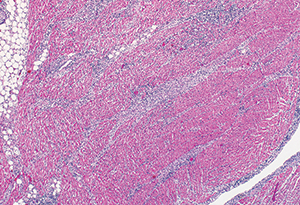
Figure 1. Above: Hematoxylin and eosin stain at 6.25x magnification of decedent heart tissue demonstrating characteristic interstitial perivascular lymphoplasmacytic pancarditis.
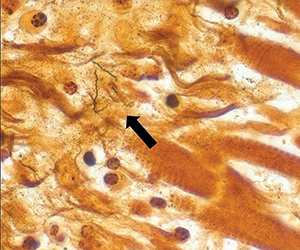
Figure 1.
Above: Hematoxylin and eosin stain at 6.25x magnification of decedent heart tissue demonstrating characteristic interstitial perivascular lymphoplasmacytic pancarditis.

Figure 2. BELOW: Warthin-Starry stain of decedent heart tissue at 158x magnification demonstrating Borrelia burgdorferi spirochetes (arrow).

Figure 2.
BELOW: Warthin-Starry stain of decedent heart tissue at 158x magnification demonstrating Borrelia burgdorferi spirochetes (arrow).

Discussion

On Dec. 13, 2013, the Centers for Disease Control and Prevention (CDC) published a report describing three cases of sudden cardiac death associated with Lyme carditis in otherwise healthy young adults ages 26 to 38.1 While two of the case-patients described in the Morbidity and Mortality Weekly Report did not seek care before their deaths, one did but was not diagnosed with or treated for Lyme disease.

Lyme disease is a zoonotic, multisystem illness caused by the spirochete B. burgdorferi, which is transmitted by certain Ixodes spp ticks. Approximately 30,000 cases are reported to the CDC each year, primarily from high-incidence states located in the northeast (Connecticut, Delaware, Maine, Maryland, Massachusetts, New Hampshire, New Jersey, New York, Pennsylvania, Rhode Island, and Vermont) and north central (Minnesota and Wisconsin) United States.2 The actual number of annual infections is estimated to be tenfold higher; Lyme disease is the most common vectorborne disease in the United States.3

Pages: 1 2 3 4 | Single Page

Topics: Cardiac ArrestCardiovascularCritical CareDiagnosisEmergency MedicineEmergency PhysicianLyme DiseasePatient SafetyPractice Management

Related

  • Why the Nonrebreather Should be Abandoned

    December 3, 2025 - 0 Comment
  • Florida Emergency Department Adds Medication-Dispensing Kiosk

    November 7, 2025 - 1 Comment
  • Q&A with ACEP President L. Anthony Cirillo

    November 5, 2025 - 0 Comment

Current Issue

ACEP Now: November 2025

Download PDF

Read More

No Responses to “Risk of Sudden Cardiac Arrest from Lyme Carditis Underscores Need for Timely Diagnosis, Treatment”

Leave a Reply Cancel Reply

Your email address will not be published. Required fields are marked *


*
*


Wiley
  • Home
  • About Us
  • Contact Us
  • Privacy
  • Terms of Use
  • Advertise
  • Cookie Preferences
Copyright © 2025 by John Wiley & Sons, Inc. All rights reserved, including rights for text and data mining and training of artificial technologies or similar technologies. ISSN 2333-2603
