
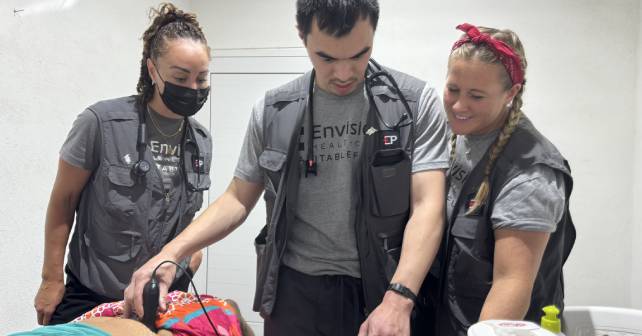
Much like Dr. Luu expresses, each medical mission that I participate in renews my love of medicine in its most pure form, while introducing me to an incredible team of likeminded individuals who truly believe that they can change the world.
Explore This Issue
ACEP Now: April Digital 02-DA Moment That Changed My Perspective
The personal meaning attained by physicians comes not only through the dramatic life-saving encounters, but through the routine difference-making that access affords. It is not only the 15-year-old with empyema, but, sometimes, it is also simplest stories that stay with me, such as a 35-year-old Haitian man presenting to a mobile clinic in the Dominican Republic.
As a Haitian who escaped to the Dominican Republic to give his family a chance, he isn’t recognized at all by the country where he resides and cannot obtain an ID or a birth certificate, let alone access the national health care system. He supports his wife, their 4 children, and both his and her parents with his work in the sugar cane fields and he knows that his health is vital to supporting his family. He signs in with the simple chief complaint of “Check Up” and waits several hours for his turn to be seen today, knowing that our mobile clinic was his only opportunity to be evaluated by a doctor. As my Creole translator and I chatted with him, my mind drifted back to Mrs. A, my stroke patient from Indonesia. I wished that she had ever had a similar opportunity to have that “check-up” that never came for her. Perhaps she could have found her hypertension much sooner. I can’t imagine how many people like her a medical mission has saved without us ever knowing it, and how many more are still waiting for that same chance, one that may never come.
Global Health is Emergency Medicine at its Core
Each and every mission has further ignited my passion for medicine, and through these diverse experiences, one commonality that serves our community of emergency care workers is the purity of the experience. There are no insurance battles, no malpractice fears or MIPS to influence decisions. It’s simply medicine in its most raw and essential form, taking care of fellow humans in need.
Organizations like EP, OWS, and IMANA have enabled me to work alongside and learn with some of the most selfless, skilled clinicians that I’ve ever met. People who not only save lives in their day jobs but choose to spend their valuable time off serving those who would otherwise have no opportunity at all.
Pages: 1 2 3 4 5 | Single Page



One Response to “Rekindling the Fire in Emergency Medicine”
April 27, 2025
Thomas Giberson, DO, FACEPIt is impportant to realize what a great honor it is to care for those who need us. If we live our lives accepting that honor,then we don’t need the outer gratification any more. what is missing in Emergency Medicine is the time to connect to our patients. I would suggest picking up a few shifts in Urgnt Care clinics. Yes, it’s seeing runny noses, etc, but it is also diagnosing Avute liupus nepritis and pulmonaru edema. Our skills developed over a lifetime of emergency care can help to pick up subtle findings FP’s would miss. I expect evey room I walk into has someone in it just waiting to die. It’s the acute meningitis that looks like every other URI, or the PE when everyone has a URI. We KNOW those people and know how to find them. When demanding the opportunity to connect with people we can exercise the cution we were trained to use. That is the voice of 43 years of Emergency Medicine in high volume-high acuity care. Burnout, which I have also experienced, is coming out of every room thinling we hate people. It is no more than transfering the inner suffering we feel by being pushed too far too fast to make money for someone else. Each of our patients become an invisible curse who are named illnesses rather than an MIT graduate engineer or crust 45 year old woman who is a train conductor and serves as the engineeer for return trips, the 17 year old woman who is a diesel mechanic, or the illiterate 75 year old who worked his butt off who has been married for 55 years and put all of his children through college becaue it was a goal too farr for him to ever reach. Go to another country and see the desparate lives people live because they have zero opportunity or care for the peole here who are given the opportunities and spit on that opportunity. Either way, you can still find the gratification kn owing it is an hoor to care for people who have zero opportunity. The cause of our suffering is not outside each of us, it lives within ourselves. We are honorable men and women of courage, integrity, deep compassion, and commintment who see, know, and feel too much while being pushed to do more with less time (half of which is documentation) for sicker, more vulnerable, patients who have become society’s throw-aways. You go to work to care for the homeless, addicts, alcoholics, irreponsible people – thos who need us. You see and feel the children beaten to death, or young mothers who are dead because of a drunk driver, and the elderly who are dumped in a nursing home to become wards of the state. And when it is donme, at the end of the day, we ask ourseles “what the hell was that about?” Our souls are depleted by those who try to drag it from us. But we go bak to work the next day. And going back each day is an act of great compassion because you see the need and have the drive to meet those needs. Take great pride in that, becaause it is a great honor to be given the chance to exercise that compassion. You have the gift of being able to do what we do and it has been an incredible honor to have worked along side sme of you.