
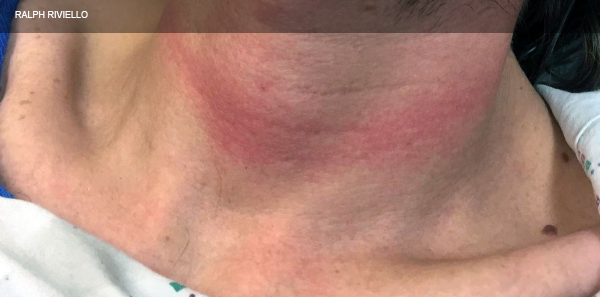
The choking game is most commonly performed by those ages 9 to 19 years (it peaks at 13 years of age), with a male-to-female ratio of 2-to-1.1,8,9 A review of choking game deaths by the Centers for Disease Control and Prevention (CDC) found 86.6 percent were males, with 13.3 years as the mean age. In the majority of deaths, the children died alone.7 Studies have shown that 6.6 percent to 17 percent of children/adolescents have performed the activity, and the vast majority of them have heard of the activity.2,5,8–11. Rural youth performed it more often than urban youth. Death rates are difficult to obtain because many cases may be misclassified as suicide. The CDC reported 82 deaths from the choking game from 1995 to 2007.7 The website GASP (Games Adolescents Shouldn’t Play) tracks choking game deaths from all over the world and has recorded more than 1,000 deaths.12
Explore This Issue
ACEP Now: Vol 37 – No 01 – January 2018Despite children/adolescents’ knowledge of the activity, awareness among parents and physicians is much more variable.1,13,14 Studies have found that 40 percent to 50 percent of young people perceived no risk from SAB, making prevention and educational programs important. It is key not to sensationalize the behavior.2,15 A study showed that the popularity of SAB has been fueled by the Internet.8 The researchers found 419 YouTube videos of the choking game were viewed 22 million times. They postulated that the Internet has normalized the activity.
The choking game is a common yet potentially harmful activity that affects older children and adolescents. Physicians need to be educated about the activity, including the regional terms used to describe it as well as the common signs and symptoms participants may exhibit.
Key Points
- The choking game, or self-asphyxial risk-taking behavior, can occur in older children, adolescents, and young adults.
- The behavior is perceived as a safer, harmless way to get “high,” although there may be serious injury and death.
- There may be regional variations in the terms used to described the activity.
- The actual mechanism is asphyxia leading to cerebral hypoxia due to alterations in cerebral blood flow.
- Parents and physicians need to be aware of the activity and have a high index of suspicion in appropriate patients.
 Dr. Riviello isprofessor of emergency medicine at Drexel Emergency Medicine in Philadelphia.
 Dr. Rozzi is an emergency physician, director of the Forensic Examiner Team at WellSpan York Hospital in York, Pennsylvania, and chair of the Forensic Section of ACEP.
References
- Andrew TA, Macnab A, Russel P. Update on “the choking game”. J Pediatr. 2009;156(6):777-780.
- Re L, Birkhoff JM, Sozzi M, et al. The choking game: a deadly game. Analysis of two cases of “self-strangulation” in young boys and review of the literature. J Forensic Leg Med. 2015;30:29-33.
- Chow KM. Deadly game among children and adolescents. Ann Emerg Med. 2003;42(2):310.
- Howard P, Leathart GI, Dornhorst AC, et al. The mess trick and the fainting lark. Br Med J. 1951;2(4728):382-384.
- Macnab AJ, Deevska M, Gagnon F, et al. Asphyxial games or “the choking game”: a potential fatal risk behavior. Inj Prev. 2009;15(1):45-49.
- Ullrich NJ, Bergin AM, Goodkin HP. “The choking game”: self-induced hypoxia presenting as recurrent seizurelike events. Epilepsy Behav. 2008;12(3):486-488.
- Russell P, Paulozzi L, Gilchrist J, et al. Unintentional strangulation deaths from the “choking game” among youths aged 6-19 years—United States, 1995-2007. MMWR Morb Mortal Wkly Rep. 2008;57(6):141-144.
- Defenderfer EK, Austin JE, Davies WH. The choking game on YouTube: an update. Glob Pediatr Health. 2016;3:2333794X15622333.
- Egge MK, Berkowitz CD, Toms C, et al. The choking game: a case of unintentional strangulation. Pediatr Emerg Care. 2010;26(3):206-208.
- Ramowski SK, Nystrom RJ, Rosenberg KD, et al. Health risks of Oregon eighth-grade participants in the “choking game”: results from a population-based survey. Pediatrics. 2012;129(5):846-851.
- Brausch AM, Decker KM, Hadley AG. Risk of suicidal ideation in adolescents with both self-asphyxial risk-taking behavior and non-suicidal self-injury. Suicide Life Threat Behav. 2011;41(4):424-434.
- Statistics. Games Adolescent Shouldn’t Play (GASP) website. Accessed Nov. 17, 2017.
- McClave JL, Russel PJ, Lyren A, et al. The choking game: physician perspectives. Pediatrics. 2010;125(1):82-87.
- Bernacki JM, Davies WH. Prevention of the choking game: parent perspectives. J Inj Violence Res. 2012;4(2):73-78.
- Deevska M, Gagnon F, Cannon WG, et al. An adolescent risk-taking behavior: “the choking game”. Pediatr Child Health. 2008;13(Suppl A):52.
Pages: 1 2 3 | Single Page




No Responses to “Recognize the Signs That Older Children and Adolescents Are Playing the Choking Game”