Logo

Log In Sign Up |  An official publication of: American College of Emergency Physicians
Navigation
  • Home
  • Multimedia
    • Podcasts
    • Videos
  • Clinical
    • Airway Managment
    • Case Reports
    • Critical Care
    • Guidelines
    • Imaging & Ultrasound
    • Pain & Palliative Care
    • Pediatrics
    • Resuscitation
    • Trauma & Injury
  • Resource Centers
    • mTBI Resource Center
  • Career
    • Practice Management
      • Benchmarking
      • Reimbursement & Coding
      • Care Team
      • Legal
      • Operations
      • Quality & Safety
    • Awards
    • Certification
    • Compensation
    • Early Career
    • Education
    • Leadership
    • Profiles
    • Retirement
    • Work-Life Balance
  • Columns
    • ACEP4U
    • Airway
    • Benchmarking
    • Brief19
    • By the Numbers
    • Coding Wizard
    • EM Cases
    • End of the Rainbow
    • Equity Equation
    • FACEPs in the Crowd
    • Forensic Facts
    • From the College
    • Images in EM
    • Kids Korner
    • Medicolegal Mind
    • Opinion
      • Break Room
      • New Spin
      • Pro-Con
    • Pearls From EM Literature
    • Policy Rx
    • Practice Changers
    • Problem Solvers
    • Residency Spotlight
    • Resident Voice
    • Skeptics’ Guide to Emergency Medicine
    • Sound Advice
    • Special OPs
    • Toxicology Q&A
    • WorldTravelERs
  • Resources
    • ACEP.org
    • ACEP Knowledge Quiz
    • Issue Archives
    • CME Now
    • Annual Scientific Assembly
      • ACEP14
      • ACEP15
      • ACEP16
      • ACEP17
      • ACEP18
      • ACEP19
    • Annals of Emergency Medicine
    • JACEP Open
    • Emergency Medicine Foundation
  • About
    • Our Mission
    • Medical Editor in Chief
    • Editorial Advisory Board
    • Awards
    • Authors
    • Article Submission
    • Contact Us
    • Advertise
    • Subscribe
    • Privacy Policy
    • Copyright Information

Recognize the Signs That Older Children and Adolescents Are Playing the Choking Game

By Ralph J. Riviello, MD, MS, FACEP; and Heather V. Rozzi, MD, FACEP | on February 6, 2018 | 0 Comment
CME CME Now Forensic Facts
  • Tweet
  • Click to email a link to a friend (Opens in new window) Email
Print-Friendly Version
Ralph Riviello
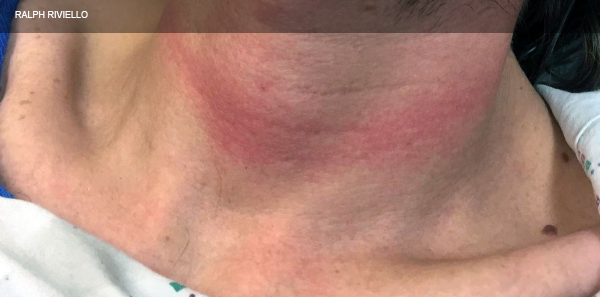
Caption: Figure 1: A ligature mark on the 15-year-old male patient’s neck.

The Case

A 15-year-old-male complaining of a headache (HA) is brought to the emergency department by his parents. They report that he has had a diffuse HA intermittently over the past few months. The HA is described as a “pressure” and tends to occur in the late afternoon after school and early evening. It is not associated with nausea, vomiting, vision changes, or neurological symptoms. There is no significant past medical, surgical, family, or social history. On physical exam, his vital signs and neurological examination are normal. You notice faint petechiae around his orbits bilaterally. You ask him to remove his hoodie, and you notice an interesting finding on his neck (see Figure 1). What is the diagnosis?

You Might Also Like
  • How to Recognize Signs of Elder Abuse, Mistreatment
  • Research on Ovarian Size in Children Provides Guidance on Dealing with Torsion, Uncomplicated Cellulitis
  • Guidance on Cerebrospinal Fluid Sterilization in Pediatric Meningitis, Carotid Injury Risk after Palatal Wound in Children
Explore This Issue
ACEP Now: Vol 37 – No 01 – January 2018

CME Now

Discussion

The diagnosis is nonfatal strangulation from “the choking game.” The image depicts a ligature mark on his neck.

The choking game, or self-asphyxial risk-taking behavior (SAB), is defined as “self-strangulation or strangulation by another person with the hands or a noose/ligature to achieve a brief euphoric state caused by cerebral hypoxia.”1,2 The SAB activity causes obstruction of the cerebral venous and arterial blood flow, along with an increase in carbon dioxide, leading to a dizzy sensation. This brief euphoric or “high” feeling just before unconsciousness is then followed by a “rush” from the surge of blood flow when the constriction is removed.2–6 Unfortunately, serious injuries, long-term complications, and even death can occur as a result of this behavior.

“The choking game” is actually a misnomer. The pressure applied to the neck is actually strangulation, while choking refers to asphyxia due to internal airway obstruction. There are several other names for this form of SAB, including gasp, space monkey, suffocation roulette, funky chicken, sleeper hold, pass out, snuff, choke out, space cowboy, cloud nine, flatliner, dream game, knockout, breath play, rush, and the French term jeu du foulard.2,7

Signs and symptoms of the choking game are related to strangulation and cerebral hypoxia. Common manifestations include headache, loss of consciousness, unexpected neck bruising, seizures, bloodshot eyes, subconjunctival hemorrhages, facial/neck petechiae, disorientation after being alone, sudden visual loss, behavioral changes, head or musculoskeletal trauma due to falls, and ropes, belts, and scarves tied to bedroom furniture/doorknobs or found knotted on the floor. A thorough history and physical examination should be performed on patients ages 9 to 21 who present with any of these complaints. Direct questioning of the patient (without parents) may be needed. Treatment is based on identifying underlying injuries such as airway trauma, stroke, or possible carotid dissection. In cases of death, ED personnel should handle the case as possible suicide. Law enforcement and the medical examiner/coroner should be contacted to conduct a thorough investigation.

Pages: 1 2 3 | Single Page

Topics: AsphyxiaAsphyxiationChoking GameCMECME NowEmergency DepartmentEmergency MedicineEmergency PhysicianStrangulationsuicideTrauma & Injury

Related

  • Pediatric Patients in Acute Mental Health Crisis Face Long Waits

    August 29, 2025 - 0 Comment
  • EM Runs in the Family

    February 26, 2025 - 0 Comment
  • Employ a Trauma-Informed Approach to Care

    December 7, 2024 - 0 Comment

Current Issue

ACEP Now: November 2025

Download PDF

Read More

No Responses to “Recognize the Signs That Older Children and Adolescents Are Playing the Choking Game”

Leave a Reply Cancel Reply

Your email address will not be published. Required fields are marked *


*
*


Wiley
  • Home
  • About Us
  • Contact Us
  • Privacy
  • Terms of Use
  • Advertise
  • Cookie Preferences
Copyright © 2025 by John Wiley & Sons, Inc. All rights reserved, including rights for text and data mining and training of artificial technologies or similar technologies. ISSN 2333-2603